

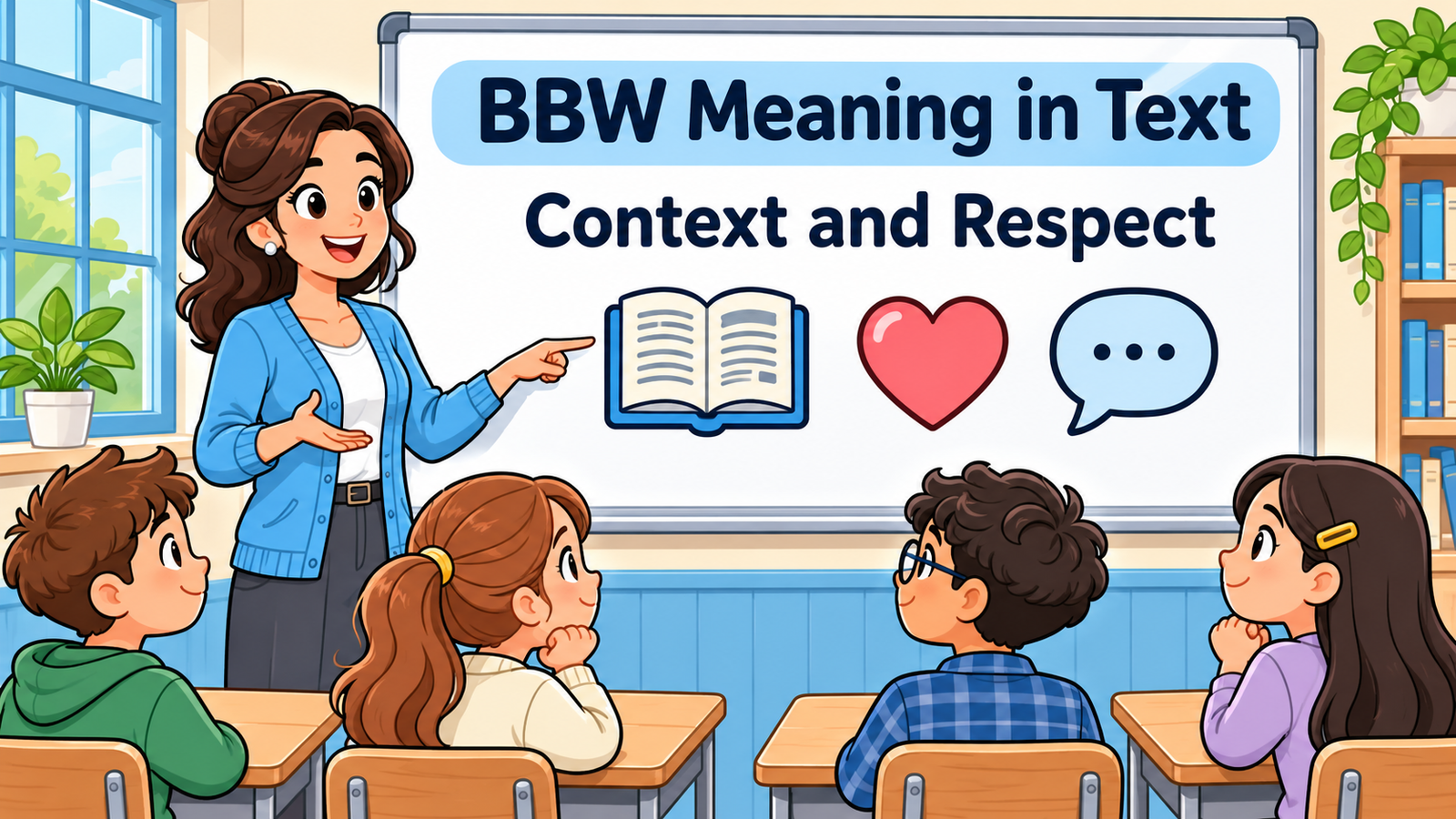
You notice BBW in a profile description or a conversation about fashion and wonder what the letters mean. Unlike a farewell such as TTYL, this abbreviation describes a person rather than an action, so understanding how it is used matters as much as knowing its expansion.
The BBW meaning in text is “big beautiful woman,” or “big beautiful women” when referring to more than one person. It is an informal description associated with plus-size women. Some people use it positively for themselves, while others do not want it applied to them.
What Does BBW Stand For?
The letters combine a reference to body size with an appreciative description. In ordinary online usage, the abbreviation can appear in self-descriptions, social communities, and discussions of attraction. The intended tone depends on the setting and the person using it.
It is not a precise measurement or a universal identity label. Knowing the expansion does not tell you an individual’s clothing size, preferences, personality, or feelings about the term. Those details cannot be inferred from an abbreviation alone.
| Question | Short answer |
|---|---|
| What does BBW mean? | Big beautiful woman or women |
| Is it formal terminology? | No, it is an informal description |
| Can someone use it positively? | Yes, including as a self-description |
| Does everyone welcome the label? | No; preferences differ |
| Does it describe a fixed size range? | No universal size range is established by the abbreviation |
Woman or Women: Which Expansion Is Correct?
The last letter can represent woman for an individual or women for a group. The surrounding sentence makes the intended number clear. “She describes herself as a BBW” refers to one person, while a discussion of BBW communities can refer more broadly to women who identify with the term.
You may also see BBWs used as an informal plural. For edited prose, writing the phrase or a context-appropriate description in full can avoid awkward constructions. Choose clear grammar rather than adding several abbreviations to a sentence that is already difficult to follow.
Where You Might See BBW Online
The term can appear in social profiles, discussions of plus-size representation, and dating conversations. It may be a person’s chosen description or someone else’s description of them. That distinction is important when deciding how to interpret or repeat it.
A fashion post using the label does not automatically carry the same intention as a dating profile. A private message may have another tone entirely. Read the surrounding content rather than allowing one familiar context to determine every occurrence.
BBW as a Self-Description
Someone may choose the term because it expresses confidence, attraction, community, or a personal identity they find comfortable. When reading that person’s description, you can recognize their choice without treating it as a rule for anyone with a similar body type.
For example, a writer might say, “I use BBW in my profile because I like the phrase.” That statement tells you about the writer’s preference. It does not establish how a friend, colleague, or stranger would feel if you used the same label for them.
Is BBW a Compliment?
It can be intended as one, but intention does not guarantee reception. Some people appreciate the positive wording, while others dislike having their body size foregrounded. A word containing beautiful can still feel unwelcome if it introduces a personal comment the recipient did not invite.
If you want to compliment someone, consider the actual reason for the compliment. “That outfit looks great” comments on the outfit. “Your presentation was excellent” recognizes their work. You do not need a body-related label to make a positive statement specific and sincere.
Is BBW Offensive?
It is not inherently an insult, but it can become disrespectful when used mockingly, repeatedly against someone’s wishes, or as a way of reducing a person to body size. The relationship and the person’s stated preference matter more than a blanket claim that the term is always acceptable.
If someone says they dislike it, use different wording. A straightforward “Thanks for telling me; I won’t use that label” resolves the issue. Arguing that the phrase must be flattering because of its expansion ignores the recipient’s actual preference.
BBW in Dating Conversations
In a dating context, the abbreviation may describe someone’s own appearance or an attraction preference. It does not tell you the person’s interests, expectations, availability, or willingness to engage with a particular message. Those matters require ordinary conversation.
A respectful opening can refer to something the person has chosen to share beyond a label: a hobby, a book, or an activity in their profile. Treat the description as one part of the introduction rather than assuming it defines the entire relationship they want.
Does BBW Always Have a Sexual Meaning?
No. It can be used in nonsexual self-description or discussions of representation and appearance. It also appears in sexualized and adult-content contexts, so the surrounding material affects its meaning and suitability for a particular audience.
The useful distinction is contextual. A neutral vocabulary explanation does not need explicit examples, and a general fashion discussion does not become sexual merely because it uses the abbreviation. At the same time, calling every use purely neutral would overlook how the term is sometimes used.
BBW vs Plus-Size and Curvy
These descriptions can overlap, but they are not exact synonyms for every person or setting. Plus-size is often used in clothing and fashion discussions. Curvy describes body shape informally. BBW combines a size-related description with an appreciative label.
None of them should be treated as a universal substitute that everyone prefers. If a person’s own wording is relevant, follow that wording. If body size is not relevant to the conversation, leaving the description out may produce a clearer and more respectful sentence.
Original Examples of Respectful Usage
The examples below focus on explaining or discussing the term rather than assigning it to an unwilling person. They are original sample sentences, not quotations from real profiles. Each makes the speaker’s purpose clear.
When writing about identity-related language, specifying who uses a term can prevent overgeneralization. “She uses this description” is more precise than “All women of this size are called this.” The difference is small in wording but substantial in meaning.
- “What does BBW mean in this profile?”
- “She uses BBW as a positive description of herself.”
- “The discussion explores language used in plus-size communities.”
- “I prefer plus-size, so please use that description for me.”
- “You don’t need to describe my body to compliment my outfit.”
How to Reply If Someone Calls You BBW
Your response can reflect your own comfort with the term. If you welcome it, a simple acknowledgment may fit. If you do not, you can say so directly without defending your preference or providing a long explanation.
If the message is unclear, ask what the sender meant before deciding how to respond. A mistaken abbreviation, a discussion of a label, and a direct personal comment are different situations. The following options address different goals rather than prescribing one reaction.
| Your preference | Possible reply |
|---|---|
| You are comfortable with it | “Thanks—that’s a term I use for myself.” |
| You prefer another description | “I prefer plus-size, actually.” |
| You do not want body comments | “Please don’t comment on my body.” |
| You do not understand the message | “What do you mean by BBW here?” |
| You want to redirect the topic | “Let’s get back to the event plans.” |
Common Misunderstandings to Avoid
Do not attach an exact weight, clothing size, or health judgment to the abbreviation. It is not a standardized category that supplies those facts. It also does not describe someone’s personality or establish what kind of attention they welcome.
Another mistake is assuming a self-label gives everyone permission to use it in every situation. A person can describe themselves one way in a profile and prefer different wording at work or in another social setting. Context and personal preference remain relevant.
FAQs About BBW Meaning in Text
What does BBW mean in a text message?
It usually means big beautiful woman, or women in the plural. It is an informal description associated with plus-size women, and its tone depends on the conversation and the person’s preference.
Is BBW always meant positively?
No. It may be appreciative or self-affirming, but it can also be unwelcome or disrespectful. Look at how it is used and whether the person being described accepts the label.
Does BBW refer to a specific clothing size?
The abbreviation does not establish a universal clothing-size range. Do not use it to infer exact measurements or treat it as a technical classification. Ask for relevant sizing information directly when needed.
Is BBW the same as plus-size?
The terms can overlap, but their meanings and tone are not identical. Plus-size often appears in fashion contexts, while BBW is a more informal appreciative description. Individual preferences vary.
What should I say if I do not like being called BBW?
You can say “I prefer a different description” or “Please don’t comment on my body.” A clear preference is enough; you do not need to justify it for someone to respect it.
Conclusion
The BBW meaning in text is an informal description, not a complete identity or a precise category. It can be positive when chosen by the person using it, but it is not a label everyone welcomes.
Read the context, respect individual wording preferences, and avoid making assumptions beyond what the message actually says. Understanding the term helps you communicate more accurately and considerately.







Leave a Reply