

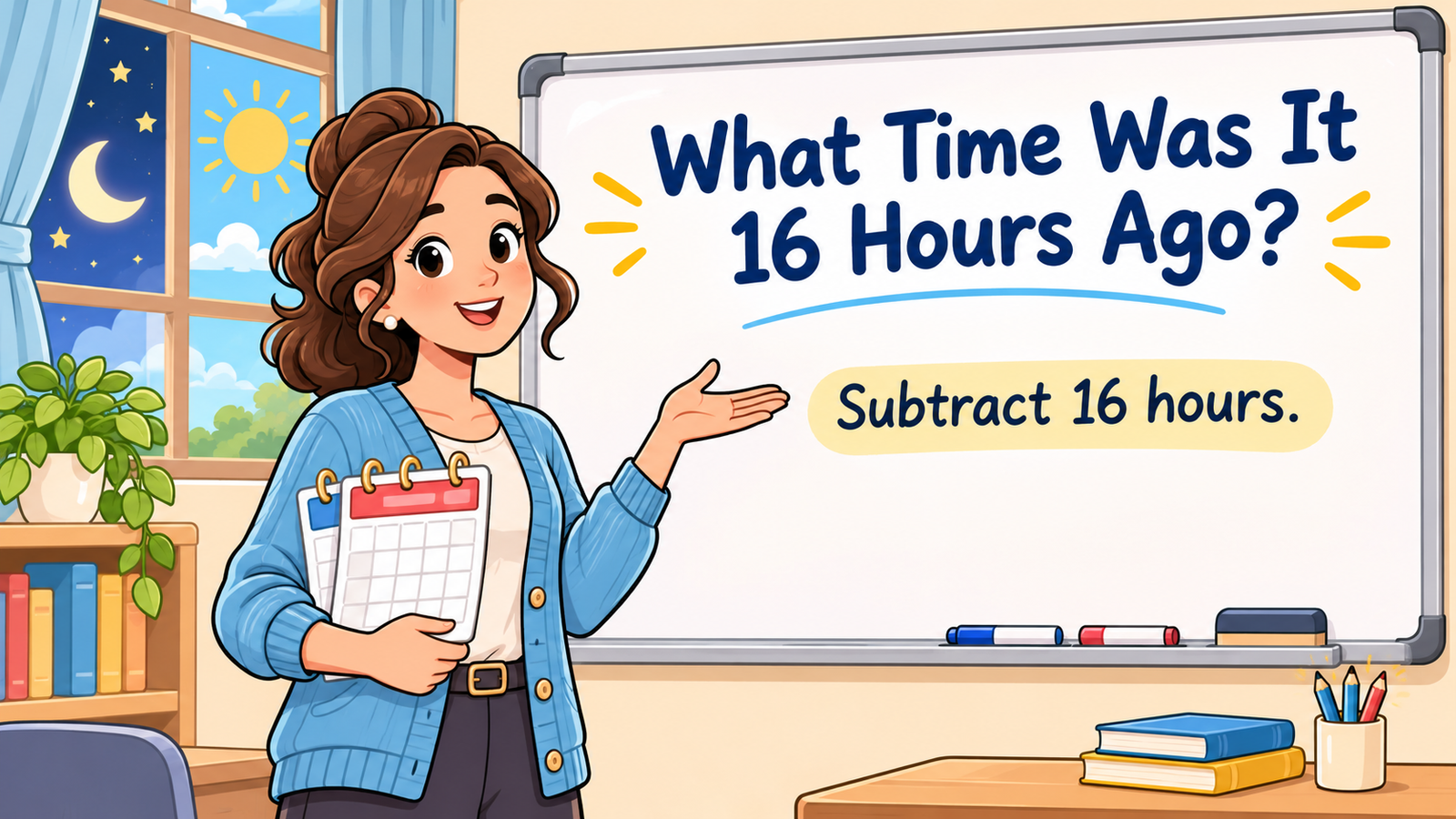
To calculate what time it was 16 hours ago, subtract sixteen hours from your starting timestamp. If it is 6:45 PM now, the answer is 2:45 AM today. If it is 1:20 PM, the answer is 9:20 PM yesterday.
Sixteen hours is long enough to cross midnight in many everyday examples, but it does not always mean yesterday. The current hour determines the date. These examples show the arithmetic; they are not a live reading of your local clock.
What Sixteen Hours Ago Actually Means
The word “ago” points backward from a reference moment. In a conversation, that moment is usually now. In a screenshot, report, or old email, it may instead be the moment the information was recorded. Establish the reference before subtracting anything.
Sixteen hours is a duration, while 4:00 PM is a time of day. They are not interchangeable even though 4:00 PM is written 16:00 on a 24-hour clock. Subtracting sixteen hours means moving backward by that amount, not automatically choosing four in the afternoon.
Use the 24-Hour Clock for Direct Subtraction
Convert the starting time to 24-hour notation. For PM hours from one through eleven, add twelve to the hour. Thus 6:45 PM becomes 18:45. Subtract sixteen from eighteen, leaving 02:45, which is 2:45 AM on the same date.
At 11:35 PM, the starting time is 23:35. Subtracting sixteen gives 07:35, or 7:35 AM today. The minute field stays at thirty-five because you have subtracted whole hours. This method avoids having to count repeatedly around a twelve-hour clock face.
Handle a Negative Hour Correctly
At 1:20 PM, use 13:20. Thirteen minus sixteen equals negative three. Add twenty-four to bring the hour into the ordinary clock range: negative three plus twenty-four is twenty-one. Your result is 21:20, or 9:20 PM yesterday.
Adding twenty-four fixes the clock display; it does not cancel the date change. Keep the previous calendar date alongside the result. A bare answer of 9:20 PM could be mistaken for tonight, which would place the event in the future rather than sixteen hours in the past.
The Important Boundary Is 4 PM
With no clock-offset change, sixteen hours before 4:00 PM is midnight at the beginning of the same day. At 4:01 PM, the result is 12:01 AM today. Starting at or after 4 PM therefore keeps the answer on today’s date.
Just before that boundary, the result belongs to yesterday. Sixteen hours before 3:59 PM is 11:59 PM yesterday. This rule is a useful reasonableness check: if you start at lunchtime and obtain an early-morning answer today, revisit the subtraction and the AM/PM conversion.
Break the Calculation Into Twelve Plus Four
For mental arithmetic, subtract twelve hours first and then subtract another four. From 8:50 AM, going back twelve hours gives 8:50 PM yesterday. Going back four more hours gives 4:50 PM yesterday. The total movement is sixteen hours backward.
From 9:10 PM, the same method gives 9:10 AM today and then 5:10 AM today. This approach works well if switching between AM and PM feels easier than using 24-hour notation. Track the date at each stage instead of trying to remember it only at the end.
Use Yesterday Plus Eight Hours as a Check
Another way to express minus sixteen hours is minus twenty-four hours plus eight hours. Start at the same clock time yesterday, then move forward eight hours. From 10:30 AM today, yesterday at 10:30 AM plus eight hours gives yesterday at 6:30 PM.
Be careful when the added eight hours crosses midnight. From 8:15 PM today, yesterday at 8:15 PM plus eight hours becomes 4:15 AM today. The shortcut is valid, but “yesterday” is only an intermediate step, not a guaranteed description of the final answer.
Keep Minutes, Seconds, and Precision Consistent
With a constant offset, subtracting sixteen whole hours leaves minutes and seconds unchanged. A starting timestamp of 21:48:32 becomes 05:48:32 on the same date. There is no need to borrow minutes because the duration contains no extra minute component.
If your starting information is approximate, keep the answer approximate too. “Around 9 PM” gives “around 5 AM,” not a precise timestamp down to the second. Accurate arithmetic cannot recover detail that was missing from the original record or rounded away by an application.
Check Month and Year Changes
An early timestamp on the first day of a month can lead into the previous month. For example, March 1 at 7:30 AM minus sixteen hours is the previous day at 3:30 PM. The date is February 28 in a common year or February 29 in a leap year.
The same idea applies at New Year. January 1 at 10:00 AM minus sixteen hours gives December 31 at 6:00 PM in the preceding year. Include the year when recording the result so that a correct clock calculation does not become an incorrect calendar entry.
Sixteen Hours in Minutes and Seconds
Sixteen hours equals 960 minutes: sixteen multiplied by sixty. Multiplying 960 by sixty gives 57,600 seconds. These equivalents help when a calculator, time log, or duration field uses a different unit from the one in your question.
Sixteen hours is also two-thirds of a standard twenty-four-hour duration. However, a local calendar day can have a different elapsed length when clocks change. Use hours or seconds for a fixed elapsed interval rather than assuming that every civil day is exactly twenty-four elapsed hours.
Read Message and Activity Timestamps Carefully
An activity label saying “16 hours ago” may be rounded, and it may have been generated before you opened the page. Refreshing the view or opening the detailed timestamp can provide a better reference than calculating from an old label that has remained on screen.
For example, if a screenshot was taken at 1:20 PM, its sixteen-hour label points approximately to 9:20 PM the previous day. A later viewer should not subtract sixteen hours from their own current clock. The label belongs to the screenshot’s reference moment, subject to the application’s rounding.
Time Zones and Exact Elapsed Time
Ordinary examples assume that the starting and ending timestamps use the same time zone and that its offset does not change. When sharing the answer internationally, include the zone or an explicit UTC offset so another person can identify the same moment.
If the interval crosses a daylight-saving change, subtract sixteen elapsed hours from the underlying timestamp rather than relying only on local clock numerals. A time-zone-aware calculator can convert the result back to local time. This matters whenever the distinction between elapsed hours and displayed wall-clock hours affects the record.
Frequently Asked Questions
What time was it 16 hours ago from 6:45 PM?
It was 2:45 AM today. In 24-hour notation, 18:45 minus sixteen hours equals 02:45, so no previous-date adjustment is needed.
What time was it 16 hours ago from 1:20 PM?
It was 9:20 PM yesterday. The subtraction crosses midnight, which makes the previous date part of the answer.
Does sixteen hours ago always mean the previous day?
No. Under a constant clock offset, starting at 4 PM or later produces a result on the same date. Earlier starting times lead to yesterday.
How can I verify a sixteen-hour subtraction?
Add sixteen hours to the proposed answer. Both its date and time should return to the starting timestamp; matching only the clock numerals is insufficient.
How many minutes are sixteen hours?
Sixteen hours contains 960 minutes. The same duration contains 57,600 seconds, which can be useful for calculators that accept seconds.
What is sixteen hours before midnight?
It is 8:00 AM on the preceding calendar date. Midnight marks the beginning of a day, so write the date explicitly to avoid ambiguity about which midnight you mean.
Conclusion
Subtracting sixteen hours is straightforward when you convert to a 24-hour clock and track midnight. If the hour becomes negative, add twenty-four and move the date back one day.
Keep the minutes unchanged for a whole-hour subtraction under a constant offset. Then add sixteen hours back to check your result, including its AM/PM label and complete calendar date.




Leave a Reply