

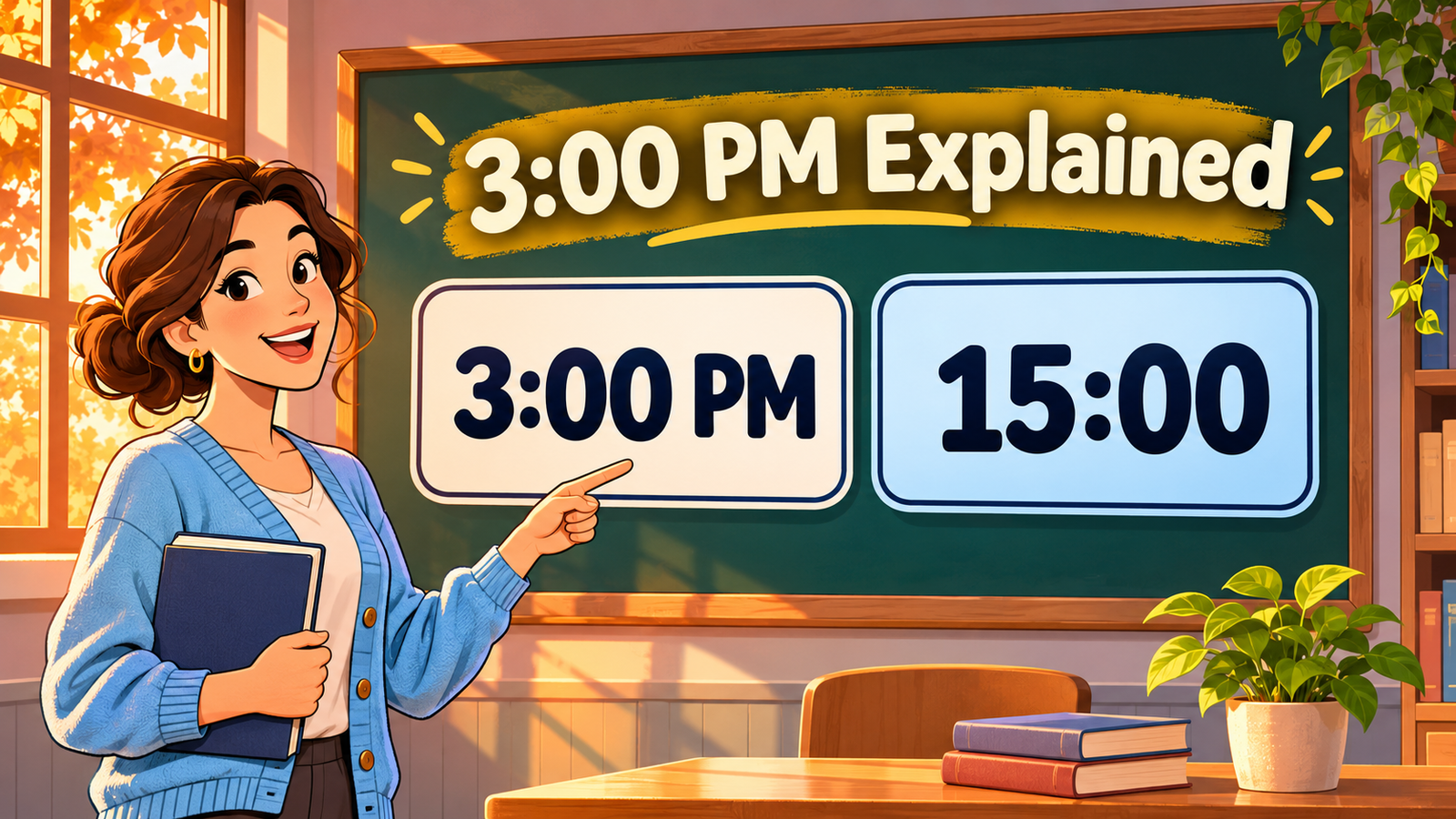
3:00 PM means three o’clock in the afternoon. Its 24-hour equivalent is 15:00. If you want to know how long until 3 PM, compare it with your current time on the correct date. For example, from 1:35 PM, the wait is 1 hour and 25 minutes.
The clock time itself is fixed, but the remaining wait changes throughout the day. This guide explains the notation, common conversions, and ways to calculate the interval. Examples are illustrative rather than a live reading of your current time.
What Does 3:00 PM Mean?
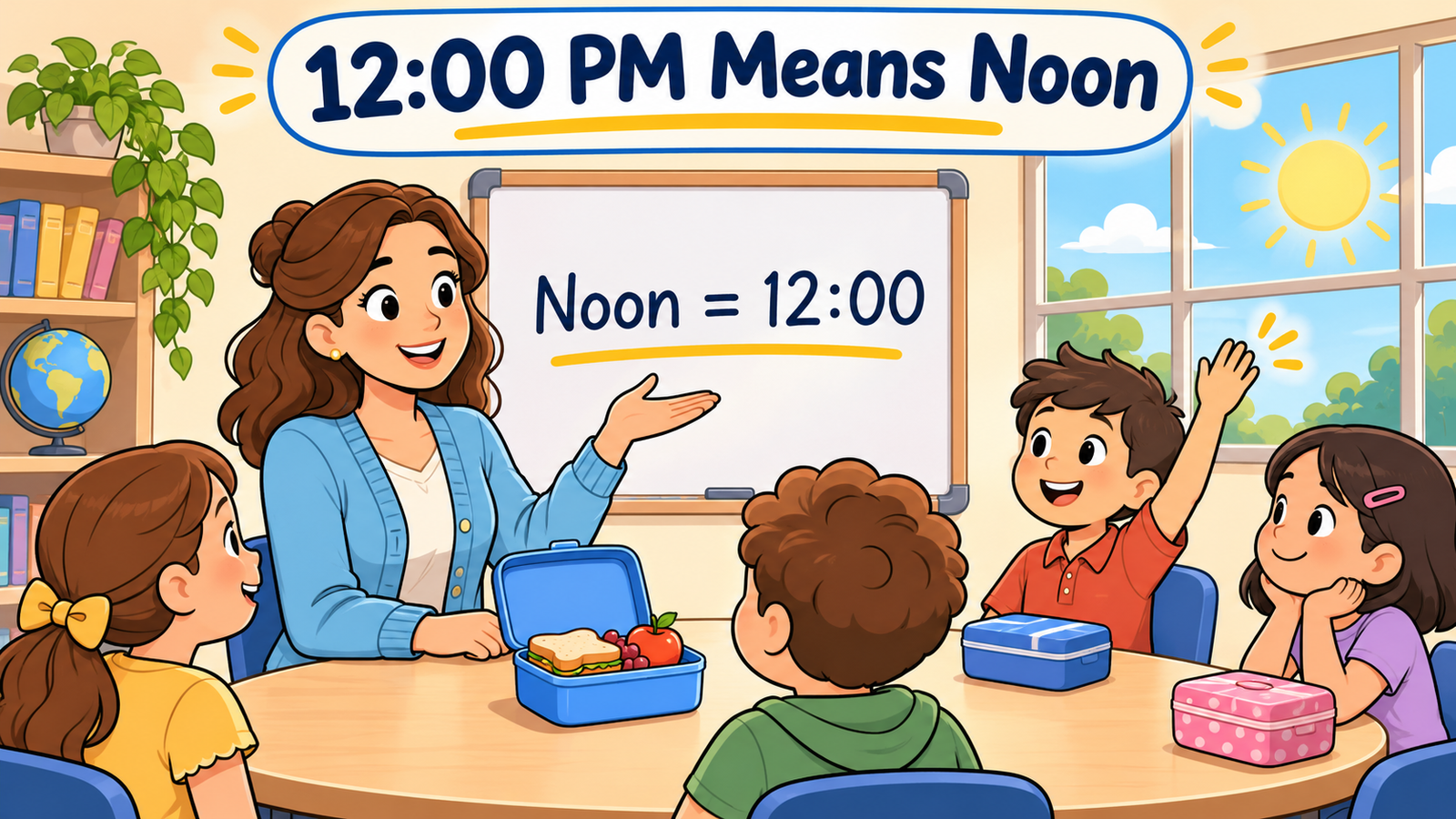
The PM label identifies the part of the 12-hour clock running from noon toward midnight. At 3:00 PM, three clock hours have passed since noon. The two zeros mean zero minutes after the hour, so the time is exactly three o’clock rather than half past three or a quarter past three.
You can write the same time as 3 PM, 3:00 PM, or 3 p.m., depending on the style you are following. These forms do not represent different moments. The important information is the hour, the PM designation, and, for a real event, the date and applicable time zone.
Convert 3:00 PM to 24-Hour Time
For afternoon hours from 1 PM through 11 PM, add twelve to the hour. Three plus twelve is fifteen, so 3:00 PM becomes 15:00. The minutes remain unchanged. This is why 3:25 PM becomes 15:25 rather than 15:00.
Do not add PM after 15:00 in ordinary 24-hour notation. The hour already identifies the afternoon. Writing “15:00 PM” mixes the two systems unnecessarily. Likewise, 03:00 means three in the morning, not three in the afternoon, so the leading zero is not a substitute for a PM label.
3 PM and 3 AM Are Different
3 AM is early morning and is written 03:00. 3 PM is afternoon and is written 15:00. On the same ordinary day, the two clock readings are twelve hours apart. This is an easy mistake to make when an alarm screen or a short message hides the AM/PM setting.
For example, a reminder intended for afternoon pickup should use 3 PM or 15:00. If it is accidentally saved as 3 AM, it will occur during the night. Reading the complete displayed time before saving an event is more reliable than checking only the numeral 3.
How Long Until 3 PM?
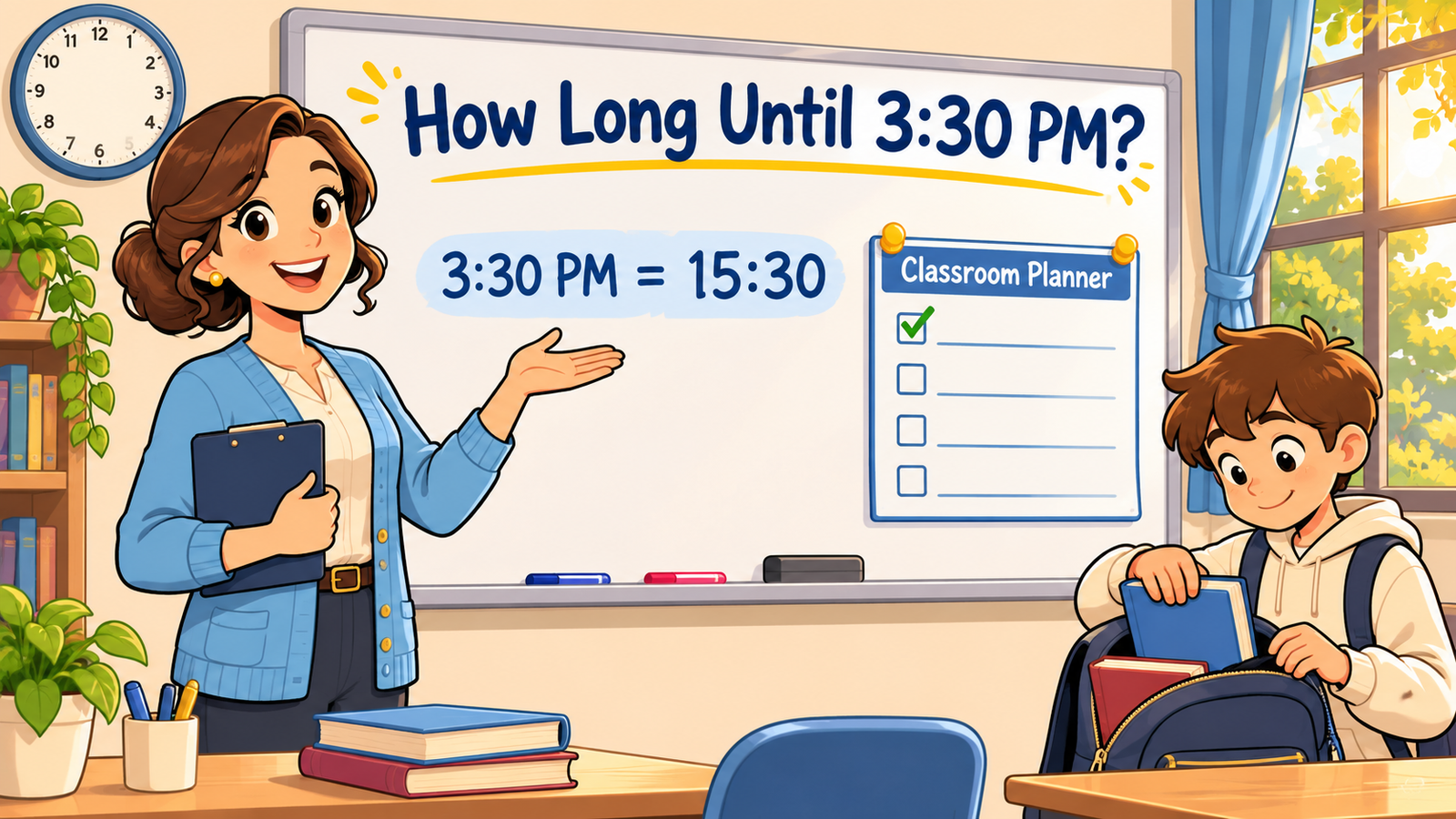
The answer depends on your starting time. From 10:50 AM, there are 4 hours and 10 minutes until 3 PM. From 12:15 PM, there are 2 hours and 45 minutes. From 2:24 PM, there are 36 minutes. These examples use the same date and time zone.
If you need the current answer, begin with your own clock rather than treating one of these examples as live. Also confirm that the event really uses local 3 PM. An invitation for 3 PM in another location can correspond to a different time and even a different calendar date for you.
Count Forward to the Target
Counting forward makes the calculation easy to follow. At 1:38 PM, count 22 minutes to 2 PM, then one hour to 3 PM. The total is 1 hour and 22 minutes. You can express the same duration as 82 minutes.
At 11:52 AM, count eight minutes to noon and then three hours to 3 PM. The result is 3 hours and eight minutes. This approach is particularly useful across noon because you can keep the AM-to-PM transition visible instead of trying to subtract numbers from different clock periods.
Calculate Using Minutes
In 24-hour clock notation, 15:00 corresponds to 900 minutes after midnight. To calculate a same-day interval, convert the starting time into minutes and subtract it from 900. At 13:38, the starting total is 13 × 60 + 38 = 818 minutes.
The difference is 900 − 818 = 82 minutes, matching the counting-forward result. Treat these totals as clock-position arithmetic. On a day with a local clock-offset change, the actual elapsed time since midnight can differ from the simple hour-times-sixty calculation, so use complete timestamps when that distinction matters.
If 3 PM Has Already Passed
At 3:40 PM, today’s 3 PM was 40 minutes ago. If you mean the next daily occurrence, tomorrow at 3 PM is normally 23 hours and 20 minutes away. Label the target as tomorrow and account for any clock-offset change before relying on that duration.
If your meeting was scheduled for today at 3 PM, it remains today’s meeting even after the start time passes. A calculator that automatically rolls forward to the next occurrence does not reschedule the meeting. Keep a fixed event’s date attached to its time rather than replacing it with whichever 3 PM comes next.
Reading 1500 in a Schedule
Some schedules display 1500 without a colon. In a clearly identified four-digit time format, this corresponds to 15:00, or 3 PM. The first two digits show the hour, and the final two digits show the minutes. Context matters because an isolated number can also represent something unrelated to time.
The shorthand “300 PM” may be intended to mean 3:00 PM, but adding the colon makes ordinary writing easier to read. For an invitation or appointment message, write “3:00 PM” or “15:00” consistently. There is no benefit in making readers guess whether a compact number is a time or a quantity.
Write Clear Appointment Instructions
An instruction such as “Meet at 3” leaves the reader to infer AM or PM, the day, and possibly the zone. “Meet at 3:00 PM on the stated date” is clearer. For remote participants, include the event’s time zone or use a calendar invitation with the correct zone assigned.
Also distinguish the start time from the arrival time. If an activity starts at 3 PM and guests should arrive ten minutes early, the arrival target is 2:50 PM. A separate departure calculation may be needed for travel. These details turn a readable clock time into an actionable schedule.
Time of Day Is Not a Duration
3:00 PM is a position on a daily clock. Three hours is a duration. Setting a timer for three hours does not automatically make it finish at 3 PM; that only happens if it starts at noon under ordinary conditions. The two pieces of information answer different questions.
For example, a three-hour timer started at 1:20 PM ends at 4:20 PM, not 3 PM. If your goal is a reminder at 3 PM, set that target time directly or calculate the correct duration from the moment you start. Mixing these concepts is a common cause of late reminders.
Quick Countdown Examples for 3:00 PM
For a morning starting point, 9:35 AM leaves 5 hours and 25 minutes until 3:00 PM today. From 11:18 AM, the wait is 3 hours and 42 minutes. After lunch, 1:42 PM leaves 1 hour and 18 minutes, while 2:53 PM leaves just seven minutes. These examples assume the same date and an unchanged clock offset.
Use the example nearest your starting time as a reasonableness check, then calculate the exact difference from your own clock. If seconds matter, keep them in the calculation: from 2:59:20 PM to 3:00:00 PM, there are forty seconds remaining. At exactly 3:00 PM, today’s countdown reaches zero; it should not silently become tomorrow’s appointment.
Plan a Departure Before the 3 PM Start
Suppose an event begins at 3 PM, you need to arrive ten minutes early, and travel takes thirty-five minutes. Your arrival target is 2:50 PM and your departure target is 2:15 PM. If it is 1:30 PM now, you have forty-five minutes before leaving, even though the event itself is ninety minutes away.
A timer started later than the moment of calculation will also finish later. If you calculate a ninety-minute wait at 1:30 PM but start that timer at 1:35 PM, it ends at 3:05 PM. For a fixed 3 PM target, use a clock-based alarm or recalculate the remaining interval immediately before starting the timer.
Frequently Asked Questions
What is 3:00 PM in 24-hour time?
It is 15:00. The minutes remain zero.
Is 3 PM morning or afternoon?
It is afternoon, three clock hours after noon.
Does 1500 mean 3 PM?
Yes, when used as a four-digit 24-hour time. Outside a time context, 1500 may simply be a number.
How long until 3 PM from 2:10 PM?
There are 50 minutes remaining on the same day.
How long until 3 PM from noon?
There are three hours, or 180 minutes, assuming no clock-offset change.
Is this page a live countdown to 3 PM?
No. It explains the notation and calculations. Use your current clock and the intended date to find your own wait.
Conclusion
3:00 PM is three in the afternoon, written 15:00 in the 24-hour system. To calculate the wait, use a clearly identified starting time and target date, then count forward or subtract the clock positions in minutes.
For real schedules, include AM or PM, the date, and any relevant time zone. Keep arrival time and travel time separate so everyone knows exactly when they need to be ready.



Leave a Reply