

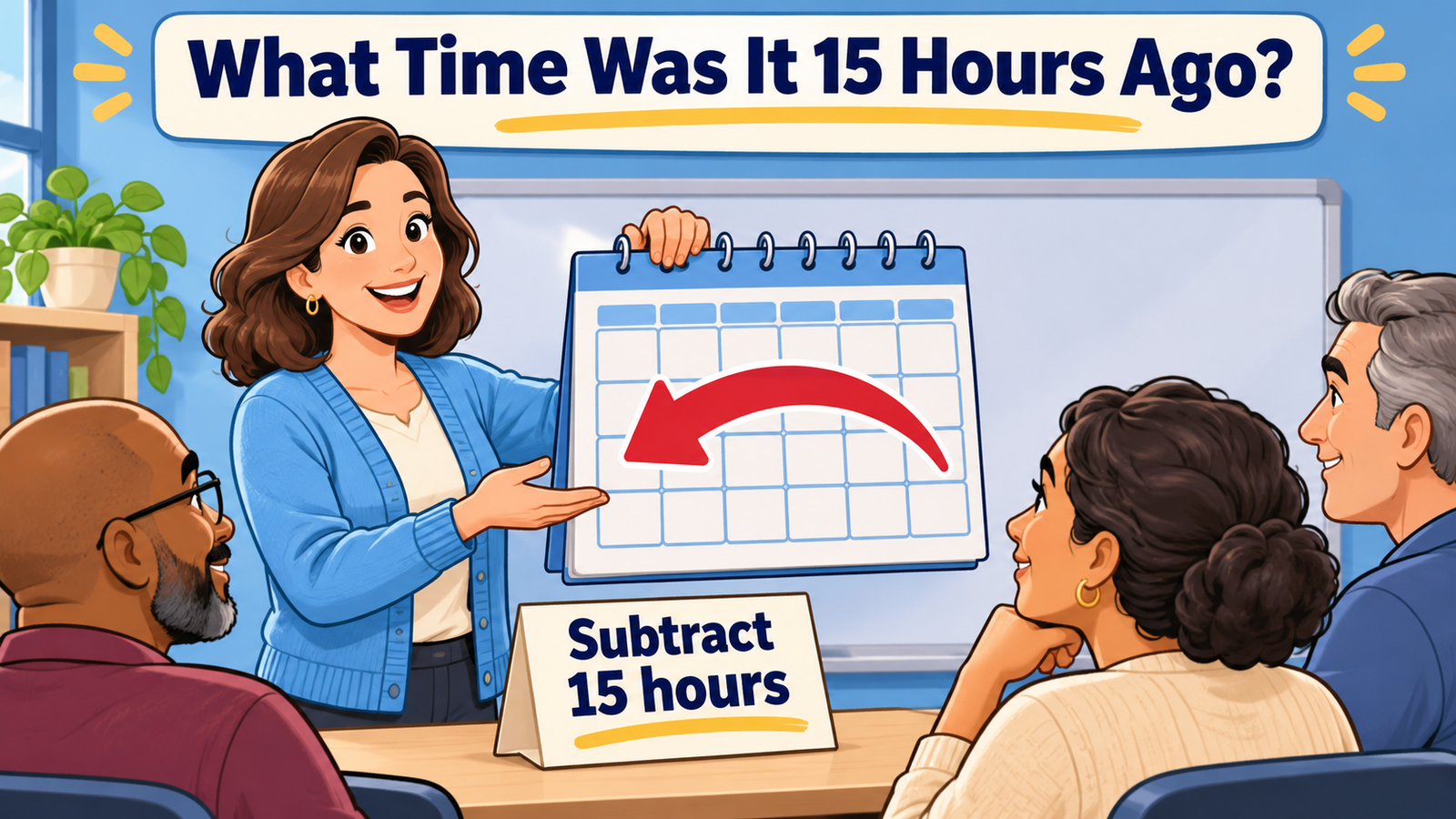
To find what time it was 15 hours ago, subtract fifteen hours from your starting date and time. For example, at 10:25 AM, fifteen hours earlier was 7:25 PM the previous day. At 8:40 PM, it was 5:40 AM on the same day.
Those examples assume the local clock offset did not change during the interval. The exact answer depends on when you begin, so this page provides a method rather than a live timestamp. Keep the date with the result: a correct clock reading attached to the wrong day is still an incorrect answer.
What Does 15 Hours Ago Mean?
“Fifteen hours ago” describes an elapsed duration before a reference moment. That reference is usually now, but it can also be the time a screenshot was taken or a report was generated. First establish the reference moment, then move backward by fifteen hours.
If a screenshot was captured at 6 PM yesterday, its “15 hours ago” label should be interpreted relative to that capture time, not the time you happen to view the screenshot today. Confusing the reference point can shift your answer by many hours even when the subtraction itself is correct.
Subtract Twelve Hours, Then Three
A convenient mental method is to split fifteen into twelve plus three. Starting at 10:25 AM, subtract twelve hours to reach 10:25 PM the previous evening. Subtract another three hours to reach 7:25 PM the previous day. The minutes stay at 25 in this unchanged-offset example.
Starting at 8:40 PM, subtract twelve hours to reach 8:40 AM that day, then another three to reach 5:40 AM. This method makes the AM/PM transition visible. Write down the intermediate result if you tend to lose track of the date while moving through midnight.
Use a 24-Hour Clock
In 24-hour notation, subtract 15 from the hour while preserving the minutes. If the starting time is 21:12, then 21 − 15 = 6, giving 06:12 on the same date. This is 6:12 AM. The method is direct when the starting hour is at least 15.
If the starting time is 08:12, subtracting 15 gives −7. Add 24 to obtain 17 and move the calendar date back one day. The result is 17:12 on the previous date, or 5:12 PM yesterday. Adding 24 handles the clock cycle; moving the date back handles the calendar.
Is Fifteen Hours Ago Always Yesterday?
No. With an unchanged local offset, starting times before 3 PM lead to the previous date, while starting times at or after 3 PM lead to the same date. At exactly 3 PM, fifteen hours earlier was midnight at the beginning of that day.
For example, at 2:59 PM, the result is 11:59 PM yesterday. One minute later, at 3 PM, the result becomes 12 AM today. The elapsed duration has not changed; the calculated past moment has crossed the midnight boundary. That one-minute example is useful for checking the date rule.
Examples Throughout the Day
At 1:15 AM, fifteen hours earlier was 10:15 AM yesterday. At 7:45 AM, it was 4:45 PM yesterday. At 12:20 PM, it was 9:20 PM yesterday. At 4:05 PM, it was 1:05 AM today. At 11:50 PM, it was 8:50 AM today.
Keep the minutes unchanged when subtracting a whole number of hours under these assumptions. A result that changes 7:45 into 4:15 usually indicates an unnecessary minute adjustment. If you are also subtracting minutes, that is a different calculation and should be written explicitly, such as fifteen hours and thirty minutes ago.
Crossing a Month or Year Boundary
Moving to the previous day sometimes means changing the month or year as well. If the starting moment is March 1 at 10 AM, fifteen hours earlier falls on the final day of February at 7 PM. The correct February date depends on whether the year is a leap year.
Likewise, January 1 at 8 AM minus fifteen hours gives December 31 at 5 PM in the previous year. Writing only “5 PM yesterday” may be enough for casual conversation, but a record or report should include the full date and year to remain clear when read later.
Convert Fifteen Hours Into Other Units
Fifteen hours equals 900 minutes, because 15 × 60 = 900. It also equals 54,000 seconds, because 900 × 60 = 54,000. These are fixed duration conversions and do not depend on where you live.
Fifteen hours is also 0.625 of a standard 24-hour day. That fraction describes a duration, not necessarily a fraction of a local calendar day during a clock change. For ordinary arithmetic, hours or minutes are usually clearer than fractions of a day because they make the intended interval explicit.
Relative Labels May Be Rounded
A label such as “15 hours ago” in an app may be rounded or displayed in coarse intervals. Without knowing that app’s display rules, do not assume the event occurred exactly fifteen hours, zero minutes, and zero seconds earlier. The label can provide an estimate rather than a precise timestamp.
If exact timing matters, look for the original date and time in the record, message details, or export. Record the time zone as well. This is especially useful when comparing several events, because small differences hidden by rounded labels can affect their apparent order.
Time Zones and Clock Changes
Fifteen elapsed hours is the same duration everywhere, but the resulting local clock time depends on the zone used to display the past moment. Keep both your reference and your result in a consistent zone, or convert them deliberately. Do not subtract hours from one zone and attach the label of another.
If a daylight-saving transition occurs within the interval, simple wall-clock subtraction may be misleading. For exact elapsed time, subtract fifteen hours from a complete timestamp and then display the result in the intended zone. The ordinary same-day-versus-yesterday shortcut assumes no offset change and should not override a date-aware calculation.
Check by Adding Fifteen Hours Back
Reverse the operation to test your answer. If your result is 7:25 PM yesterday, add twelve hours to reach 7:25 AM today, then three hours to reach 10:25 AM. That matches the original starting time, so both the hour and date are consistent.
For written records, keep the reference time beside the calculated result. “Calculated from 10:25 AM on the stated date” is more useful than an isolated answer that will become unclear later. The word ago is relative; a complete timestamp remains understandable after the conversation has moved on.
Quick Reference: What Was the Time 15 Hours Ago?
Use this table to check a calculation based on an exact reference time. The examples assume a constant local clock offset throughout the interval. For another minute value, preserve those minutes while subtracting the fifteen whole hours.
| Reference time | 15 hours earlier | Result date |
|---|---|---|
| 12:00 AM | 9:00 AM | Previous day |
| 6:00 AM | 3:00 PM | Previous day |
| 12:00 PM | 9:00 PM | Previous day |
| 2:59 PM | 11:59 PM | Previous day |
| 3:00 PM | 12:00 AM | Same day |
| 6:00 PM | 3:00 AM | Same day |
| 11:00 PM | 8:00 AM | Same day |
The change between 2:59 PM and 3:00 PM is a helpful boundary check: the result moves from the previous date to midnight on the current date. If a clock change occurs during the interval, use a complete timestamp instead of applying this table directly.
Frequently Asked Questions
What time was it 15 hours ago?
Subtract fifteen hours from your reference date and time. The answer changes depending on when you start.
Is 15 hours ago always the previous day?
No. Under an unchanged offset, a starting time at or after 3 PM produces a same-day result.
What is 15 hours before 2 PM?
It is 11 PM on the previous day, assuming no clock-offset change.
What is 15 hours before 9 PM?
It is 6 AM on the same day under ordinary unchanged-offset conditions.
How many minutes are in 15 hours?
There are 900 minutes, equivalent to 54,000 seconds.
Does an app’s 15-hours-ago label give an exact time?
Not necessarily. It may be rounded. Check the original timestamp when precision matters.
Conclusion
Calculating fifteen hours ago means moving backward from a clearly identified reference moment. Subtract twelve hours and then three, or use 24-hour arithmetic, while keeping the date attached to the result.
Check the answer by adding fifteen hours back. For rounded app labels, changing time zones, or daylight-saving transitions, use the complete timestamp rather than relying only on the displayed clock hour.



Leave a Reply