

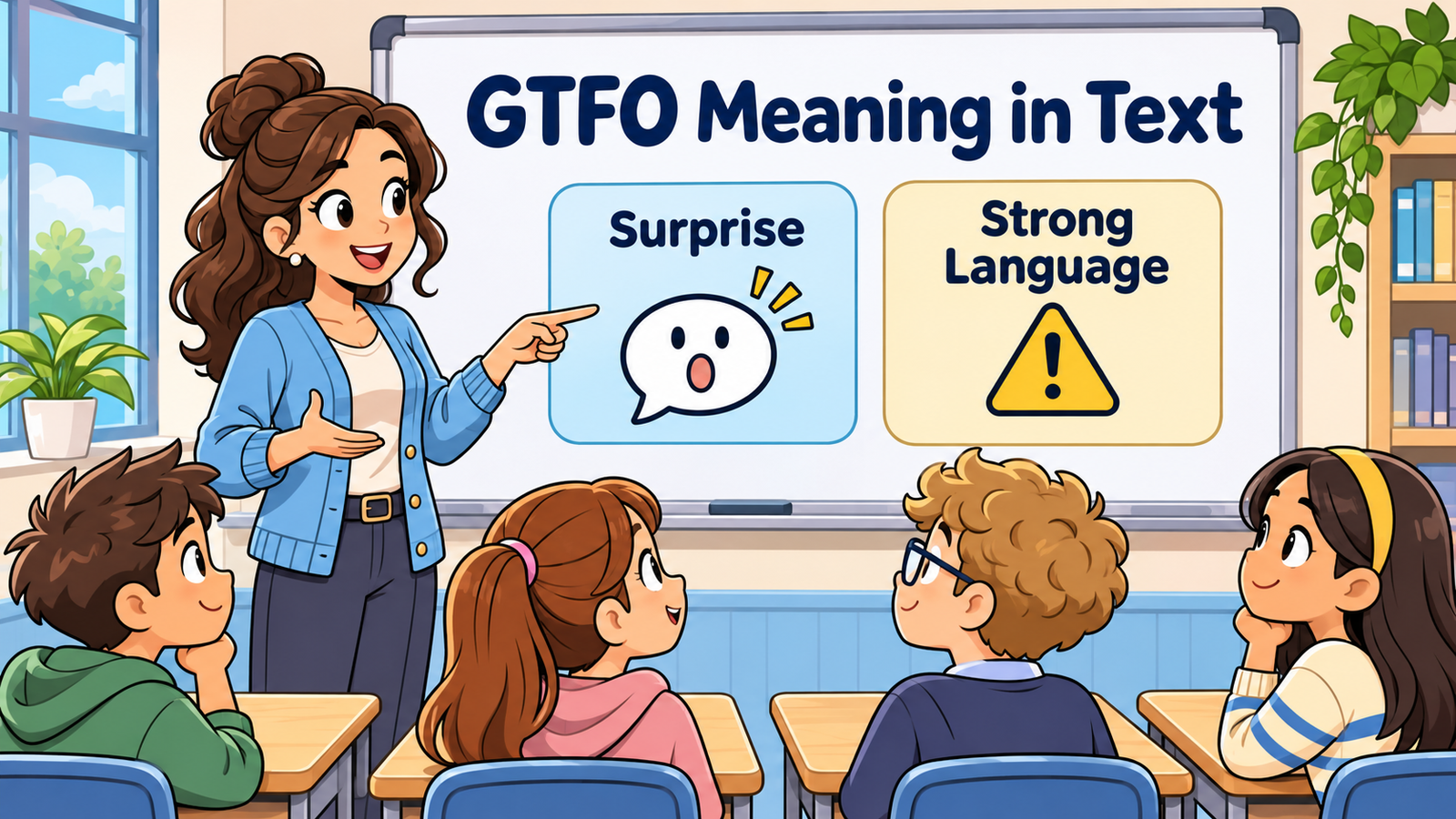
A friend shares unbelievable news, and someone replies “GTFO! Seriously?” In another chat, a person writes “GTFO of this group.” The letters are identical, but one message may express surprise while the other tells someone to leave.
The GTFO meaning in text is “get the f* out.”** It is a profane phrase used to dismiss someone, demand that they leave, or express strong disbelief. The surrounding sentence helps identify the intention, but the abbreviation remains strong language even when used jokingly.
What Does GTFO Stand For?
GTFO takes the first letters of get the fuck out. The censored expansion is often used in general-audience explanations, but the underlying phrase is the same. Shortening it does not remove the profanity or make it automatically polite.
To interpret a message, distinguish the expansion from the conversational function. The words can be used literally as a command or figuratively as a reaction. Knowing both uses prevents you from treating every surprised reply as an instruction to leave.
| Message | Likely function |
|---|---|
| “GTFO of this chat.” | A hostile or forceful demand to leave |
| “GTFO! Your story won the prize?” | Surprise or disbelief |
| “I need to GTFO of here.” | The speaker wants to leave |
| A standalone “GTFO” | Meaning and tone may remain unclear |
GTFO as a Command to Leave
The literal use directs someone out of a place, discussion, or interaction. In an online disagreement, it can dismiss a person rather than address what they said. Words such as “of this group” make the requested action explicit.
If you need to end a conversation yourself, clearer wording can avoid needless hostility. “I don’t want to continue this discussion” states your boundary. “Please leave this chat” communicates the action directly, though the surrounding circumstances still affect how it will be received.
GTFO as Surprise or Disbelief
Some people use the phrase as an emphatic version of “No way!” It may respond to unexpected good news, an unlikely coincidence, or a surprising claim. In that use, the sender may want more details rather than wanting the other person to disappear.
For example, “GTFO, you found the missing painting?” could express amazement. If the next message says “That’s incredible—where was it?”, the follow-up supports that reading. Without the follow-up, a recipient unfamiliar with the sender’s style might reasonably be uncertain.
Playful Use Among Friends
Friends can develop a shared style that includes exaggerated language. A phrase that feels hostile from a stranger may be understood as teasing within an established relationship. That familiarity explains a possible reading; it does not guarantee every use will land well.
If a friend dislikes the expression, choose different wording. “I meant that as surprise, not as a dismissal” can clarify your intention. Adding “I’ll say it differently next time” acknowledges that the recipient’s experience matters too.
GTFO When the Speaker Wants to Leave
The subject of the sentence matters. “You need to GTFO” directs the statement at another person. “I need to GTFO” describes the speaker’s own wish to leave. The phrase is still forceful, but the target and practical meaning have changed.
Imagine someone says, “This event is too crowded; I need to GTFO.” A useful response might discuss leaving together or finding a quieter place. Replying as though they had ordered you away would misunderstand the grammar of the sentence.
Is GTFO Always Angry?
No. The surprise and joking uses show why anger is not the only possible interpretation. However, the phrase can sound aggressive when it arrives without context or follows a disagreement. A reader does not have to assume a friendly intention when the evidence is unclear.
Look for the actual action and follow-up. Is the person celebrating, asking for details, rejecting a claim, or telling someone to leave? Those clues are more informative than a rule based only on capitalization or the presence of an emoji.
Do Lowercase Letters or Emojis Change the Meaning?
Lowercase gtfo and uppercase GTFO can represent the same expression. Capitals may add emphasis, but some people use them for all abbreviations. A laughing emoji can suggest playfulness or accompany mockery, so it does not settle the matter by itself.
The sentence remains the strongest starting point. “gtfo of my messages” is a direct dismissal despite the lowercase spelling. “GTFO! Congratulations!” has a positive follow-up despite the capitals. Read both the wording and the situation before responding.
How to Reply to a Surprised GTFO
If the reaction is clearly friendly, confirm the news or provide the requested details. “Yes, really! They announced it this morning” answers disbelief without repeating the profanity. You can keep the exchange warm while using your own language style.
If the tone is uncertain, ask briefly: “Do you mean you’re surprised?” That gives the sender a chance to explain. A simple clarification can prevent an excited reaction from becoming an unnecessary argument.
How to Reply to a Hostile GTFO
You can set a boundary, end the exchange, or ask for respectful wording. A short sentence such as “I’m willing to discuss the issue, but not while being insulted” identifies the condition for continuing without escalating the language.
You do not have to produce a clever comeback. If the conversation is going nowhere, leaving it can be the most practical response. When repeated unwanted messages are the problem, using the available mute or block controls may serve you better than replying to every one.
| Situation | Possible reply |
|---|---|
| Friendly disbelief | “Yes, it’s true—I’m excited too.” |
| Unclear tone | “Are you surprised, or asking me to leave?” |
| Unwanted hostile language | “Please speak to me respectfully.” |
| A discussion you want to end | “I’m stepping away from this conversation.” |
| The speaker wants to leave an event | “Would you like to head out now?” |
GTFO vs GTG
GTG can mean got to go or good to go. It is not a shortened polite version of GTFO, and the extra letter is not a minor change in spelling. The phrases have different expansions and can perform very different functions.
“GTG, my ride is here” is an ordinary departure notice. “GTFO” directed at someone can be a profane dismissal. If you mean you need to leave a conversation, use clear departure wording rather than assuming the abbreviations are interchangeable.
GTFO vs STFU
STFU expands to a profane instruction to stop talking, whereas GTFO relates literally to leaving. Both can also appear as exaggerated reactions, but their direct meanings differ. One targets speech; the other targets presence or participation.
If you are explaining the terms to an English learner, describe the intended action as well as the strong tone. Recognizing offensive language helps someone understand an exchange without needing to use the expressions in their own messages.
Original Examples With Clear Context
The examples below illustrate different functions of the phrase. They are original sample messages rather than quotations. Their purpose is to make the distinction readable, not to recommend the wording for every situation.
Notice how the subject and follow-up guide the interpretation. A question about surprising news differs from a direct instruction, while a sentence beginning with I describes the speaker’s own intention.
- “GTFO! The tiny garden won first prize?” — A surprised reaction.
- “GTFO of the discussion if you’re only here to insult people.” — A forceful dismissal.
- “I’m exhausted; I need to GTFO of this noisy place.” — The speaker wants to leave.
- “GTFO, you’re joking! That’s amazing.” — Disbelief followed by positive wording.
- “No way! Tell me what happened.” — A less offensive alternative for surprise.
Better Alternatives for Different Intentions
For surprise, try “Seriously?”, “You’re kidding!”, or “That’s unbelievable!” For leaving, “I need to head out” is clear. For a boundary, “Please stop contacting me” or “I’m ending this discussion” states the actual request.
Match the alternative to your purpose. A cheerful “No way!” does not replace a firm boundary, and a command to leave does not express congratulations. Identifying what you want the sentence to accomplish makes it easier to choose effective words.
FAQs About GTFO Meaning in Text
What does GTFO mean in a message?
It expands to get the f*** out. It can be a profane demand to leave, a dismissal, or an emphatic expression of disbelief. The surrounding sentence helps identify the intended function.
Is GTFO always an insult?
Not always; it may be intended as a surprised or playful reaction. However, it remains strong language and can be unwelcome. Shared context does not guarantee that every recipient will read it positively.
What does GTFO mean after good news?
It may mean something like “No way!” or “Are you serious?” A positive follow-up supports that interpretation. If the tone is unclear, ask rather than assuming either excitement or hostility.
Is GTFO the same as GTG?
No. GTG commonly means got to go or good to go. GTFO has a profane expansion and can direct someone else to leave. They should not be substituted for each other.
What is a polite alternative to GTFO?
For surprise, use “Really?” or “That’s incredible!” For a boundary, state the action you want clearly. For your own departure, “I need to leave now” communicates the meaning without profanity.
Conclusion
The GTFO meaning in text includes strong profanity, but its conversational role can range from dismissal to disbelief. The sentence’s subject, situation, and follow-up reveal more than the abbreviation alone.
Clarify an uncertain message, respond to the actual intention, and choose alternatives that fit your own tone. You can express surprise or set a firm boundary without leaving your meaning to an aggressive-looking shortcut.










Leave a Reply