

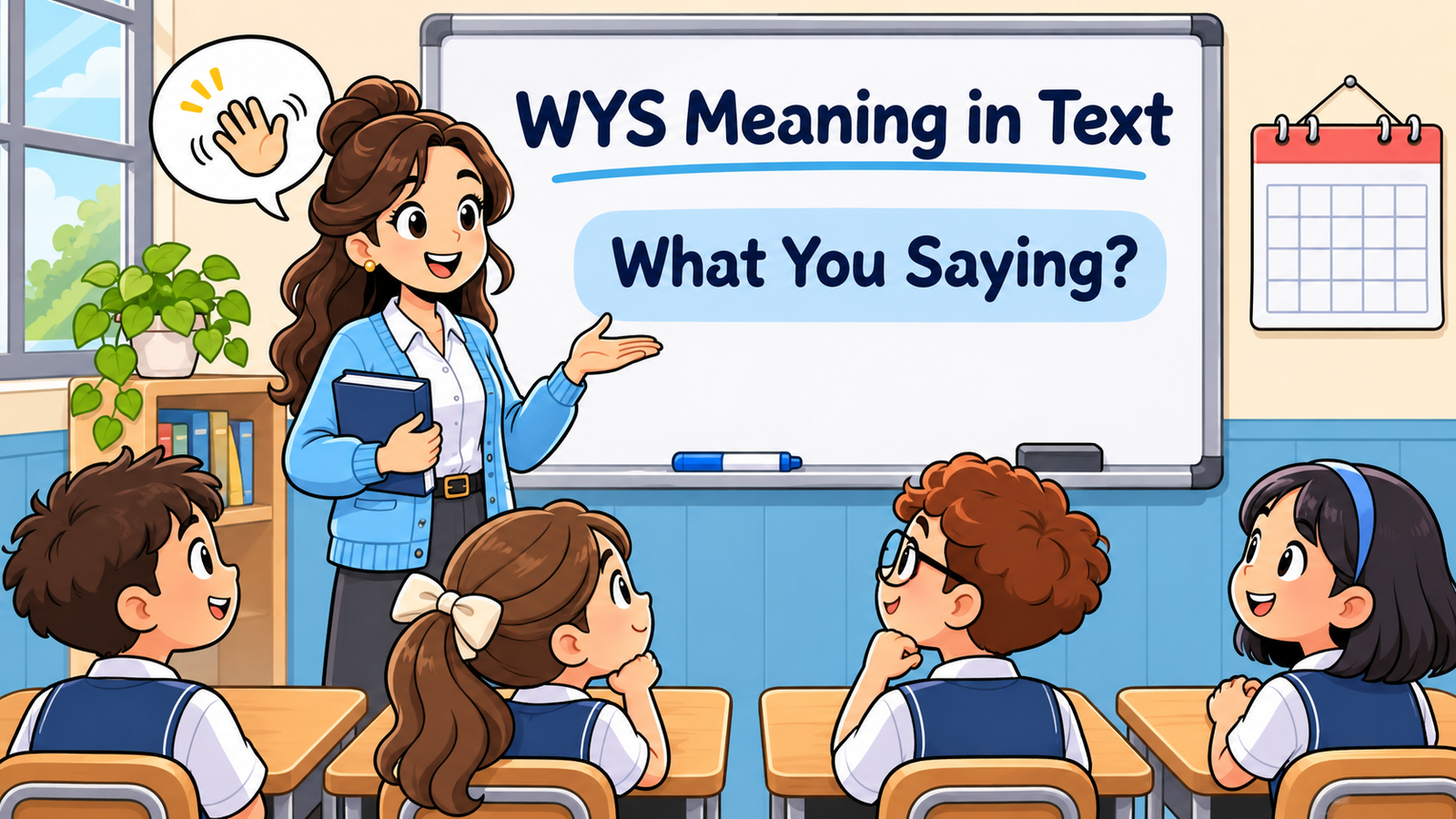
A friend opens a chat with “WYS tonight?” You do not need to repeat the last thing you said. In this setting, they are probably asking what you are doing later or whether you have plans.
The WYS meaning in text can be “what you saying?”, a casual conversation starter similar to what’s up. However, WYS also has other recorded expansions, including whatever you say and what you said. Its position in the conversation helps you decide whether it is a greeting, a reply, or a request for clarification.
What Does WYS Stand For?
What you saying is an informal version of what are you saying. In casual conversation, it can function as an open-ended check-in rather than a literal question about speech. Adding tonight or later often turns it into a question about plans.
Do not apply that reading automatically to every message. A standalone WYS after a disagreement may perform a different job from WYS at the start of a friendly exchange. Read what came before it and look for any follow-up.
| Message | Possible reading |
|---|---|
| “Hey, WYS this afternoon?” | What are your plans? |
| “WYS? Haven’t heard from you.” | A casual check-in |
| “Fine, WYS.” after an argument | Possibly whatever you say |
| “WYS about my suggestion?” | Asking what you mean or think |
WYS as a Casual Greeting
At the beginning of a chat, WYS can invite a general update. A friend might be asking how things are going, whether you are busy, or whether you feel like talking. You usually do not need to answer every possible version of the question.
A short response such as “Just finished work—how about you?” keeps the exchange natural. If the sender wants something specific, they can ask next. Treating the opener as a friendly invitation often works better than giving a detailed account of your entire day.
WYS Tonight and Questions About Plans
A time expression narrows the meaning. “WYS tomorrow?” points toward tomorrow’s activities, while “WYS after the meeting?” asks about the period after that event. Your answer can mention both availability and any existing arrangement.
For example, “I’m free after six, but I need to stay near home” gives the other person something useful to work with. Saying “nothing” may also be fine, but it can leave them unsure whether you actually want to make plans.
WYS as Whatever You Say
In a reply, WYS may stand for whatever you say. Depending on the exchange, that can sound accepting, resigned, or sarcastic. It is not automatically a friendly greeting just because the same letters were used that way earlier.
If someone replies WYS after you make a claim, you may need to clarify whether they agree or want to stop discussing it. “Are you okay with the plan, or would you prefer something else?” asks for the practical answer without escalating a disagreement.
WYS as What You Said
Another possible expansion is what you said. This can indicate agreement with an earlier comment, similar to saying that someone has already expressed your view. The preceding statement is essential to that interpretation.
In an important discussion, ask for a clearer commitment if you need one. Agreement with an opinion is not necessarily agreement to perform a task. “Do you also want to help organize it?” checks the next step rather than treating a brief response as an offer.
Other Contexts and Status Questions
Some communities use WYS for what’s your status, including gaming discussions. A teammate might want to know where you are, whether you are ready, or how your part of an activity is progressing. That differs from a general social greeting.
The useful reply names the relevant status: “Ready at the entrance” or “Still finishing this round.” You do not have to memorize every possible expansion. If the usual greeting does not fit the activity, ask what information the sender needs.
WYS vs WYD
WYD commonly represents what you doing, or what are you doing. It focuses more directly on an activity. WYS as a greeting can be broader, leaving room for plans, news, or a general check-in.
The responses may overlap in everyday conversation. “Cooking dinner” could answer either question. The distinction becomes useful when someone adds a time or purpose: “WYS Saturday?” is more likely to invite a discussion of plans than a report of your present activity.
WYS vs WYA and HBU
WYA commonly means where you at, asking about location. HBU means how about you, returning a question to the other person. Neither is an exact replacement for WYS, even though all three can appear in the same casual exchange.
For example, “WYS later?” might lead to “I’m free. HBU?” If a meeting is then arranged, “WYA?” asks where someone is. Recognizing the different jobs helps you answer the question actually being asked rather than sending an unrelated update.
How to Reply to WYS Naturally
Start with the context you can see. For a friendly opener, share a short update and return the question. For a planning message, give your availability. For an ambiguous reply, ask which meaning was intended.
You can also decline without sounding dismissive. “Busy this evening, but I can catch up tomorrow” answers the likely invitation and offers another option. You do not need to use slang yourself to respond comfortably to someone who does.
| Situation | Possible reply |
|---|---|
| A general check-in | “Doing well, just taking a break. You?” |
| A question about tonight | “Free after dinner. What did you have in mind?” |
| You are unavailable | “Working late today—maybe another time.” |
| The meaning is unclear | “Are you asking about my plans?” |
| A possible disagreement | “Can you tell me what you prefer?” |
Does WYS Mean Someone Is Flirting?
It can start a conversation that becomes flirty, but the abbreviation alone does not establish romantic interest. Friends, classmates, teammates, and acquaintances can all use a casual opener without implying anything beyond conversation.
Pay attention to the actual invitation and how both people participate. “Would you like to go on a date?” is clearer than reading romantic intent into WYS. The sender’s gender also does not change the letters into a special hidden message.
Original Examples in Different Situations
These sample exchanges show how the same opener can lead to different practical answers. They are original examples rather than rules about how everyone texts. The extra context is what makes each one easier to interpret.
Notice that a useful reply can state a limit as well as an interest. Being friendly does not require sharing your exact location, cancelling existing plans, or agreeing to something before you know what is being suggested.
- “WYS after class?” — “Heading to the library for an hour.”
- “Hey, WYS?” — “Good, just finished my project. How are you?”
- “WYS this weekend?” — “Visiting family on Sunday, free Saturday.”
- “WYS later?” — “Maybe available—what’s the plan?”
- “WYS?” — “Not sure which meaning you intend here.”
Clearer Alternatives for Formal Messages
For work, write the specific question: “Are you available after the meeting?” or “What is the status of the draft?” The reader can answer immediately without deciding which expansion of WYS you intended.
For a personal message to someone unfamiliar with your slang, “How’s it going?” preserves a relaxed tone. Clear wording is especially useful when a plan depends on a time, location, or commitment that should not remain implied.
FAQs About WYS Meaning in Text
What does WYS mean in a text message?
It can mean what you saying as a casual greeting or question about plans. Other readings include whatever you say and what you said, so context matters.
What does WYS tonight mean?
It usually asks about your plans or availability tonight. You can answer with what you are doing and ask what the sender has in mind.
Is WYS rude?
A friendly opener is not inherently rude. A reply meaning whatever you say may sound dismissive or sarcastic, depending on the surrounding exchange.
Is WYS the same as WYD?
They can overlap, but WYD asks about what someone is doing. WYS can function more broadly as a greeting and also has other expansions.
How should I answer if I do not understand WYS?
Ask a short clarifying question such as “Do you mean what I’m doing later?” That is more reliable than guessing from the abbreviation alone.
Conclusion
The WYS meaning in text depends on whether the message starts a conversation, responds to a comment, or asks for an update. What you saying is a useful starting point for a friendly opener, but it is not the only possible interpretation.
Use the surrounding sentence, give the practical information being requested, and clarify when the meaning remains uncertain. A relaxed conversation works best when both people understand the question.







Leave a Reply