

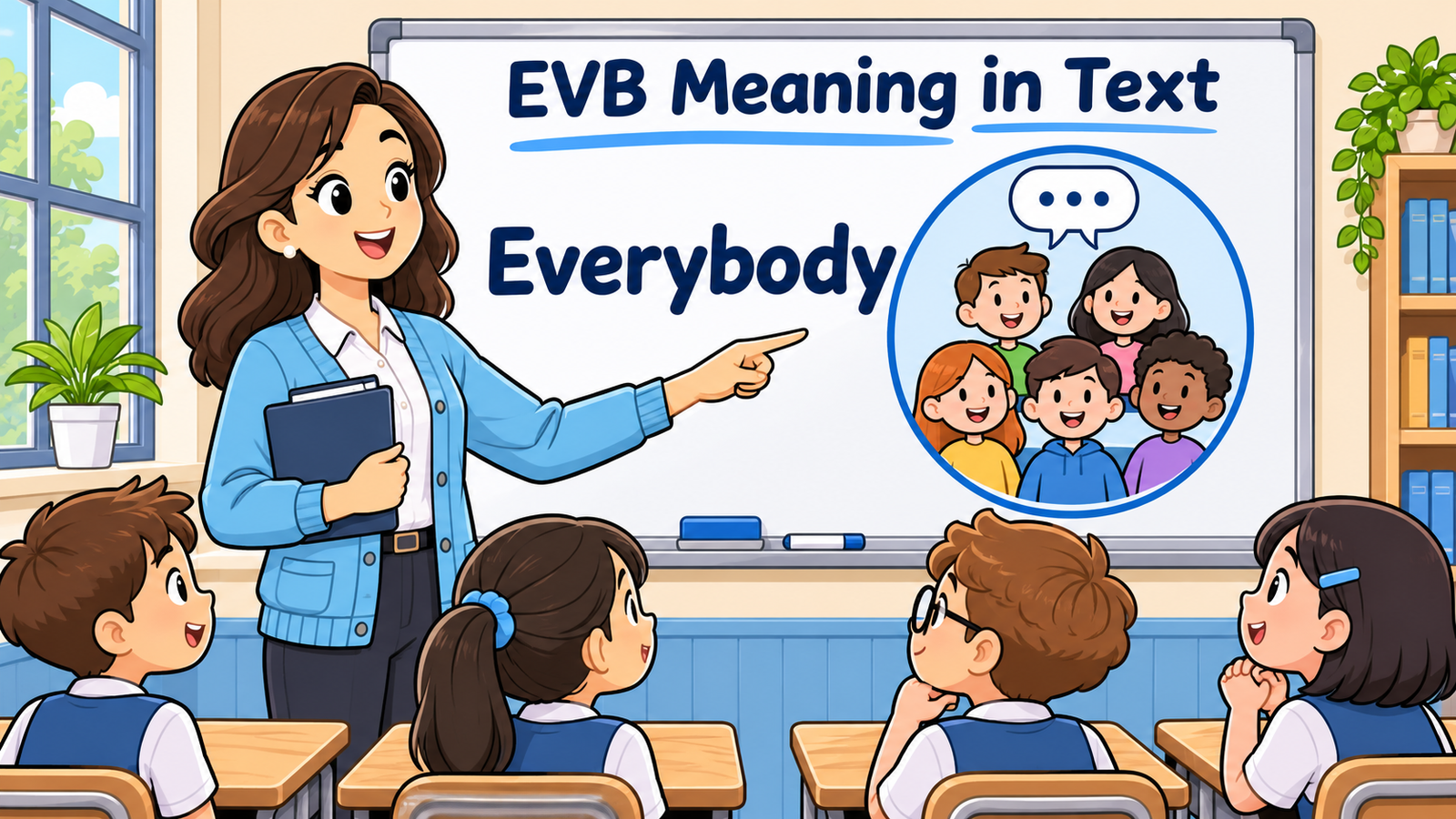
Someone posts “evb bring a notebook” in a class group, and you wonder whether EVB names a person or a particular team. In an ordinary message like this, it is a shortened way of writing everybody.
The EVB meaning in text is usually “everybody.” It refers to the people included in the conversation or situation. That might mean the members of a group chat, the people attending an event, or a broad audience in a caption—not necessarily every person everywhere.
What Does EVB Stand For?
EVB is informal shorthand for the single word everybody. It is not an initialism that needs three separate words beginning with E, V, and B. Trying to invent a full phrase for each letter can make a straightforward message unnecessarily confusing.
You may see evb in lowercase or EVB in capitals. Both can represent the same word. Casual writers often shorten familiar words without following one formal system, so recognition depends on the sentence around them.
| Short message | Expanded reading |
|---|---|
| “Is evb ready?” | Is everybody ready? |
| “Thanks evb.” | Thanks, everybody. |
| “Evb needs a ticket.” | Everybody needs a ticket. |
| “Tell evb the room changed.” | Tell everybody the room changed. |
Who Does Everybody Include?
The group is defined by context. In a message to four project partners, everybody usually refers to those partners. In a caption about an audience at a performance, it may refer to the people at that event.
If the scope matters, ask for it. “Do you mean everyone in this chat or the whole club?” prevents a small ambiguity from becoming a planning problem. The abbreviation itself cannot tell you who was invited or who is expected to act.
EVB in Group Chats
A sender may use EVB to address several people at once. “Evb check the updated schedule” is directed toward the relevant group rather than one named person. It can be a reminder, an announcement, or a request.
Typing EVB does not, by itself, guarantee that an app sends an everyone notification. It is ordinary text unless a particular service has a separate feature with its own behavior. If a message is important, make the request explicit and use the group’s usual communication method.
EVB in Captions and Comments
In a caption, everybody can be descriptive or exaggerated. “Evb is talking about this scene” may mean many people in the writer’s social circle are discussing it. It is not necessarily a measured statement about an entire audience.
That distinction matters when reading popularity claims. A casual caption can describe the writer’s impression without proving universal agreement. You can understand the slang while still recognizing that the statement may be enthusiastic shorthand rather than a precise count.
Everybody or Everyone?
Everybody and everyone are generally interchangeable when they refer to all the people in a relevant group. “Everybody is ready” and “Everyone is ready” communicate the same basic idea. EVB shortens the first word, but everyone can be a natural full-word alternative.
Do not confuse everyone with every one. Everyone refers to people collectively; every one emphasizes each individual item or person in a set. For example, “Every one of these folders needs a label” is a different grammatical construction.
Is Everybody Singular or Plural?
In standard English, everybody takes a singular verb: everybody is, everybody has, and everybody needs. The word refers to multiple people collectively, but its grammatical agreement is singular. This remains the underlying grammar when you expand EVB.
A casual message might omit a verb or use nonstandard wording. When rewriting it for school or work, restore a complete sentence rather than copying every shortcut. “Evb ready?” can become “Is everybody ready?” without changing the intended question.
Using They After Everybody
You can use singular they to refer back to everybody. “Everybody should bring their notebook” avoids assuming anyone’s gender and reads naturally. The sentence combines a singular indefinite pronoun with a familiar gender-neutral reference.
Keep the rest of the meaning clear as well. “Everybody should bring their own notebook” emphasizes one notebook per person. Small words such as own can supply practical information that the abbreviation alone does not provide.
How to Reply to EVB
EVB normally belongs to a larger message, so respond to that message rather than to the abbreviation itself. If someone asks whether everybody is ready, you can confirm your own readiness. If they announce a change, acknowledge the detail you need to follow.
Avoid speaking for the whole group unless you actually know everyone’s position. “I’m ready” is more accurate than “We all are” when you have not checked with others. A group-directed question does not require one person to guess on everybody else’s behalf.
| Message | Useful reply |
|---|---|
| “Evb ready for the call?” | “I’m ready; joining now.” |
| “Evb bring a pen.” | “Got mine packed.” |
| “Does evb agree with Tuesday?” | “Tuesday works for me.” |
| “Tell evb the address changed.” | “Which group should I notify?” |
Does EVB Have a Different Meaning on TikTok?
Everybody is a documented reading in TikTok captions and comments, and the same shorthand can appear elsewhere. The meaning does not automatically change when the conversation moves to Instagram, WhatsApp, or another messaging service.
However, any group can develop its own abbreviations. If EVB appears as a product code, project name, or technical label, everybody may not fit. Read the topic and ask for the relevant definition rather than forcing a slang explanation into a specialist discussion.
EVB vs PPL and Y’all
Ppl shortens people, while EVB shortens everybody. The distinction can affect scope: “People asked about it” does not necessarily mean every person asked. “Everybody asked” makes a broader claim about the group.
Y’all means you all and directly addresses the people being spoken to. Everybody can address a group or describe one. These expressions may overlap in casual messages, but they are not interchangeable in every grammatical position.
Original Examples With Clear Context
The examples below illustrate announcements, thanks, and questions. They are original sentences designed to show how the shortened word fits naturally into an exchange. Expand EVB to everybody and check whether the sentence still makes sense.
Also notice when a specific group is named. “Evb on the planning team” is more precise than an unexplained everyone when several groups share the same conversation. Clear scope helps readers know whether the request applies to them.
- “Evb on the planning team should check the new time.”
- “Thanks, evb, for helping set up the room.”
- “Can evb bring a reusable cup?”
- “Evb who booked a seat should have the details.”
- “I can’t answer for evb, but Friday works for me.”
- “Does evb mean our group or all the volunteers?”
When to Write Everybody in Full
Use the full word in formal emails, instructions, essays, and messages to unfamiliar readers. It is easy to read and avoids excluding people who do not know the abbreviation. Shortening a word is not helpful if the audience has to pause to decode it.
For practical announcements, add the action and deadline too. “Everybody attending the workshop should confirm by Thursday” tells readers who is included and what is required. That is more useful than a vague “evb reply” with no explanation.
FAQs About EVB Meaning in Text
What does EVB mean in a message?
It usually means everybody in informal texts, captions, and group conversations. The surrounding topic identifies which people are included.
Is EVB an acronym for three words?
Not in the everyday slang use. It shortens the single word everybody rather than assigning a separate word to each letter.
Should I write everybody is or everybody are?
Use everybody is in standard English. Everybody takes a singular verb even though it refers to multiple people.
Does writing EVB notify everyone in a chat?
The letters alone are ordinary text. Notification behavior depends on the app and any separate mention feature being used.
Can I use EVB in a professional email?
Writing everybody or everyone is clearer. For work instructions, also specify the relevant team, requested action, and deadline.
Conclusion
The EVB meaning in text is usually everybody, but understanding the word is only the first step. You also need to know which group the sender means and what they are asking that group to do.
Expand the shorthand, check the sentence, and reply for yourself unless you can accurately speak for others. Clear wording keeps a quick group message useful instead of leaving people to guess.








Leave a Reply