

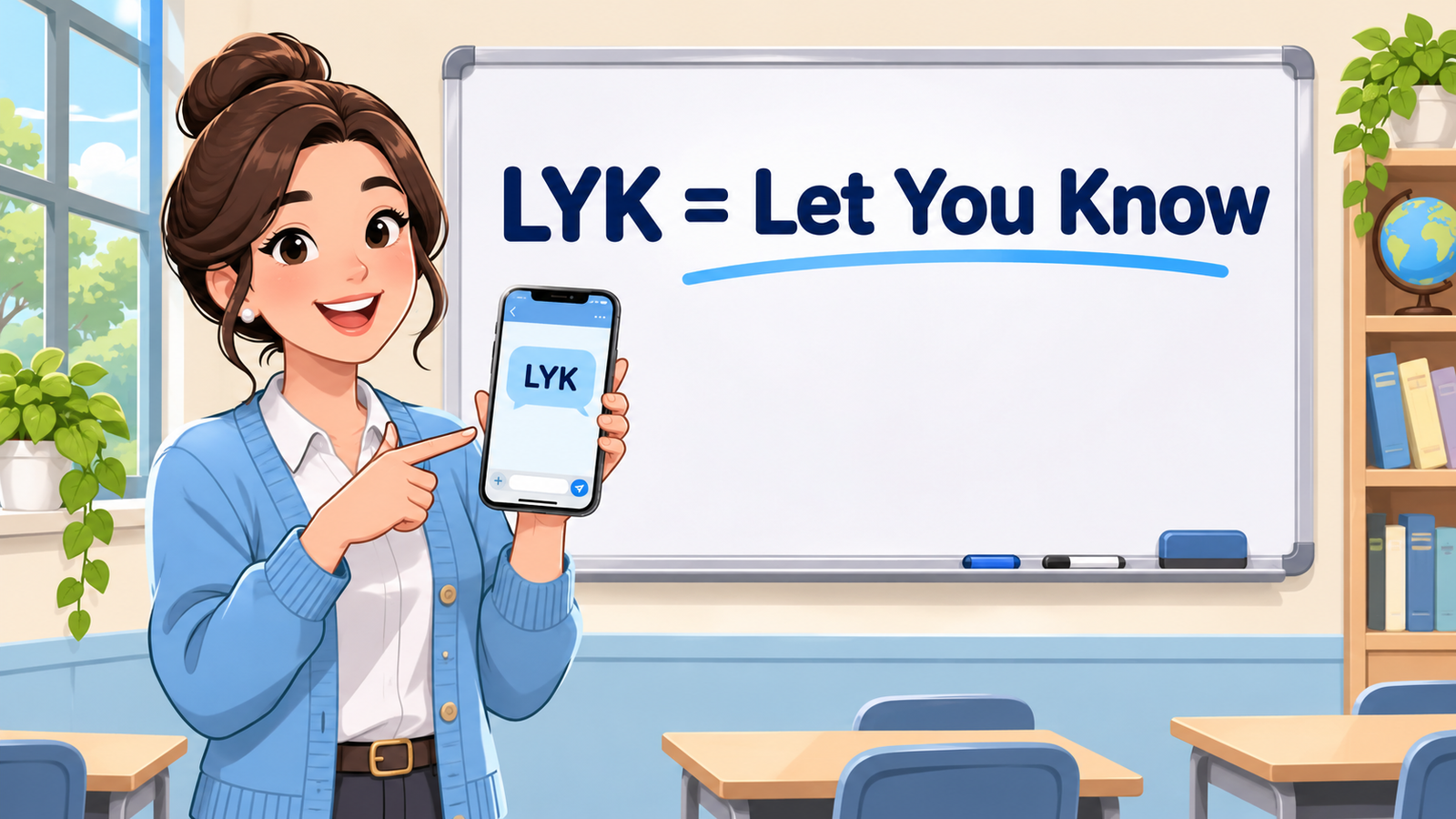
You ask a friend whether the tickets are still available, and they answer, “Checking now, I’ll lyk.” The message is short, but it tells you something useful: they are going to send an update after they find out.
LYK means “let you know” in texting. It usually appears inside a sentence such as “I’ll LYK tomorrow.” Understanding who is giving the update makes this abbreviation much easier to use, especially when it appears beside the similar shortcut LMK.
What Does LYK Stand For?
The three letters represent let you know. Here, let means allow, and know refers to having the information. Together, the phrase functions like tell you or inform you. “I’ll LYK the result” therefore means that the sender will tell the recipient the result.
The letters do not include a subject or a tense. Those usually come from the surrounding words: I’ll, we will, or just. “Just letting you know” may also be shortened informally with LYK, but the complete sentence is the best guide to the intended wording.
How to Use LYK in a Sentence
Place LYK where you would naturally write let you know. For example, “I’ll LYK which entrance is open” works because the full sentence would be “I’ll let you know which entrance is open.” You do not need to add another you after the abbreviation.
Give the recipient enough detail to understand the update. “I’ll LYK” leaves both the subject and timing dependent on earlier messages. “I’ll LYK about the booking after lunch” answers those questions without making the text much longer.
LYK vs LMK: Who Sends the Update?
LYK means let you know; LMK means let me know. In “I’ll LYK,” the speaker is offering information. In “LMK when you finish,” the speaker is asking the other person to provide information. Switching the middle letter reverses the direction of the request.
Imagine that Maya is checking a train timetable for Omar. Maya writes, “I’ll LYK if the last train is running.” Omar answers, “Thanks, LMK before I book the taxi.” Both messages concern the same update, but each abbreviation reflects a different person’s position.
Original LYK Examples for Everyday Texts
Travel: “The platform hasn’t been announced. I’ll LYK when it appears.” Shopping: “I’m comparing the two sizes and will LYK which one fits.” Group plans: “I’ll ask whether the table seats six and LYK this afternoon.” Each message names information that is still being checked.
An update can also concern a decision: “I’ll LYK whether I can volunteer once my shift is confirmed.” That statement is not an acceptance. It means the person intends to give an answer later, so the organizer should not yet count them as available.
How to Reply to I’ll LYK
A simple “Thanks, keep me posted” acknowledges the promise without adding pressure. If the information is time-sensitive, explain your deadline: “Thanks—I need to order by four, so an update before then would help.” The deadline is more useful than repeatedly asking whether they know yet.
When no reply is necessary, you can let the conversation pause. If the promised update does not arrive and you still need it, follow up with a specific question: “Have you heard whether the hall is available?” This is clearer than sending an unexplained question mark.
Does LYK Mean Yes, No, or Maybe?
LYK alone does not express agreement or refusal. “I’ll LYK” often postpones an answer, but the reason could be a schedule check, a missing detail, or a decision that has not been made. You cannot reliably infer rejection from the abbreviation.
If you must make a plan, separate a confirmed answer from a possible one. For instance, “No problem; I’ll keep you as unconfirmed until Thursday” gives both people a shared understanding. This is particularly useful when reserving seats or arranging transport.
LYK on Snapchat, Instagram, and WhatsApp
The familiar texting expansion can appear on different messaging apps. A Snapchat message about meeting later and a WhatsApp message about a delivery can both use LYK for let you know. The platform itself does not supply a special extra meaning.
Lowercase lyk and uppercase LYK generally communicate the same shortcut. Capital letters may reflect typing style rather than emotion. Read the surrounding sentence before deciding that a short message sounds impatient, enthusiastic, or dismissive.
When Writing the Full Phrase Works Better
For a new client, a teacher, or someone who may not know texting abbreviations, write “I’ll let you know.” In a work email, you can be more precise: “I’ll confirm the delivery window by noon tomorrow.” That tells the reader what you will provide and when.
Use shorthand when it genuinely helps the conversation. If the other person asks what LYK means, explain it plainly instead of adding more abbreviations. Clear communication matters more than matching everyone else’s texting style.
Frequently Asked Questions
What is the full form of LYK?
In ordinary text conversations, LYK stands for let you know. It often follows I’ll or will.
Is LYK the same as LMK?
No. LYK refers to telling you something, while LMK asks someone to tell me something.
What does I’ll LYK later mean?
It means the sender intends to provide information or a decision later. It does not give a definite time unless one is stated.
Is LYK rude?
The abbreviation is not inherently rude. Tone depends on the complete exchange and whether the sender follows through.
Can I use LYK in a professional email?
Writing the full phrase is usually clearer. A specific promise such as “I’ll confirm by Tuesday” is especially useful.
Does LYK mean like?
Some people use unconventional spellings, but in “I’ll LYK,” let you know is the natural reading. Check the sentence if that expansion does not fit.
Conclusion
LYK is a convenient way to shorten let you know when you are offering an update. Remember the direction: I’ll LYK means I will tell you; LMK asks you to tell me.
For a smoother conversation, include what you are checking and when you expect an answer. Those small details prevent a quick text from leaving the other person unsure about the plan.







Leave a Reply