

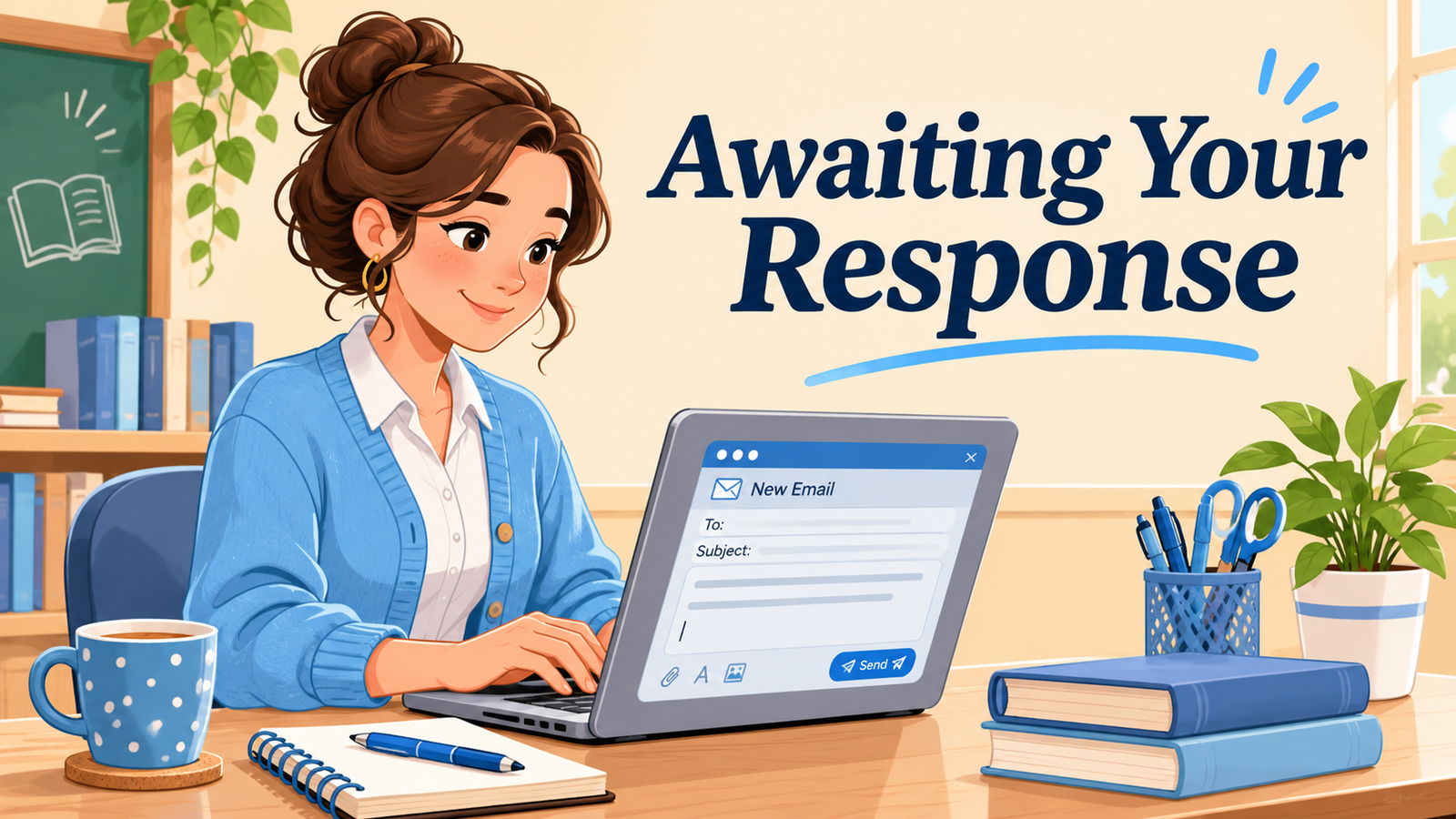
An email can be courteous throughout and still end with a line that sounds unexpectedly stern. “Awaiting your response” is one of those endings: easy to understand, yet not always the most comfortable choice.
Awaiting your response means waiting for your reply. It usually signals that the sender needs an answer, feedback, or a decision. Whether it sounds professional or impatient depends on the request, the relationship, and the wording around it.
What the Phrase Communicates
The phrase tells the reader that the conversation is still open. Something remains unanswered, such as a proposed date, an attached document, or a request for approval. It does not, by itself, explain how quickly the reply is needed.
That missing detail matters. If a supplier needs your choice before arranging delivery, the message should identify the choice and the timing. “Please confirm the delivery address by Wednesday” gives you something concrete to do; “awaiting your response” merely describes the sender’s position.
Is Awaiting Your Response a Complete Sentence?
As a standalone line, it is a sentence fragment because it lacks an expressed subject and a finite verb. Fragments can work in email closings, but a full sentence is often easier to read: “I am awaiting your response” or “We are awaiting your response.”
The verb await takes its object directly. Write “awaiting your response,” without for. If you prefer wait, use “waiting for your response.” These two constructions communicate a similar idea, but their grammar is different.
Is It Polite or Pushy?
The wording is formal, and formality is not automatically politeness. A short closing that emphasizes waiting may feel firm, particularly when the recipient has only just received the message. A friendly greeting elsewhere cannot always remove that impression.
Consider the reason for writing. After an agreed deadline has passed, a firm reminder may be appropriate. For a first request to someone who is doing you a favor, a direct but considerate question usually works better: “Could you share your comments when you have a chance?”
A Better First Request
An effective request names the action, provides enough context, and leaves the recipient able to answer. For example: “Hello Mara, I have attached two draft schedules. Could you let me know which one works for your team by Tuesday afternoon? That will help us reserve the room.”
This example does not need an additional line announcing that a response is awaited. The question already makes that clear. If you add a closing, “Thank you for your help” ends the message warmly without repeating the request.
How to Follow Up Without Sounding Impatient
A follow-up is easier to answer when it briefly restores the context. Try: “Hello Daniel, I am following up on the seating plan sent last week. Could you confirm whether the revised layout meets your requirements? We need to finalize the arrangement on Thursday.”
Avoid assuming silence means refusal or carelessness. The recipient may need information from someone else. An optional line such as “If you need more time, please let me know” gives them a useful way to respond even when they cannot yet make a decision.
Alternatives for Different Situations
For a warm professional ending, “I look forward to hearing from you” works when no urgent deadline needs emphasis. For feedback, be specific: “I would appreciate your comments on the introduction.” For an appointment, ask “Could you confirm your preferred time?”
If timing matters, state it plainly and explain why: “Please send your selection by noon on Monday so we can prepare the materials.” Avoid pairing a firm deadline with “whenever convenient,” because those instructions pull in different directions and make your expectation harder to judge.
Awaiting Your Response vs Looking Forward to Your Response
Awaiting emphasizes the current state of waiting. Looking forward to emphasizes anticipation and often feels warmer. Both can fit professional correspondence, but neither replaces an explicit question when the recipient needs to know what to provide.
Suppose you sent a draft contract and need comments on two sections. “Please review sections two and four and send any changes by Friday” does more work than either closing. Choose your final line only after making the main request clear.
How to Reply When Someone Is Awaiting Your Response
If you can answer, address the request directly: “The revised date works for us. Please proceed with the booking.” You do not need to repeat their phrase or apologize automatically for receiving a normal request.
If you cannot answer yet, acknowledge it and give a realistic next step: “I have received the draft and need to check the figures with our team. I expect to respond on Thursday.” A useful progress update is better than an unexplained promise to reply soon.
Common Mistakes to Avoid
Do not write “I am awaiting for your response.” Choose either awaiting your response or waiting for your response. Also avoid using “your positive response” when the other person needs genuine room to disagree or decline.
Another mistake is stacking several closings: “Awaiting your response, looking forward to hearing from you, please reply soon.” One clear request and one natural closing are enough. Extra phrases can make a message feel more demanding without adding information.
Frequently Asked Questions
What does awaiting your response mean?
It means the sender is waiting for your reply, often because a question or decision is still outstanding.
Is awaiting for your response correct?
No. Use awaiting your response or waiting for your response.
Is the phrase rude?
Not inherently, but it may sound formal or impatient in some situations. A specific, considerate question is often clearer.
What is a warmer alternative?
I look forward to hearing from you is a common option when you do not need to emphasize a deadline.
Can I use it in a job application?
You can, but an ending that thanks the reader and expresses interest in discussing the role often sounds more natural.
How should I respond if I need more time?
Acknowledge the message, explain what remains to be checked, and give a realistic date for your answer.
Conclusion
Awaiting your response expresses that a reply is still expected. It is understandable and formal, but it works best when the email already explains what answer is needed and when.
Before sending, check the action, timing, and tone. A short, specific request with a considerate closing usually helps the reader respond more easily than repeated reminders that you are waiting.








Leave a Reply