

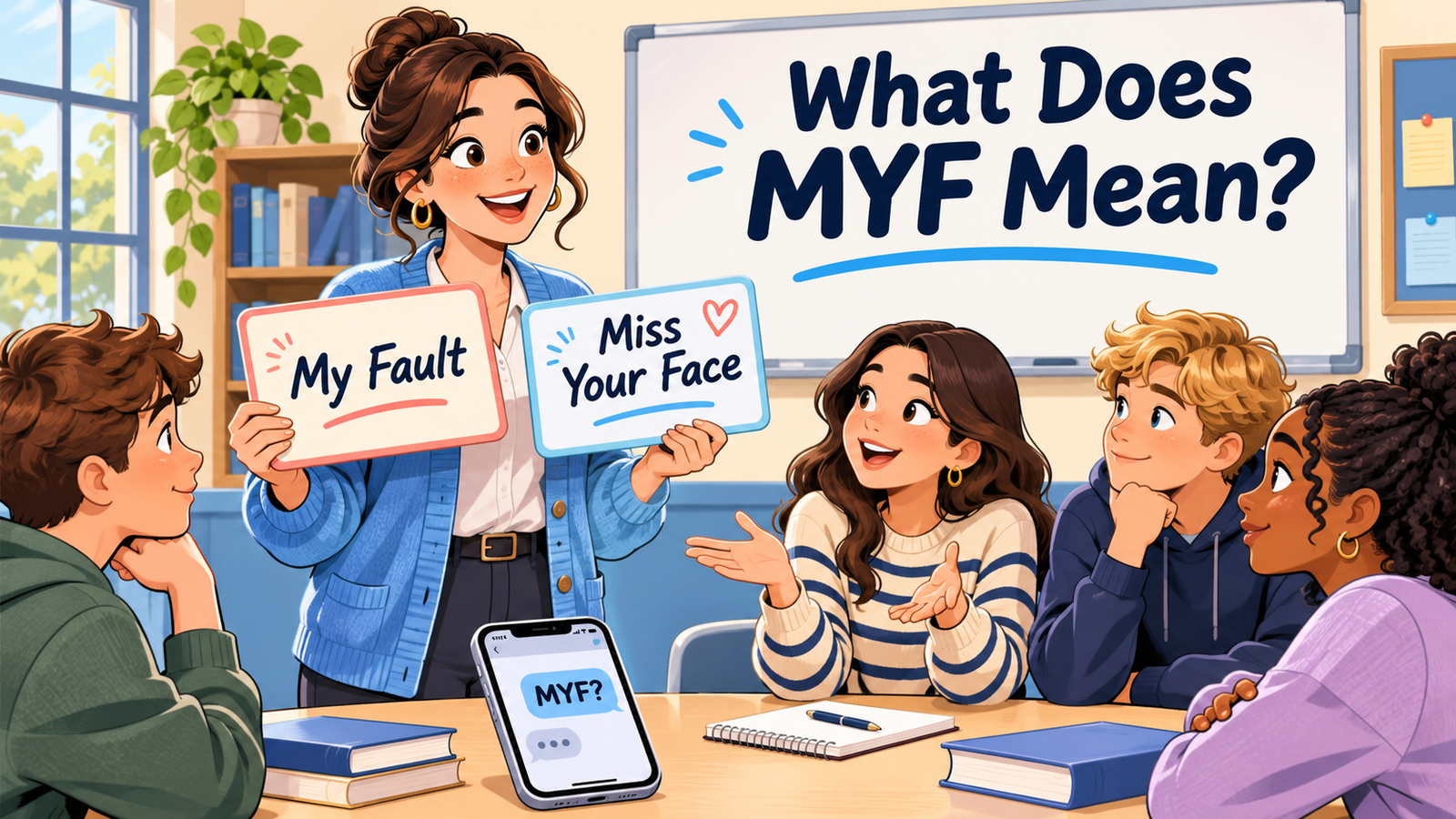
A message says “myf,” and two different explanations seem possible. Is the sender apologizing, or saying they miss you? Both readings can fit ordinary online conversations, so guessing from the letters alone is unreliable.
MYF can mean “my fault” or “miss your face.” After an error, the apology reading often fits. In a message about not seeing someone, the affectionate reading is more plausible. There is no single expansion that safely explains every message.
MYF as My Fault
When someone has made a mistake, my fault is a way of accepting responsibility. They might have sent the wrong address, missed a turn in a game, or misunderstood a plan. MYF can serve as a brief acknowledgment of that error.
For example: “I told you the rehearsal started at six, but it’s actually five. Myf—I’ll send the corrected schedule.” The wording after MYF matters because it explains what the sender will do next. The abbreviation alone does not repair the confusion.
MYF as Miss Your Face
Miss your face is an informal, affectionate way of saying that you miss seeing someone. It refers to the person’s presence and company, not merely their appearance. Friends, relatives, and romantic partners can all use this kind of expression.
Consider: “The café isn’t the same without our Saturday chats. MYF! Are you visiting next month?” The reference to shared time supports the missing-you interpretation. Nothing in this example suggests that an apology is being offered.
How to Choose the Right Meaning
Start with the message immediately before and after the abbreviation. References to forgetting, mixing something up, or causing an inconvenience support my fault. References to distance, memories, visits, or catching up support miss your face.
Then check the relationship and the purpose of the conversation. A teammate discussing an accidental move is probably talking about responsibility. A friend who moved away may be expressing affection. These are clues rather than guarantees, and a short question can resolve what context leaves open.
How to Reply to My Fault
For a minor mistake, you might say “No worries—thanks for fixing it” or “Okay, please use the updated address.” Choose a reply that fits what happened. You do not have to pretend an error was harmless if it caused a real problem.
If the mistake affected you, remain specific: “Thanks for acknowledging it. I waited at the old entrance, so please call me if the plan changes again.” This accepts the acknowledgment while explaining what needs to improve. A clear boundary can be polite.
How to Reply to Miss Your Face
If you share the feeling, respond naturally: “Miss you too! Let’s arrange a call this weekend.” You can also suggest something concrete, such as a walk or a video chat. A small plan turns a warm message into an opportunity to reconnect.
If you do not want to match the level of affection, you can still be kind: “It’s good to hear from you. Hope everything is going well.” You do not owe an identical phrase, a romantic response, or an immediate promise to meet.
Does MYF Mean Someone Is Flirting?
The letters do not establish romantic interest. Even miss your face can be a friendly expression between people who know each other well. An apology reading carries a completely different purpose and should not be mistaken for affection.
Look for direct evidence in the conversation, such as an explicit date invitation, rather than treating an abbreviation as a secret confession. If your own response could be misunderstood, use complete words. Clear wording helps both people avoid assumptions.
MYF on Different Apps
A message’s platform does not settle its meaning. People bring the same shorthand into texts, private messages, comments, and group conversations. A caption may also address a wider audience than a direct message, which changes who the phrase refers to.
Read the visible context rather than assigning one expansion to each app. A comment beneath a correction could be an apology, while a private message about a reunion could express missing someone. The action being discussed is the stronger clue.
Is MYF the Same as MF or My Bad?
Do not assume that removing or adding a letter makes no difference. MF can be a vulgar abbreviation, so it should not automatically be read as MYF. If you suspect a typo, check before responding to an insult that may not have been intended.
When MYF means my fault, it overlaps with my bad as an informal acknowledgment of a mistake. Neither expression is a substitute for a full apology when someone has been seriously inconvenienced. In that case, explain the error, take responsibility, and offer a practical remedy.
What About Other Suggested Expansions?
Some online explanations also suggest my friend. That may be someone’s personal shorthand, but it is not a dependable default for an unfamiliar message. Initials can acquire private meanings within a group, and those meanings may never become widely understood.
Avoid presenting every possible expansion as equally established. If a sentence does not fit either of the main readings, ask “What do you mean by MYF here?” That is a normal clarification, not a failure to keep up with slang.
Writing MYF Without Causing Confusion
Use the abbreviation only when the recipient is likely to recognize it. If you are apologizing to a customer or contacting someone for the first time, write the full sentence. “That was my mistake; I have corrected the attachment” is easy to understand.
Even between friends, adding a few words helps. “MYF, I mixed up the dates” points toward an apology. “MYF—wish we could have coffee” points toward missing the person. The extra context can prevent a reply that heads in the wrong direction.
Frequently Asked Questions
What does MYF stand for in texting?
Two documented interpretations are my fault and miss your face. The surrounding conversation determines which one fits.
Does MYF always mean my fault?
No. It can also express missing someone, and private groups may use their own shorthand.
Is MYF romantic?
It can appear in a romantic exchange, but neither the abbreviation nor miss your face automatically proves romantic interest.
How do I reply to an unclear MYF?
Ask a brief clarifying question, such as Do you mean my fault or miss your face?
Is MYF appropriate for formal emails?
Complete wording is more reliable in formal communication and with recipients who may not know the abbreviation.
Are MYF and MF interchangeable?
No. MF can have a vulgar meaning, so confusing the two can change the message substantially.
Conclusion
MYF becomes easier to understand when you identify what the conversation is doing. An error points toward my fault; a wish to reconnect points toward miss your face.
Respond to the actual purpose rather than the abbreviation alone. If the meaning remains uncertain, a simple clarification is safer and more natural than assuming an apology, an insult, or a romantic signal.








Leave a Reply