

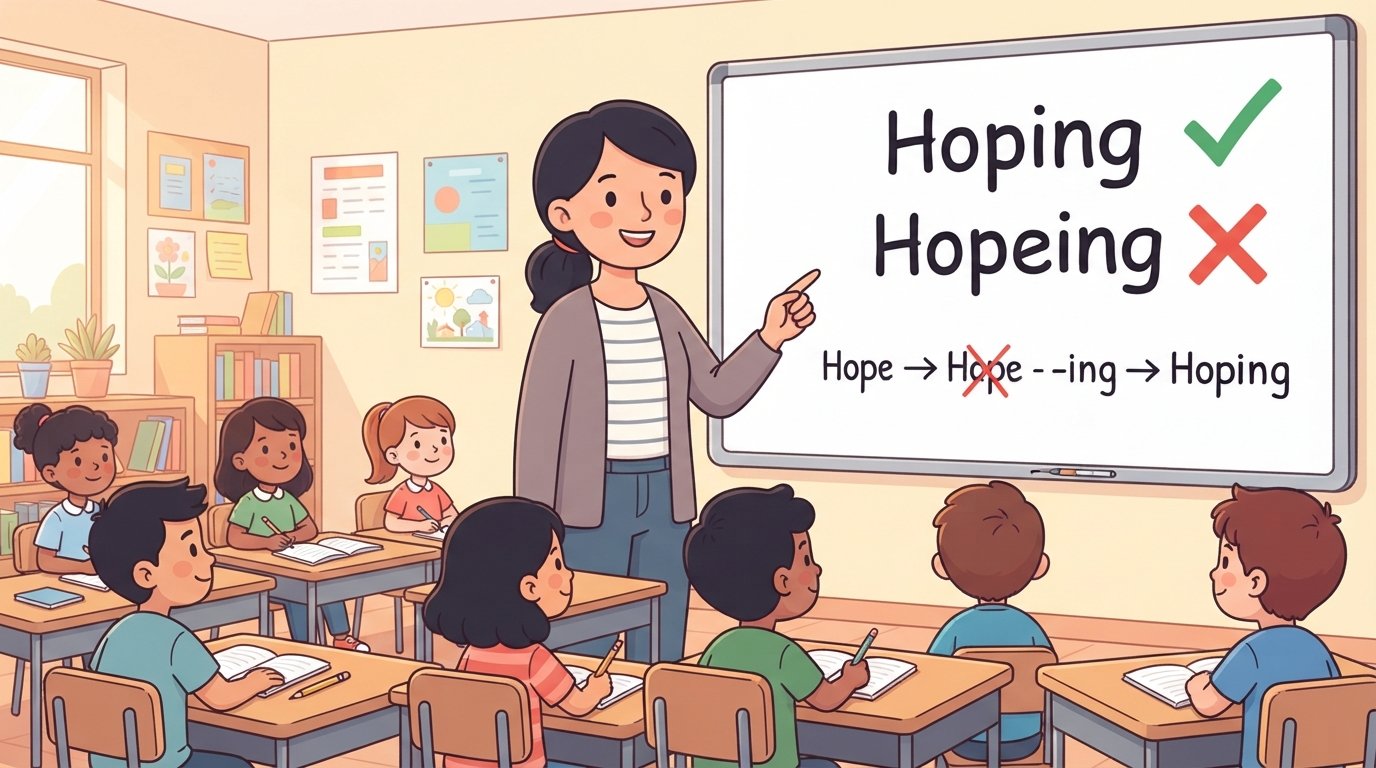
Ever typed out a message, hesitated for a second, and second-guessed whether it’s hopeing or hoping? You’re definitely not the only one. This is one of those spelling questions that trips up English learners and native speakers alike.
If you’ve been searching Hopeing Or Hoping, here’s the quick answer: “hoping” is the correct spelling, and “hopeing” is not. Still, knowing why it’s correct can help you avoid the same slip with other English words.
This guide breaks down the grammar rule behind the spelling, walks through practical examples, points out common mistakes, and helps you use the word confidently in everyday writing.
Getting to the Bottom of Hopeing Or Hoping
Confusion between hopeing and hoping usually comes up when adding the suffix -ing to the verb hope.
The correct form is:
Hoping
The incorrect form is:
Hopeing
What Makes “Hoping” the Right Choice?
English spelling follows a specific pattern when -ing is added to verbs that end in a silent e. In these cases, the silent e is usually dropped before -ing is attached.
Examples:
| Base Verb | + ing Form |
|---|---|
| Hope | Hoping |
| Make | Making |
| Write | Writing |
| Dance | Dancing |
| Smile | Smiling |
Since hope ends with a silent e, the correct change is:
Hope → Hoping
Not:
Hope → Hopeing
The Grammar Rule That Explains Hoping
Dropping the Silent “E”
One of the most reliable spelling rules in English states:
When a verb ends in a silent “e,” drop that “e” before adding “-ing.”
A few more examples that follow this rule: Love → Loving, Move → Moving, Bake → Baking, Share → Sharing, Arrive → Arriving.
Hope follows this exact pattern without exception.
Where the Rule Doesn’t Apply
English is full of exceptions, but hope isn’t one of them. For instance, See → Seeing, Agree → Agreeing. Here, the final e stays put because dropping it would create pronunciation confusion.
Hope, on the other hand, becomes hoping cleanly, making the spelling easy to apply once you understand the rule.
What Does “Hoping” Actually Mean?
Hoping is the present participle and gerund form of the verb hope.
It expresses:
- Wanting something positive to happen
- Looking forward to a favorable outcome
- Feeling optimistic about what’s ahead
Sentences Using Hoping
A few common examples: I am hoping for good weather this weekend. She is hoping to get accepted into her dream university. We are hoping the project finishes on time. They were hoping for better results. He keeps hoping things will improve.
In each case, hoping is the spelling you want.
Why “Hopeing” Shows Up So Often
Knowing the reasons behind the mistake makes it easier to avoid.
1. Spelling by Ear
Many writers spell words the way they sound. Since “hope” carries a clear long-vowel sound, some assume adding -ing should naturally produce hopeing. But English spelling doesn’t always match pronunciation.
2. Mixing It Up With Other Words
Certain words do keep the e before -ing, like:
- Agree → Agreeing
- See → Seeing
Because of these examples, some writers wrongly assume hope should follow the same path.
3. Simple Typing Slips
In emails, texts, and social media posts, people typing quickly often accidentally write hopeing without noticing. Most spell-check tools will catch this error.
Hopeing Or Hoping: A Side-by-Side Look
Here’s a quick comparison that makes the distinction obvious.
| Feature | Hopeing | Hoping |
|---|---|---|
| Correct English spelling | No | Yes |
| Accepted in dictionaries | No | Yes |
| Follows grammar rules | No | Yes |
| Suitable for academic writing | No | Yes |
| Suitable for professional communication | No | Yes |
There’s no contest here — hoping is the only correct form.
Hoping in Real-World Communication
Professional emails: I am hoping to schedule a meeting next week; we are hoping to receive your feedback soon.
Academic writing: researchers are hoping the study will provide new insights; students are hoping for strong exam results.
Casual conversations: I’m hoping everything goes well; she’s hoping to travel next year.
Getting the spelling right keeps your writing looking polished and professional.
Other Words That Follow the Same Pattern
Seeing more examples helps the rule stick.
Silent-E Verbs That Drop the E
These words all lose the final e before -ing is added: Hope → Hoping, Drive → Driving, Live → Living, Save → Saving, Inspire → Inspiring, Achieve → Achieving.
Spotting this pattern makes English spelling feel much more manageable overall.
Easy Ways to Lock In the Correct Spelling
If you keep hesitating over Hopeing Or Hoping, these simple tricks can help.
Apply the Rule
Ask yourself:
Does the word end in a silent “e”?
If the answer is yes, drop the e before adding -ing.
Compare With Familiar Words
Line it up with:
- Hope → Hoping
- Make → Making
- Smile → Smiling
The pattern becomes second nature quickly.
Say It Out Loud
“Hoping” feels natural because it matches standard English spelling conventions. “Hopeing” tends to look off once you’re familiar with the rule.
Mistakes Worth Watching For
Incorrect: I am hopeing everything works out. Correct: I am hoping everything works out.
Incorrect: We are hopeing to visit next month. Correct: We are hoping to visit next month.
Incorrect: She was hopeing for a promotion. Correct: She was hoping for a promotion.
Getting the spelling right boosts your credibility, especially in professional and academic writing.
Why Correct Spelling Actually Matters
Some people brush off small spelling mistakes, but they genuinely shape how readers see your writing.
Correct spelling brings improved clarity, better communication, a stronger professional image, greater academic accuracy, and more reader trust. Whether you’re drafting an email, an essay, a blog post, or a social media update, spelling things correctly shows attention to detail.
Key Takeaways
Hoping is the correct spelling; hopeing is not accepted in standard English. The silent e in hope is dropped before adding -ing, and this rule applies to similar verbs like making, writing, and smiling. Using the correct spelling strengthens the overall quality of your writing.
FAQs About Hopeing Or Hoping
Is “hopeing” an actual word?
No. Hopeing doesn’t appear in standard English dictionaries. The correct form is hoping.
Why do people write “hopeing” instead of “hoping”?
Many assume the base word should stay unchanged when -ing is added, or they’re influenced by how the word sounds and by fast typing habits.
Is “hoping” grammatically correct?
Yes. Hoping is the proper present participle and gerund form of the verb hope.
How is “hoping” used in a sentence?
You could say, “I am hoping to hear from you soon” or “They are hoping for positive results.”
Does every silent-e word drop the e before -ing?
Not every one, but many do — including making, writing, and hoping. A few exceptions, like seeing and agreeing, keep the e.
Which is correct — “hoping for” or “hopeing for”?
Hoping for is correct. Hopeing for is a spelling mistake.
Conclusion
When it comes down to Hopeing Or Hoping, the answer is clear: hoping is the correct spelling, while hopeing simply isn’t. The reason comes down to a well-known English spelling rule that drops a silent e before adding -ing.
Once you understand this rule and practice it with similar words, avoiding this common spelling error becomes second nature. The next time you’re writing an email, an essay, or a social media post, you’ll know exactly which spelling to use — and why it’s correct.


Leave a Reply