

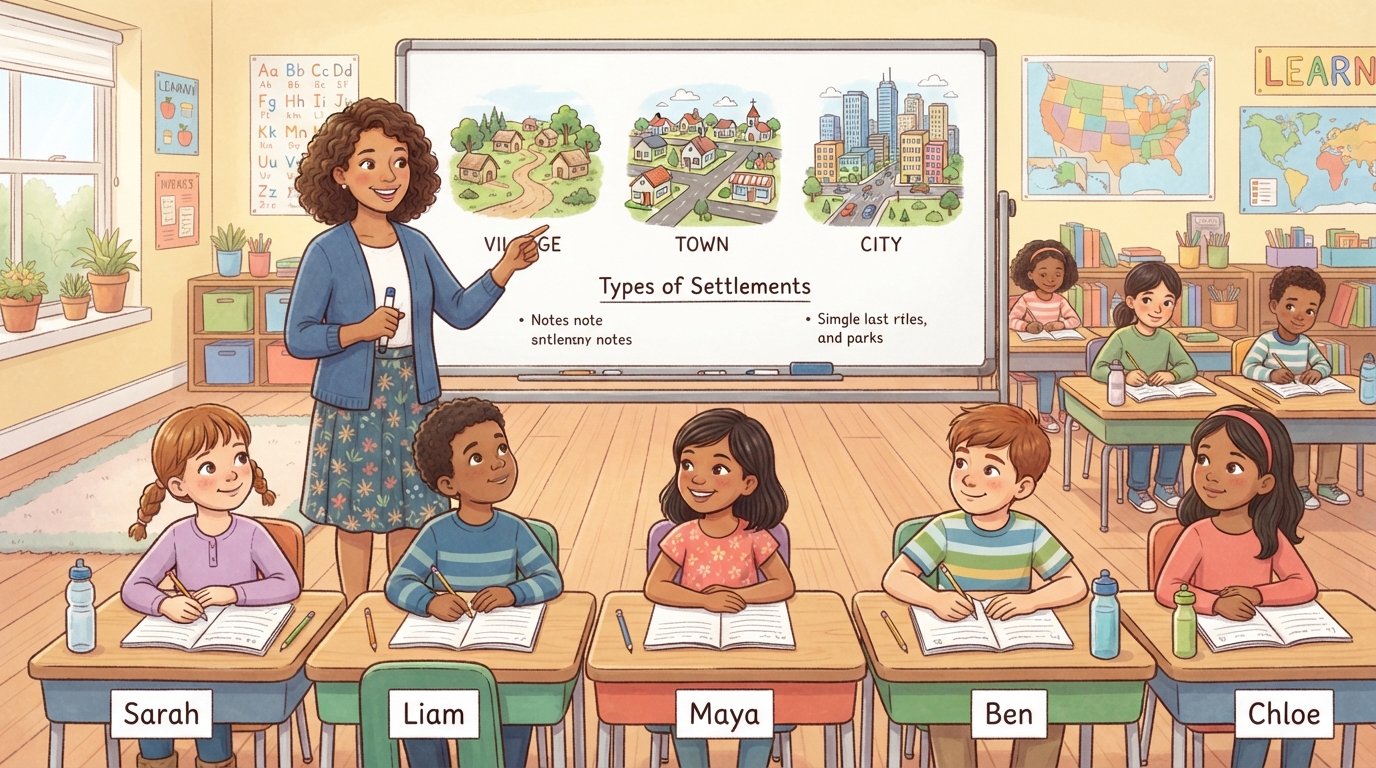
When learning English, many learners often get confused about the difference between city, town, and village. These three words all describe places where people live, but they differ in terms of size, population, government structure, and the kinds of facilities available. A village is generally the smallest and most rural of the three, a town sits somewhere in the middle with its own local government, and a city is the largest and most developed, often serving as a hub for business, culture, and administration. Understanding this simple distinction helps you describe places more accurately, whether you’re writing, traveling, or just having a casual conversation.
Knowing how to tell city vs town vs village apart is useful in everyday English, academic writing, and even legal or governmental contexts, since each term can carry specific meanings depending on the country. With a bit of practice and a few clear examples, you can confidently use each word in the right context. Paying attention to population size, infrastructure, and local governance will make your understanding of these terms much stronger. Over time, learning these distinctions, reviewing real-world examples, and practicing regularly all add up to a clearer picture of how human settlements are classified.
Understanding City vs Town vs Village
At the heart of this comparison is a simple idea: size and function increase as you move from village to town to city.
- A village is a small, rural community, usually the smallest type of settlement.
- A town is a populated area with fixed boundaries and its own local government, larger than a village but smaller than a city.
- A city is a large, important settlement, often with significant population, infrastructure, and administrative power.
Here’s a quick reference table:
| Term | Typical Size | Key Feature | Example |
|---|---|---|---|
| Village | Very small (a few hundred to a few thousand people) | Rural, close-knit community | Castle Combe, England |
| Town | Medium (a few thousand to tens of thousands) | Fixed boundaries, local government | Davos, Switzerland |
| City | Large (tens of thousands to millions) | Major hub for business and culture | New York, London |
Notice how each term reflects a different stage in how a settlement grows, from a small rural community all the way up to a major urban center.
What Exactly Is a Village?
The word village comes from a French term referring to a group of buildings. A village is a small community, usually located in a rural area, where residents typically know one another personally.
Key Features of a Village
- Small population, often ranging from a few dozen to a few thousand residents
- Close-knit social life, with strong community ties
- Limited infrastructure, such as fewer shops, schools, or healthcare facilities
- Primarily agricultural or rural in character
Examples of villages:
- Castle Combe, Wiltshire, England
- Riquewihr, Alsace, France
- Small farming communities across rural regions worldwide
Example sentence:
- “The quiet village had only one small shop and a single church.”
What Exactly Is a Town?
Town comes from an Old English word originally referring to a walled or fenced-in place, such as a farm or courtyard. Today, the word refers to a populated area with fixed boundaries and its own local government.
Key Features of a Town
- Larger population than a village, but smaller than a city
- Defined boundaries and an established local government
- More developed infrastructure, including shops, schools, and healthcare services
- Often serves as a marketplace or administrative center for the surrounding rural area
Examples of towns:
- Davos, Switzerland
- Reading, England
- Fátima, Portugal
Example sentence:
- “The town had a small government office, a marketplace, and several schools.”
Common Expressions Using “Town”
- “Go to town” means to do something wholeheartedly or enthusiastically.
- “A night on the town” refers to an evening spent enjoying entertainment and social activities.
- “The talk of the town” describes something everyone in a community is discussing.
What Exactly Is a City?
According to most standard definitions, a city is an inhabited place of greater size, population, or importance than a town or village. Cities function as economic, cultural, and political hubs, often with extensive infrastructure and a formalized system of governance, typically led by a mayor or city council.
Key Features of a City
- High population density
- Extensive infrastructure, including public transportation, healthcare, and educational institutions
- A wide range of employment opportunities across many industries
- Formal governance structures, such as a mayor or city council
Examples of cities:
- New York City, United States
- London, England
- Tokyo, Japan
Example sentence:
- “The city offered countless job opportunities, along with museums, hospitals, and universities.”
City vs Town vs Village: The Key Differences at a Glance
| Feature | Village | Town | City |
|---|---|---|---|
| Population Size | Smallest | Medium | Largest |
| Governance | Often informal or minimal | Local government with fixed boundaries | Formal government (mayor/council) |
| Infrastructure | Very limited | Moderate | Extensive |
| Economic Activity | Mostly agricultural | Mixed, often a local marketplace | Diverse, includes business and industry |
| Social Life | Close-knit, personal | Balanced community feel | More anonymous, but full of opportunity |
A simple way to remember it:
- Village = smallest and most rural
- Town = medium-sized, with local government
- City = largest and most developed
Why This Distinction Matters
Understanding city vs town vs village is important because these classifications aren’t just casual descriptions — in many countries, they carry legal and administrative significance.
- Definitions vary by country and even by individual states or regions.
- Some places, such as certain U.S. states, allow both “town” and “city” statuses, each with distinct legal implications.
- In the United Kingdom, a settlement’s official status as a “city” is often tied to historical or royal designation, rather than population size alone.
This means that what qualifies as a city in one country might only be classified as a large town in another, so context always plays an important role.
Common Mistakes and How to Avoid Them
Here’s a list of frequent errors related to city vs town vs village:
- Using “city” and “town” interchangeably:
- Incorrect: We visited a small city with only a few thousand residents.
- Correct: We visited a small town with only a few thousand residents.
- Confusing “village” with “town”:
- Incorrect: The village has its own mayor and city council.
- Correct: The town has its own mayor and city council.
- Ignoring regional differences:
- Incorrect: Assuming every country defines these terms the same way.
- Correct: Remembering that legal definitions of city, town, and village vary by country and region.
Tips to avoid these mistakes:
- Consider the population size first.
- Think about whether the place has formal local government.
- Look at the level of infrastructure and services available.
- Remember that legal definitions can vary, so context matters.
Practical Tips for Mastery
Getting comfortable with city vs town vs village takes a bit of practice, but a few strategies can help:
- Think in terms of scale: village is smallest, town is in the middle, city is largest.
- Use a memory trick: “Village is quiet, Town has structure, City has skyscrapers.”
- Study real-world examples: compare well-known villages, towns, and cities to see the differences firsthand.
- Practice descriptive writing: try describing a village, a town, and a city using specific details about population, government, and infrastructure.
A short practice exercise: Fill in the blanks below.
- The small ___ (village/town/city) had only one shop and a single school.
- New York is considered a major ___ (village/town/city) with millions of residents.
- The ___ (village/town/city) had its own mayor and a defined set of boundaries.
- Farmers in the ___ (village/town/city) knew nearly all of their neighbors personally.
Answers: 1) village 2) city 3) town 4) village
Wrapping Up
Understanding the difference between city, town, and village comes down to recognizing scale, governance, and infrastructure. A village is the smallest and most rural type of settlement, a town sits in the middle with its own local government and moderate infrastructure, and a city is the largest, most developed, and most economically significant of the three. By paying attention to population size, governance structures, and available services, you can confidently describe any settlement with accuracy. Practicing with real-world examples and reviewing these distinctions regularly will help you use these terms naturally and correctly in everyday conversation and writing.
Frequently Asked Questions
What’s the main difference between a city, a town, and a village?
A village is a small, rural community; a town is a mid-sized settlement with its own local government; and a city is a large, important settlement with extensive infrastructure and formal governance.
Can a small city ever be smaller than a large town?
Yes, in some cases. Legal definitions vary by country, so a settlement officially classified as a “city” might have a smaller population than a large “town” in another region.
Why do people often mix up these three terms?
Since the terms describe similar things — populated settlements — and their definitions can vary by country, many people use them interchangeably without realizing the distinctions.
Is population size the only factor that determines these classifications?
No. Governance structure, infrastructure, and even historical or legal designation all play a role, in addition to population size.
How can I remember the difference between city, town, and village?
Think about scale and structure: village is the smallest and most rural, town is medium-sized with local government, and city is the largest with the most developed infrastructure.






Leave a Reply