

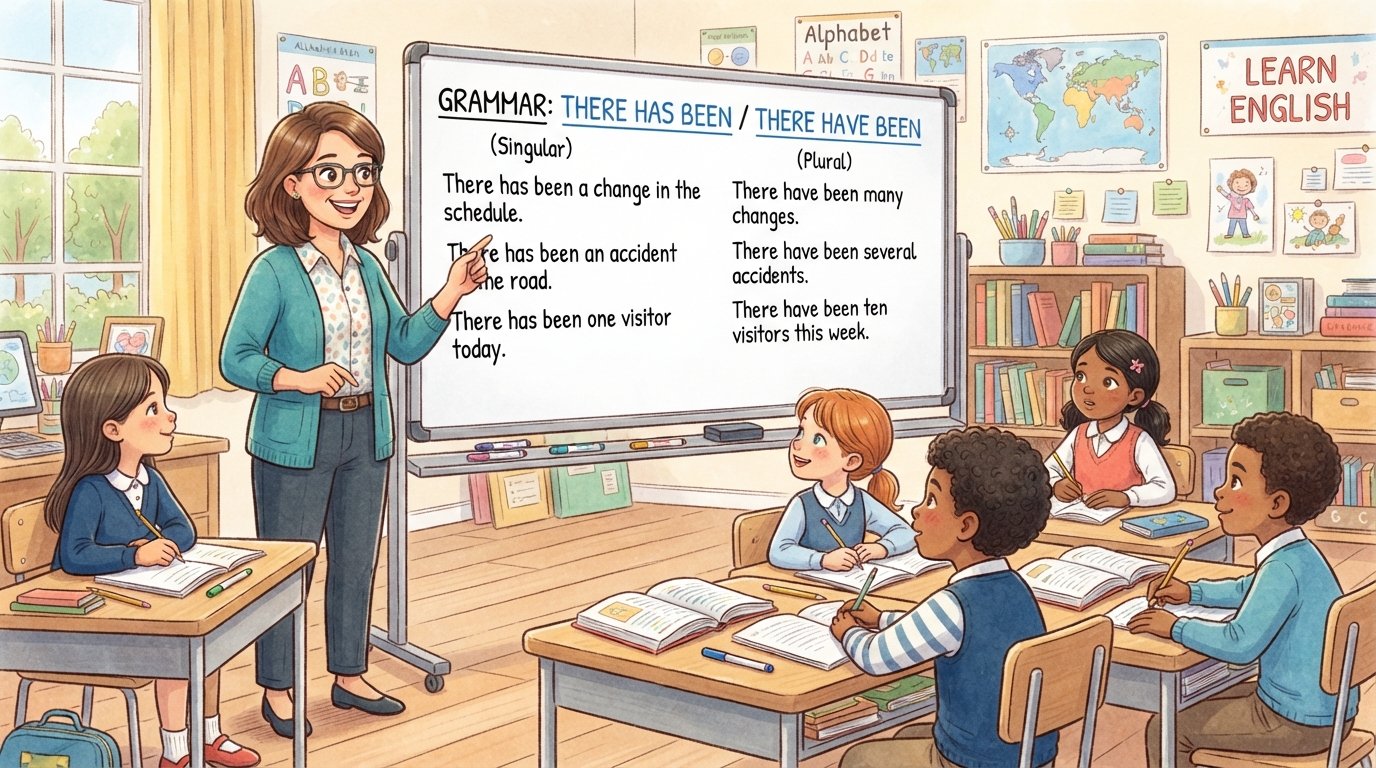
When learning English, many learners often get confused about whether to use there has been or there have been. The correct choice depends on the noun that follows, not on the word “there” itself. For singular or uncountable nouns, we use there has been. For plural nouns, we use there have been. For example, you would say, “There has been an accident,” but you’d say, “There have been several accidents.” Understanding this simple rule makes your English more accurate and confident, helping you avoid one of the more common mistakes learners make with subject-verb agreement.
Knowing the rules behind present perfect tense and subject-verb agreement is genuinely useful here. This distinction can seem tricky at first, since “there” itself isn’t the true subject of the sentence, but with practice and clear examples, you can master it. Always check what comes after “has been” or “have been,” since that noun determines which form is correct. Paying attention to singular and plural nouns, and remembering which verb pairs with which, will make your usage simple, effective, and confident. Over time, understanding this rule, reviewing real examples, and practicing consistently will strengthen your overall grasp of English grammar.
Understanding “There Has Been” vs. “There Have Been”
At the core of this confusion is a simple rule: the verb must agree with the noun that follows “has been” or “have been,” not with the word “there.”
- Has been is used with singular nouns and uncountable nouns.
- Have been is used with plural nouns.
Here’s a quick reference table:
| Following Noun | Correct Form | Example |
|---|---|---|
| Singular noun | there has been | There has been a problem with the printer. |
| Uncountable noun | there has been | There has been some confusion about the plan. |
| Plural noun | there have been | There have been many problems this week. |
Notice how the word “there” itself never changes — it’s always the noun that follows which decides whether “has been” or “have been” is correct.
Why “There” Isn’t the Real Subject
Sentences beginning with “there” can be confusing because “there” looks like the subject, but it isn’t. In these sentences, “there” simply introduces the idea, while the real subject comes right after “has been” or “have been.”
- Incorrect: There has been several complaints about the service.
- Correct: There have been several complaints about the service.
In this example, “complaints” is plural, so the sentence needs “have been,” even though “there” comes first.
When writing, always ask: “What noun comes after has been or have been?” Identify that noun first, then choose the matching verb form.
Using “There Has Been” Correctly
There has been is used with:
- Singular nouns: an accident, a delay, a mistake
- Uncountable nouns: progress, confusion, damage, traffic
Examples in everyday sentences:
- There has been a delay in the flight schedule.
- There has been some progress on the new project.
- There has been a lot of rain this month.
Common contexts where “there has been” appears:
- News reports describing a single event
- Discussions about uncountable concepts like progress or damage
- Formal writing describing one specific situation
These examples show that there has been fits naturally whenever the noun that follows is singular or can’t be counted individually.
Using “There Have Been” Correctly
There have been is used with:
- Plural nouns: accidents, delays, mistakes, changes
Examples:
- There have been several accidents on this road.
- There have been many changes to the schedule.
- There have been numerous complaints about the new policy.
Using “there have been” in questions and negatives:
- Have there been any updates on the project?
- There haven’t been any major issues so far.
Notice that in questions, the word order shifts slightly, but the same agreement rule still applies: check the noun, then choose the correct verb form.
Singular vs. Plural: A Closer Look
Getting comfortable with there has been or there have been really comes down to correctly identifying whether the following noun is singular, uncountable, or plural.
| Noun Type | Example Noun | Correct Form | Example Sentence |
|---|---|---|---|
| Singular | An accident | there has been | There has been an accident on Main Street. |
| Uncountable | Progress | there has been | There has been progress on the negotiations. |
| Plural | Accidents | there have been | There have been accidents on Main Street. |
A simple way to remember it: if you can count more than one of the noun, use “have been.” If you can’t, use “has been.”
Collective Nouns and Special Cases
Just like with other subject-verb agreement rules, collective nouns — like team, group, or committee — can create some ambiguity.
- Singular emphasis: Use has been when the group is treated as one unit.
- There has been a team working on this project for months.
- Plural emphasis: Use have been when referring to multiple distinct items or people.
- There have been several teams competing in the tournament.
Example with events:
- There has been an event scheduled for next week. (one event = singular)
- There have been several events scheduled for next month. (multiple events = plural)
This distinction is subtle, but it matters for clear, professional English.
“There Has Been” and “There Have Been” in Present Perfect Tense
Both phrases belong to the present perfect tense, which describes something that started in the past and still has relevance now, or something that has happened at an unspecified time before now.
Present Perfect with singular/uncountable nouns:
- There has been a change in leadership.
- There has been growing interest in renewable energy.
Present Perfect with plural nouns:
- There have been many changes in leadership over the years.
- There have been growing concerns about renewable energy policies.
| Form | Noun Type | Example |
|---|---|---|
| There has been | Singular/Uncountable | There has been an improvement in sales. |
| There have been | Plural | There have been improvements in sales. |
Notice how the meaning stays almost the same, but the grammar shifts based on whether you’re referring to one thing or several.
Common Mistakes and How to Avoid Them
Here’s a list of frequent errors related to there has been vs. there have been:
- Mismatching singular and plural nouns:
- Incorrect: There has been many changes recently.
- Correct: There have been many changes recently.
- Overlooking uncountable nouns:
- Incorrect: There have been a lot of traffic today.
- Correct: There has been a lot of traffic today.
- Ignoring the real subject in the sentence:
- Incorrect: There has been several reports of theft. (unless “reports” is being treated oddly)
- Correct: There have been several reports of theft.
Tips to avoid mistakes:
- Identify the noun that follows “has been” or “have been” first.
- Remember: singular or uncountable = has been, plural = have been.
- Read sentences aloud; your ear can often catch mistakes your eyes might miss.
Practical Tips for Mastery
Mastering there has been or there have been takes practice, but a few strategies can help:
- Always check the following noun: ask whether it’s singular, uncountable, or plural.
- Use a memory trick: “One thing HAS happened; many things HAVE happened.”
- Practice with real examples: write sentences using different nouns to build familiarity.
- Watch for uncountable nouns: words like traffic, progress, and damage always take “has been,” even though they might feel plural.
Example exercise: Fill in the blanks:
- There ___ (has/have) been a mistake in the report.
- There ___ (has/have) been several mistakes in the report.
- There ___ (has/have) been a lot of noise outside.
- There ___ (has/have) been many complaints this week.
Check answers: 1) has 2) have 3) has 4) have
Wrapping Up
In English, choosing correctly between there has been and there have been depends entirely on the noun that follows, not on the word “there” itself. Remember that singular and uncountable nouns always pair with has been, while plural nouns always pair with have been. By identifying the real subject of the sentence first, paying attention to subject-verb agreement, and practicing with real examples, you can avoid common mistakes, sound more confident, and make your English fluent and natural. Focusing on this small but important piece of grammar ensures that your writing stays clear, accurate, and professional.
Frequently Asked Questions
Is “there has been” always used with singular nouns?
Yes, “there has been” is used with singular nouns and uncountable nouns, such as “there has been an accident” or “there has been progress.”
When should I use “there have been” instead?
Use “there have been” when the following noun is plural, such as “there have been several accidents this month.”
Why do learners often get this wrong?
Many learners mistakenly treat “there” as the subject of the sentence, when in reality, the noun that follows determines whether “has been” or “have been” is correct.
How can I remember the correct usage?
Focus on the noun that comes after “has been” or “have been”: if it’s singular or uncountable, use “has been”; if it’s plural, use “have been.” Practicing with examples helps this rule stick.
Is this rule important for sounding fluent in English?
Yes, using “there has been” and “there have been” correctly is an important part of sounding fluent, confident, and grammatically accurate in everyday English.










Leave a Reply