

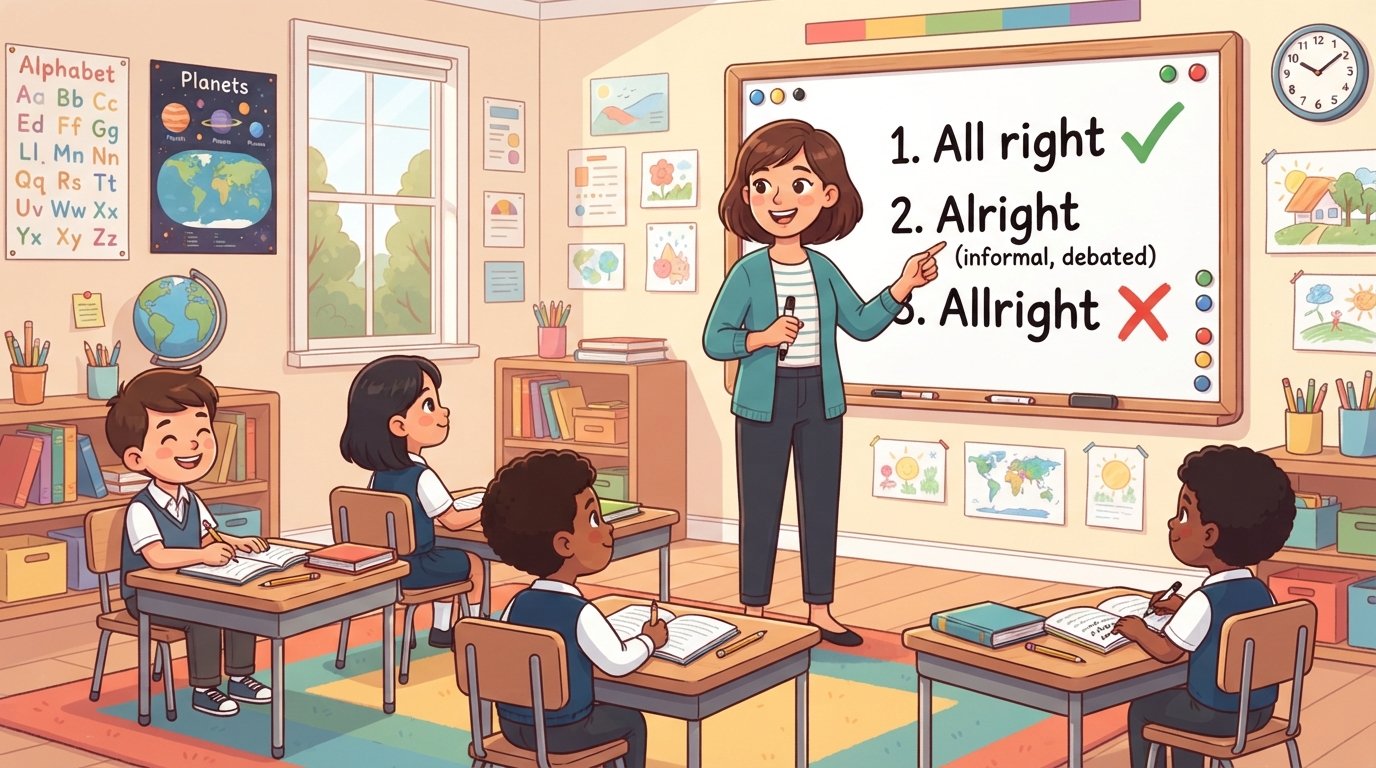
Texting a friend “u alright?” feels perfectly normal, but writing “allright” in the same message would look off to most readers. Alright vs allright isn’t really a fair fight — one is a widely debated but recognized word, and the other is simply a spelling mistake nobody defends.
Alright vs Allright: The Quick Answer
- Alright — A one-word spelling that’s informal but increasingly common in casual writing.
- Allright — Not a recognized word at all; a straightforward misspelling.
- All right — The traditional two-word phrase, considered the only fully “correct” and formal option.
So the real debate in English isn’t “alright vs allright” — it’s “alright vs all right.” “Allright” simply never earned a place in any dictionary.
Quick Comparison
| Form | Status | Best Use |
|---|---|---|
| All right | Standard, always accepted | Formal writing, academic work |
| Alright | Informal, widely used but debated | Casual writing, dialogue, texting |
| Allright | Incorrect spelling | Never — avoid entirely |
Where Did “Alright” Come From?
“Alright” first appeared in written English around 1893, formed by combining “all” and “right” the same way other compound words like “already” and “altogether” were built centuries earlier.
Here’s the key difference: “already” and “altogether” date back to the Middle Ages and are fully accepted, standard English words today. “Alright,” by comparison, is a much newer arrival — and English usage authorities haven’t fully welcomed it the same way.
Why Do “Already” and “Altogether” Get a Pass, But Not “Alright”?
This is where things get interesting. Compare these two-word phrases and their one-word equivalents:
- “We’ve already studied that.” (previously done) vs. “We studied all ready.” (all of us prepared) — different meanings
- “Let’s avoid the situation altogether.” (completely) vs. “Let’s sing all together.” (all of us at once) — different meanings
In these cases, the one-word and two-word versions actually mean different things, which justified both forms existing separately in the dictionary.
“Alright” and “all right,” on the other hand, mean exactly the same thing. That overlap is part of why usage guides like Garner’s Modern American Usage still call “alright” unnecessary — arguing that “all right” already does the job perfectly well.
What Does “All Right” Mean?
“All right” is the traditional, universally accepted two-word phrase. It functions as an adjective, adverb, or affirmative statement.
Examples
- “The answers were all right.” (all correct)
- “I was playing all right until the interruption.” (adequately)
- “All right, let’s get started.” (affirmative, like “okay”)
- “She said she was all right after the fall.” (safe, unharmed)
Major style guides, including those followed in academic and professional writing, treat “all right” as the only fully safe choice — appropriate in every context, from formal essays to casual notes.
What Does “Alright” Mean?
“Alright” carries the exact same meanings as “all right” — it’s simply the condensed, one-word version.
Examples
- “This pizza isn’t my favorite, but it’s alright.”
- “I slipped on the ice, but I’m alright.”
- “Alright, let’s move on to the next topic.”
You’ll see “alright” frequently in:
- Text messages and casual chats
- Song lyrics and dialogue in fiction
- Blogs, social media, and informal articles
- Everyday spoken English
Despite its popularity, most formal style guides still flag it as nonstandard — meaning it’s widely used but not universally accepted in edited, professional writing.
Is “Allright” Ever Correct?
No — never. Unlike “alright,” which at least has dictionary listings and a documented history, “allright” (with double L) has no linguistic standing whatsoever. It’s simply a typo that blends the double L from “all” with an accidental extra letter, or a misremembering of how “alright” is spelled.
Common Mistake Examples
- Incorrect: “Is it allright if I bring a friend?”
- Correct (informal): “Is it alright if I bring a friend?”
- Correct (formal): “Is it all right if I bring a friend?”
If you’ve ever typed “allright,” autocorrect has probably already caught it — and for good reason.
Alright vs Allright vs All Right: Usage Data
Studies analyzing English usage since the 1970s show that “alright” has been steadily climbing in popularity, especially in informal and digital writing. Even so, “all right” is used roughly eight times more often than “alright” in published, edited text. In a well-known American Heritage Dictionary usage survey, roughly two-thirds of language experts rejected “alright” outright, while over 90% accepted “all right” in the same contexts.
“Allright,” meanwhile, doesn’t even register as a measurable variant — it simply isn’t used by careful writers at all.
When Should You Use Each Form?
| Context | Recommended Form |
|---|---|
| Academic papers, essays | All right |
| Business emails, reports | All right |
| Text messages, casual chats | Alright (acceptable) |
| Fiction dialogue | Alright (natural, conversational) |
| Any context | Never “allright” |
A Simple Rule to Remember
If you’re ever unsure, default to “all right.” It’s accepted everywhere, in every register, without exception. Save “alright” for genuinely casual writing where a relaxed tone fits. And simply cross “allright” off your list entirely — it isn’t a word, and it never has been.
FAQs About Alright vs Allright
Is “allright” a word?
No. “Allright” is not recognized in any major dictionary. It’s a common misspelling, often confused with the debated but real word “alright.”
Is “alright” grammatically correct?
It’s debated. “Alright” appears in many dictionaries as an informal variant, but formal style guides still recommend “all right” for professional and academic writing.
What’s the safest option to use in writing?
“All right” is always safe, in any context. “Alright” works fine informally, but “allright” should never be used at all.
Why do “already” and “altogether” get accepted, but not “alright”?
Because “already” and “altogether” carry different meanings from their two-word counterparts, while “alright” and “all right” mean exactly the same thing — making the one-word form feel redundant to many grammar authorities.
Will “alright” eventually become fully standard?
Possibly. Language evolves over time, and “alright” has been gaining ground for decades. For now, though, “all right” remains the safer, more widely accepted choice.
Conclusion
When it comes to alright vs allright, there’s really no contest — “allright” simply isn’t a word and should be avoided entirely. The real, ongoing debate is between “alright” and “all right.” For casual writing, texting, and dialogue, “alright” works fine. For anything formal — essays, reports, professional communication — stick with the traditional two-word “all right.” Either way, leave “allright” out of your vocabulary for good



Leave a Reply