

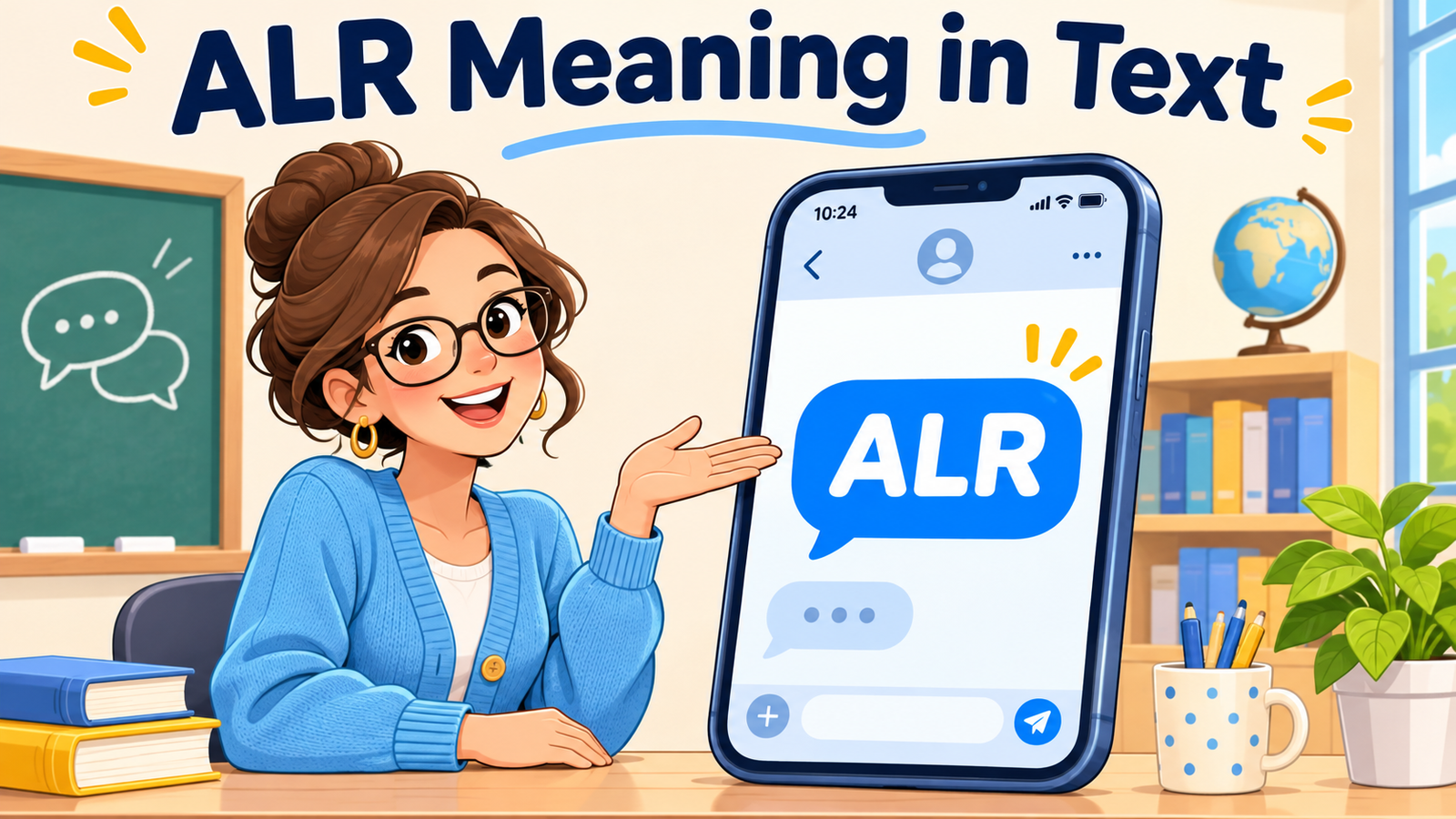
You suggest a different meeting place, and your friend answers with three letters: “alr.” There is no greeting, explanation, or emoji. Should you take it as agreement, annoyance, or simply a quick reply?
ALR usually means “alright” in casual texting. It can acknowledge information, accept a suggestion, or signal that someone is ready to move on. The basic meaning is simple, but the surrounding conversation tells you what the person is agreeing to.
What Does ALR Stand For?
ALR is a shortened written form of alright. It is informal shorthand rather than a word you would normally use in an essay. Depending on the sentence, a natural replacement might be okay, understood, fine, or sure.
Try replacing it in the message before interpreting the tone. “Alr, send the address” becomes “Alright, send the address.” That makes sense as a practical request. There is no need to search for a hidden meaning when the ordinary reading fits.
ALR in Everyday Conversation
Imagine this exchange: “The library entrance is closed. Use the side door.” — “Alr, thanks for telling me.” Here, the sender acknowledges an update. They are not expressing a strong opinion about the situation; they are showing that they received the instruction.
Now compare: “Would you like to practice together tomorrow?” — “Alr, I can do lunchtime.” In this example, ALR introduces acceptance, and the rest of the sentence supplies the useful detail. The same abbreviation performs a slightly different job because the previous message asks a question.
Does ALR Sound Rude or Dry?
A short reply can feel distant when you expected enthusiasm, but brevity alone does not establish irritation. Someone carrying shopping bags might send the same three letters that they would normally expand into a friendly sentence. Their usual texting habits matter.
Look at the whole exchange before deciding. If you shared something upsetting and received only “alr,” it may feel unsupportive because it does not address your feelings. You can say, “I was hoping to talk about it a little more.” This names the communication problem without claiming to know the sender’s mood.
How to Reply to ALR
When ALR finishes a practical exchange, another reply may be unnecessary. If you already agreed on a time and place, you can simply follow the plan. Messaging does not require an endless sequence of acknowledgments after every detail has been settled.
If a detail remains open, ask about it: “Great, which entrance should I use?” When you are unsure whether the person agreed, confirm directly: “Just checking—does Saturday afternoon work?” A precise question is more useful than replying with another abbreviation that leaves the same uncertainty.
ALR, OK, and All Right
OK and ALR can serve similar purposes, but OK is easier for a broad audience to recognize. All right is the conventional two-word spelling, especially useful in careful writing. Alright is common in informal writing, while ALR is another step toward conversational shorthand.
Consider three versions of one reply: “Alr, I’ll check”; “Okay, I’ll check”; and “All right, I’ll review the figures this afternoon.” The final version gives a clearer commitment. Choose according to the recipient and the information they need, rather than assuming that the shortest wording is always best.
Does Capitalization Change the Meaning?
ALR and alr normally represent the same shorthand. One person may type in capitals because they treat abbreviations that way, while another uses lowercase for nearly everything. Capitalization alone is a weak guide to emotion.
Punctuation and extra words can shape a reader’s impression, but they are not a fixed code. “Alr!” may look enthusiastic and “alr…” may look hesitant, yet both still require context. If the stakes are important, ask a real question instead of trying to decode a period or an ellipsis.
When to Write the Full Phrase
Use complete wording when communicating with someone who may not know your shorthand. For a teacher, customer, or new colleague, “Understood, I’ll send the document tomorrow” explains both your acknowledgment and your next action.
ALR also makes a poor substitute for a thoughtful response to a serious message. If a friend describes a difficult day, a question such as “Do you want to talk about what happened?” is more helpful. Matching the emotional purpose of the conversation matters as much as knowing the abbreviation.
Practice Reading ALR in Context
In “Alr, I’ll bring the spare charger,” the sender accepts responsibility for bringing an item. A suitable reply is “Thanks—that would help.” The extra clause gives you more information than the shorthand itself.
In “You alr?” the writer may be asking whether you are all right. A natural answer might be “Yes, just tired after the trip.” This is a useful reminder to read the sentence structure: ALR is not always a standalone agreement.
Frequently Asked Questions
What does ALR mean in a text message?
It usually means alright, functioning as an informal acknowledgment or agreement.
Is ALR an angry reply?
Not necessarily. The prior messages, the person’s habits, and the situation are better clues than three letters alone.
Can I answer ALR with nothing?
Yes, if the conversation is already complete and there is no question or remaining detail to address.
Does ALR mean the same thing from everyone?
The usual expansion stays the same, but the purpose and tone depend on the individual conversation.
Can I use ALR in a work email?
Complete wording is clearer, especially with unfamiliar recipients or when you need to confirm a task.
What does you alr mean?
It can mean are you all right, asking about your well-being rather than agreeing to a plan.
Conclusion
ALR is a quick way of writing alright, but a useful interpretation goes beyond expanding the letters. Check whether the sender is accepting a plan, acknowledging information, or asking whether you are okay.
Reply to that purpose. Confirm missing details, offer support when needed, and let a finished conversation end naturally. Clear communication is more useful than assuming every short reply carries a hidden emotion.








Leave a Reply