

You ask a friend whether to meet at the café or the park, and they reply “idc.” They might mean either option works. The same reply after you explain something upsetting would feel quite different. Understanding the letters is easy; understanding the tone takes more context.
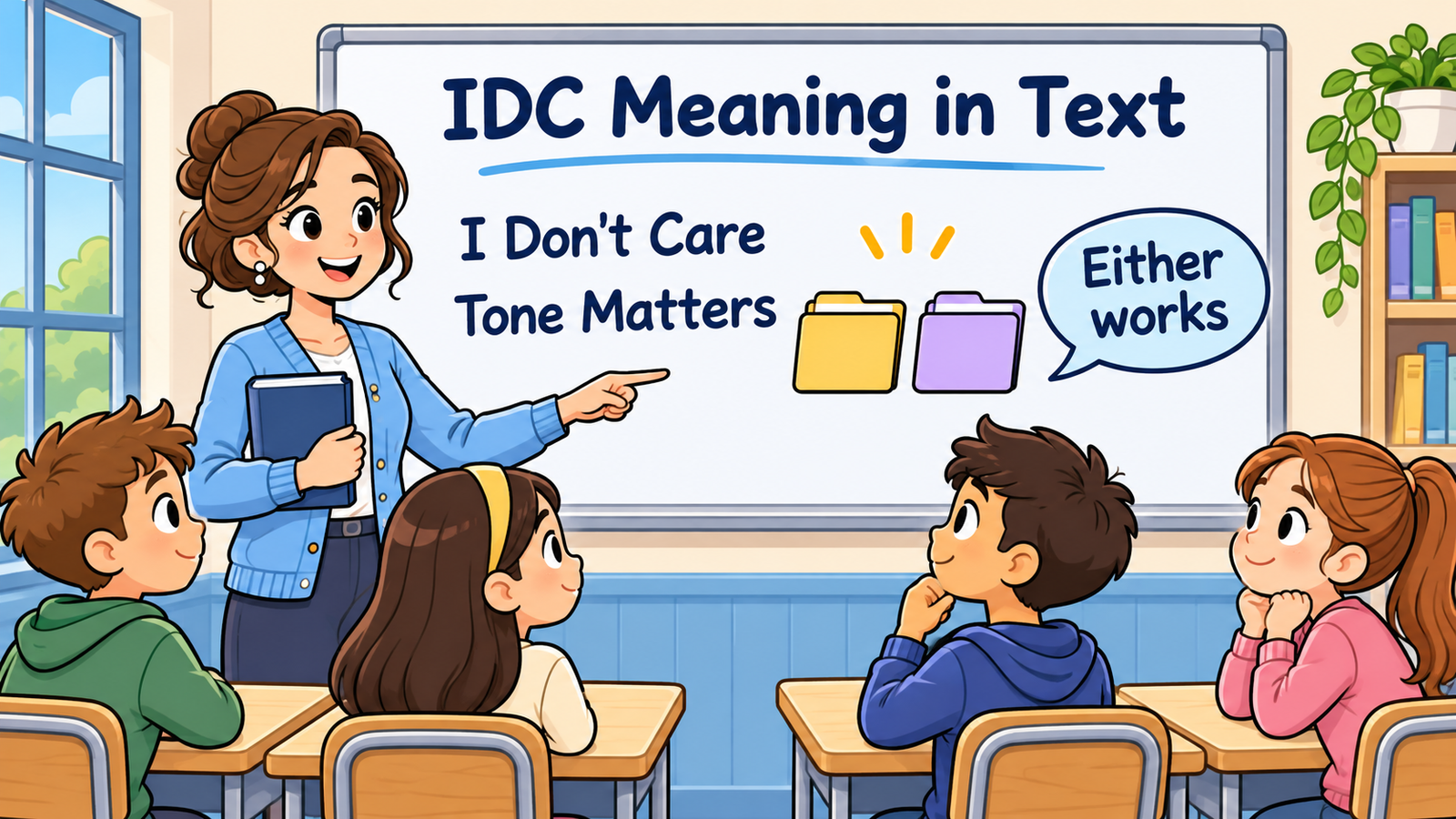
The IDC meaning in text is “I don’t care.” It can express a lack of preference, a lack of interest, or a dismissive attitude. The message’s subject and the words around it help you distinguish those possibilities.
What Does IDC Stand For?
IDC uses the initial letters of I don’t care. It is informal shorthand, usually suited to casual conversation rather than a carefully worded professional message. Both uppercase IDC and lowercase idc can represent the same phrase.
The important question is what the person says they do not care about. A choice of snack is different from another person’s feelings. Do not expand the phrase into a broader judgment than the message actually supports.
| Message | Plausible meaning |
|---|---|
| “Tea or coffee?” — “IDC, either works.” | No preference between the options |
| “IDC about that show.” | Lack of interest in a subject |
| “IDC what people think of my shoes.” | Other people’s opinions will not guide the choice |
| “I’m upset about this.” — “IDC.” | A potentially dismissive response |
IDC When Someone Has No Preference
In a low-stakes choice, the sender may simply be flexible. “IDC which table we use” can mean either table is acceptable. That does not necessarily indicate boredom with the activity or a lack of interest in the people involved.
You can confirm the choice and move ahead: “Okay, let’s use the one by the window.” If the choice matters more than the sender realizes, mention the relevant difference. A clear decision is more useful than debating the shorthand when there is no sign of conflict.
IDC When Someone Is Uninterested
The phrase can also communicate that a topic does not interest the sender. “IDC about the rankings” may mean they do not want to follow that discussion. It is a statement about a subject, not necessarily about their willingness to talk at all.
A natural reply could change the topic: “Fair enough—how did your project go?” If you need their input for a shared task, explain the practical reason instead. “We need to choose an entry, so could you help compare these two?” makes the request more concrete.
Why IDC Can Sound Dismissive
A blunt response can feel hurtful when someone has shared a concern or asked for consideration. The abbreviation gives little room for reassurance, so the recipient may hear rejection even when the sender intended something narrower.
Compare “IDC which route we take” with “IDC that you’re worried.” The first concerns a choice. The second dismisses a feeling. The complete wording reveals a clearer difference than any rule claiming the abbreviation is always harmless or always rude.
IDC About Opinions or Criticism
Someone may use the phrase to say they are not letting other people’s opinions determine a decision. “IDC if everyone else prefers the other color” could express confidence in a personal choice. It does not automatically mean the person rejects all advice.
If you are replying, focus on the actual issue. “Then choose the color you like” may fit a harmless preference. For a shared decision, explain why others’ needs matter instead of treating independence as either automatically admirable or automatically selfish.
How to Reply to IDC
Match the response to the situation. If the message means no preference, choose an option or ask whether there are any constraints. If it dismisses something important, explain the specific point that needs attention.
You can clarify tone without accusing the sender of a hidden motive. “Do you mean either option is fine?” checks an ordinary choice. “Are you saying you don’t want to discuss this?” checks whether a conversation has reached a boundary.
| Situation | Possible reply |
|---|---|
| Choosing between two plans | “Okay, I’ll choose the earlier time.” |
| Unclear preference | “So either option works for you?” |
| A topic they do not enjoy | “No problem; let’s talk about something else.” |
| A shared decision still needs input | “I need to know what you can actually attend.” |
| A response that feels dismissive | “This matters to me. Can we discuss it respectfully?” |
IDC vs IDM
IDM means I don’t mind. In many everyday choices, it emphasizes acceptance or the absence of an objection, while IDC can emphasize a lack of concern. Their practical answers may overlap, but the tone can differ.
If a friend asks to change a meeting time, “IDM, the later time works” sounds more clearly accommodating than a bare IDC. Adding the actual acceptable time is even better because it confirms the arrangement rather than relying entirely on tone.
IDC vs IDK
IDK means I don’t know, which describes missing knowledge. IDC describes a lack of concern or preference. Confusing the two can make an uncertain answer sound much more dismissive than the writer intended.
For example, “IDK which room we’re using” means the sender does not have the information. “IDC which room we use” means the choice does not matter to them. If your own message contains the wrong abbreviation, correct it directly rather than hoping the reader infers the intended one.
Original Chat Examples
These examples show how a few additional words can clarify the intended scope. They are sample exchanges written for this guide, not fixed scripts. Adapt the wording to the person and the decision involved.
The clearest messages identify both the area of flexibility and any important limit. Saying you have no preference about one part of a plan does not mean you are available for every possible version of that plan.
- “IDC which film, but I need to leave by nine.”
- “IDC about matching colors; use whichever folder is available.”
- “IDC who presents first. I’m ready either way.”
- “IDC about that rumor. I’d rather discuss the assignment.”
- “Either café is fine. Could we choose one near the station?”
The final example communicates flexibility without the abbreviation. It also adds a useful preference, showing that a cooperative answer can be more detailed than a simple yes or no.
Capital Letters, Punctuation, and Emojis
Capitalization may contribute emphasis, but it does not prove anger. Some people capitalize all abbreviations, while others type every message in lowercase. An emoji may soften the appearance of a reply without resolving the underlying question.
If you need to know whether someone agrees to a plan, a smiling face after IDC is less useful than an explicit confirmation. Look for words that answer the question. Do not treat punctuation as a precise code for someone’s emotional state.
Warmer Alternatives to IDC
For a choice, try “Either works for me” or “You can choose.” For a topic you do not follow, “I don’t have a strong opinion on that” is clear without sounding as abrupt. For a boundary, “I’d rather not discuss this” states the limit directly.
Choose the alternative that expresses your real intention. “Either works” is not appropriate if one option creates a problem for you. Being polite does not require pretending you have no preference; it requires communicating the preference clearly enough for the other person to understand.
Using IDC in Work or Group Messages
A short reply can be read by people who do not know your usual tone. In a group planning discussion, IDC may leave everyone unsure whether you are flexible, disengaged, or asking someone else to take responsibility.
Write the useful detail instead: “Both dates work for me” or “I have no preference about the layout.” These sentences preserve the practical meaning while making the scope explicit. They are easier for others to act on and less likely to create unnecessary friction.
FAQs About IDC Meaning in Text
What does IDC mean in a message?
It means I don’t care. Depending on the context, it may express no preference, lack of interest, or a dismissive attitude. Read what the person is referring to before deciding how to respond.
Is IDC always rude?
No. It can be a casual way to say either option is acceptable. However, it may sound dismissive when someone is sharing a concern or asking for thoughtful input. The surrounding conversation matters.
Does IDC mean the same thing as IDM?
Their meanings can overlap in a choice, but IDM means I don’t mind. It often communicates acceptance more gently. IDC can sound stronger because it directly states a lack of concern.
What should I reply if someone says IDC?
Confirm the choice if the person has no preference. If the reply is ambiguous, ask what they mean. If something important is being dismissed, explain the specific issue you need to discuss.
Can I use IDC in a professional message?
It is usually clearer to write “I have no preference” or name the options that work for you. That wording communicates flexibility without requiring colleagues to guess your tone.
Conclusion
The IDC meaning in text is straightforward, but its effect depends on what the sender is discussing. Having no preference about a plan is different from dismissing a person’s concern.
Read the full message, clarify the scope when needed, and choose wording that expresses your actual intention. A few extra words can preserve a relaxed tone while making the conversation much easier to understand.








Leave a Reply