

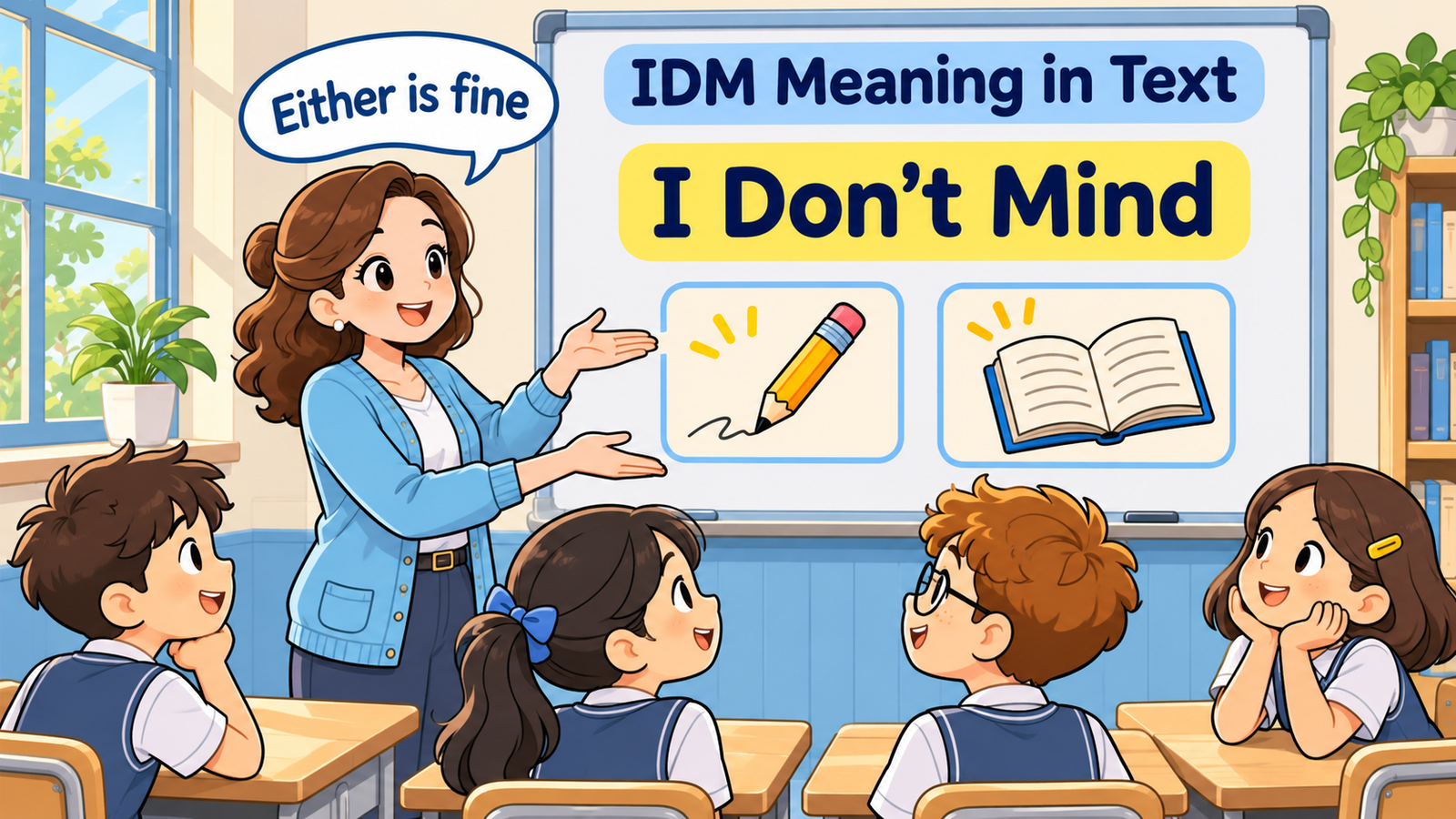
You ask whether to meet indoors or outside, and your friend replies “idm.” The answer may look vague if you have not seen it before, but it usually communicates flexibility. They are telling you the proposed choice is not a problem for them.
The IDM meaning in text is “I don’t mind.” In everyday chat, it can mean the sender has no objection, accepts a suggestion, or has no strong preference between options. Read the question it answers to understand exactly what they are comfortable with.
What Does IDM Stand For?
IDM represents the initial letters of I don’t mind. It is casual shorthand rather than a complete explanation of someone’s preferences. A person might use it to accept a small change or let someone else choose between equally acceptable options.
The phrase is usually limited to the matter under discussion. “IDM sitting outside” does not say anything about every other part of the plan. Understanding the scope prevents a flexible response from being interpreted more broadly than the sender intended.
| Question or message | Reply | Likely interpretation |
|---|---|---|
| “Can we meet a little later?” | “IDM, six works.” | The later time is acceptable. |
| “Which color should we use?” | “IDM, either is fine.” | No strong preference between the options. |
| “Would you mind checking this?” | “IDM checking it.” | The sender is willing to help. |
| “Do you listen to IDM?” | A music-related answer | The letters probably name a music genre. |
IDM as No Objection
When someone proposes a change, the abbreviation can say the change is acceptable. “IDM moving to the other room” indicates that the sender does not object to the move. It does not necessarily express excitement, but it can still be a clear cooperative response.
If you are organizing the arrangement, acknowledge it and confirm the new detail. “Thanks—we’ll use the room upstairs” makes the plan explicit. That is more useful than repeatedly asking whether the person is truly happy when they have already given a straightforward answer.
IDM When Either Option Works
A choice-related reply may indicate that the sender considers both options acceptable. If you ask whether to use blue or green paper, “IDM” can leave the decision to you. The person may be flexible rather than uninterested in the project.
Still, practical constraints can matter. “IDM which café, as long as it is near the station” gives you freedom within a limit. If you are the sender, adding that limit helps the other person choose without accidentally creating a problem.
Answering Do You Mind Questions
Questions involving mind can confuse learners because the response describes an objection rather than the proposed action itself. “Do you mind if I open the window?” asks whether opening it would bother the listener. “I don’t mind” means it would not be a problem.
For maximum clarity, add a short confirmation: “IDM—go ahead.” If you do object, state the reason directly: “I’d rather keep it closed because the room is cold.” A complete sentence avoids uncertainty about what yes or no refers to.
Does IDM Mean an Enthusiastic Yes?
Not necessarily. Acceptance and enthusiasm are different. Someone can be comfortable with a suggestion without being especially excited about it, and that is often enough for an ordinary shared decision.
If the distinction matters, ask about the preference rather than inventing one. “Would you actually enjoy this, or would you prefer another activity?” can be appropriate when planning a special occasion. For a routine choice of stationery, that level of clarification may be unnecessary.
IDM vs IDC
IDC means I don’t care. In some choices, both abbreviations can lead to the same practical result: the other person may choose. The wording differs because IDM focuses on a lack of objection, while IDC can suggest a lack of concern.
Compare “IDM waiting ten minutes” with “IDC.” The first identifies something the sender accepts. The second may sound less clear or more abrupt. Adding the actual acceptable option often matters more than choosing the supposedly perfect abbreviation.
IDM vs IDK
IDK means I don’t know. It indicates missing information, not acceptance. If someone asks which classroom is booked, IDK means you do not have the answer. IDM would instead suggest that you do not object to a choice, which may not answer the question at all.
You can combine the ideas in a full sentence when necessary: “I don’t know which room is booked, but either one works for me.” This distinguishes knowledge from preference and gives the reader more useful information than a single three-letter reply.
How to Reply to IDM
If the other person has accepted a clear proposal, acknowledge it and proceed with that proposal. “Great, let’s meet at six” confirms the arrangement. If they have offered help, thank them and provide the information they need.
If the reply does not answer an essential question, ask the remaining one. “Thanks—are you available on Thursday?” distinguishes willingness from availability. Someone can be happy to help in principle while still being unable to do it at a particular time.
| Situation | Natural reply |
|---|---|
| Accepting a time change | “Thanks, I’ll confirm six o’clock.” |
| Letting you choose a color | “Let’s use blue, then.” |
| Agreeing to review a paragraph | “I appreciate it. I’ll send the draft.” |
| Unclear availability | “Would tomorrow afternoon work?” |
| A possible misunderstanding | “Just checking—you are okay with the new venue?” |
Original Examples for Everyday Chat
The clearest examples name the action or choice being accepted. This keeps the abbreviation from carrying more meaning than it actually contains. A short clarification can make a casual message both friendly and precise.
Use these as patterns rather than fixed scripts. The useful details will differ depending on whether you are making plans, dividing work, or responding to a small request from a friend.
- “IDM taking the later train; I’ll bring a book.”
- “IDM which design we use, but the heading needs to be readable.”
- “IDM helping with the display after lunch.”
- “IDM if you borrow the notebook. Please return it tomorrow.”
- “IDM staying indoors if the weather changes.”
Does IDM Have Other Meanings?
Yes. In music discussions, IDM can stand for intelligent dance music, a label associated with electronic music. A message about an IDM album or playlist is therefore different from a reply accepting a plan.
Organizations and products can also use the same letters as names or abbreviations. Instead of guessing from a long list, look for the subject of the sentence. If “I don’t mind” does not make grammatical or practical sense, ask what the sender means.
Does the Meaning Change Across Apps?
The ordinary chat expansion does not automatically change between WhatsApp, Snapchat, Instagram, or another service. A reply to a proposed plan can mean the same thing across those platforms. A music discussion can use the genre meaning on any of them.
What changes is the conversation, not necessarily the definition. A group may have its own shorthand, and a screenshot may omit the question being answered. Read enough of the exchange to identify the relevant context before deciding the meaning.
Clearer Alternatives for Formal Messages
In a work message, “That time works for me” or “I have no objection to the change” is easier to interpret. If you are volunteering, “I can review the draft tomorrow” adds a useful commitment that IDM alone does not supply.
Avoid writing that you do not mind when you actually need a different arrangement. A respectful preference is still a preference: “I can do Friday, but Thursday would be difficult.” Clear limits help people plan more effectively than reluctant flexibility expressed through shorthand.
FAQs About IDM Meaning in Text
What does IDM mean in a text message?
It usually means I don’t mind in ordinary conversation. It can accept a suggestion, express no objection, or indicate flexibility between options. The preceding question identifies what the sender is accepting.
Is IDM a yes or a no?
It means the person has no objection, which often allows the proposed action to go ahead. With “Do you mind?” questions, adding “go ahead” or naming the accepted action makes the answer clearer.
Is IDM more polite than IDC?
It often sounds more accommodating, but tone still depends on the complete message. Naming the acceptable option is clearer than relying on either abbreviation to communicate your entire attitude.
Does IDM mean the person is uninterested?
Not necessarily. They may simply be flexible. If you need to know their actual preference, ask directly rather than treating a lack of objection as proof of boredom or disengagement.
What does IDM mean in a playlist description?
It may refer to intelligent dance music. The album, artist, or genre discussion provides the clue. That meaning is separate from the everyday reply I don’t mind.
Conclusion
The IDM meaning in text is usually an easygoing acceptance: the sender does not object or has no strong preference about the matter being discussed. It does not automatically reveal enthusiasm, availability, or agreement to unrelated conditions.
Read the question, confirm the practical detail, and add your own limits when needed. A flexible response works best when both people understand exactly what has been accepted.








Leave a Reply