

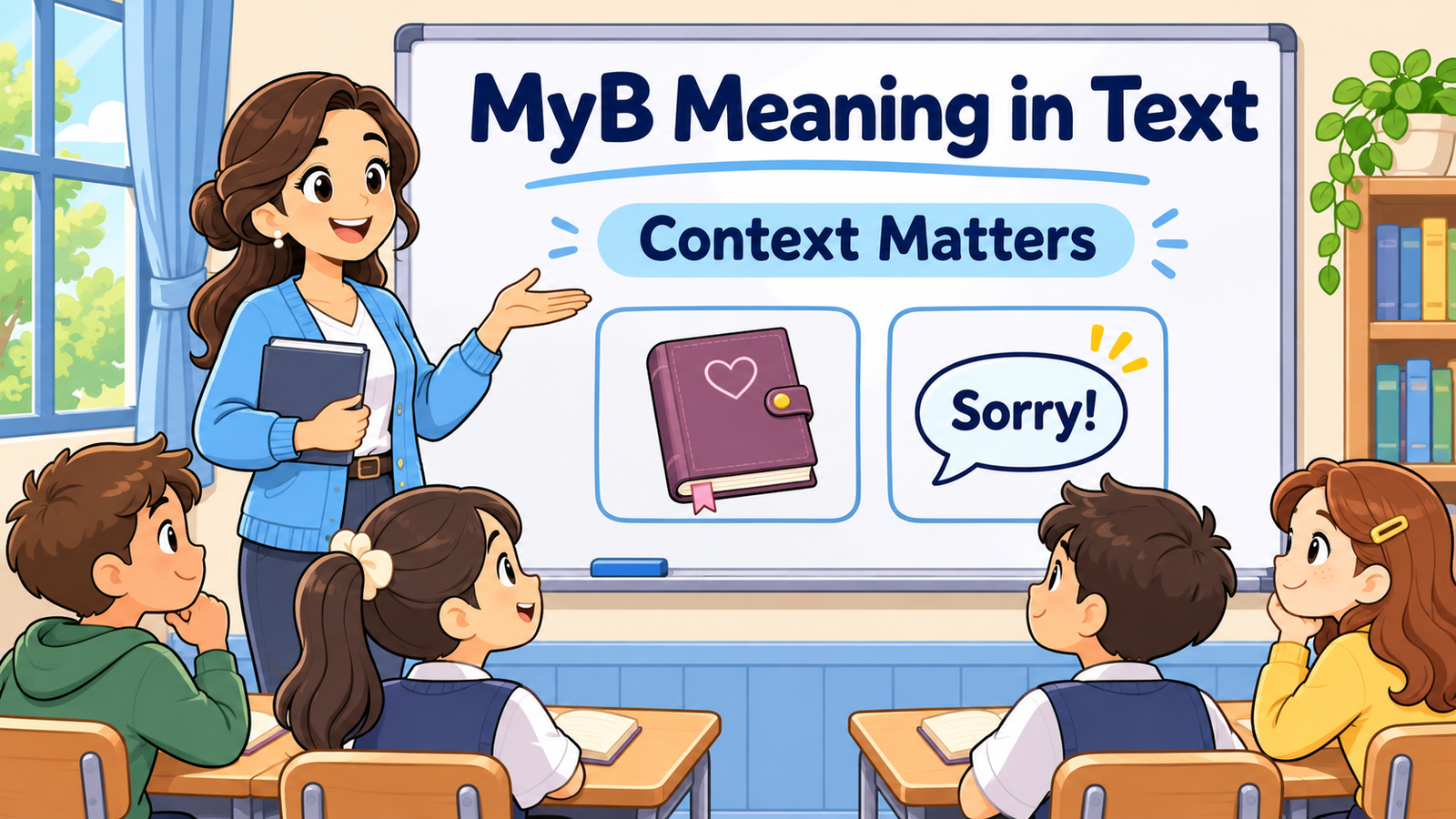
A friend asks about a private plan and receives “MYB.” Someone else types “my b” after sending the wrong address. Those messages look similar, but treating them as the same reply could turn a small apology into an unnecessary argument.
The MyB meaning in text often points to “mind your business.” However, the spaced expression “my b” commonly represents “my bad,” and a sender may type it without the space. Read the sentence and the previous message before deciding whether the person is setting a boundary or admitting a mistake.
What Does MYB Stand For?
As an initialism, MYB can represent mind your business. It tells another person that the subject is private or that their involvement is not wanted. The wording can be teasing between friends, but it can also sound blunt.
“My b” works differently. It shortens my bad, an informal acknowledgment of a mistake. Capitalization alone cannot reliably separate the meanings because people do not follow one consistent spelling system in casual messages.
| Message | Likely interpretation |
|---|---|
| “How much did that gift cost?” — “MYB.” | Mind your business |
| “My b, I attached the old version.” | My bad |
| “That detail is private. MYB.” | A direct privacy boundary |
| “myb” with no surrounding conversation | Ask for context |
MYB as Mind Your Business
This reading fits a response to a personal question, unwanted advice, or a comment the sender considers intrusive. For example, someone asking about another person’s income may receive a short refusal instead of an explanation.
The practical message is that the person does not want to share that information. You can respect the boundary without agreeing that every question was inappropriate. “Understood, we can leave it there” keeps the exchange from becoming a debate over private details.
My B as My Bad
After an obvious error, my b is more likely to be a casual apology. “My b, I meant the west entrance” admits that the original directions were wrong. The correction supplies the strongest clue about the meaning.
A useful reply acknowledges the correction: “No problem, I’ll meet you there.” For a mistake with real consequences, the apology may need a practical next step. You can ask for the corrected document or confirmed time without arguing about the abbreviation.
How the Previous Message Changes the Meaning
Start by identifying what prompted the reply. Was someone asked to explain a personal matter, or were they told that they had made an error? Those situations support different interpretations even when the letters are identical.
Consider “You sent this to the wrong group.” A reply of “myb, deleting it now” makes sense as an apology. After “Tell me what your sister said privately,” the same letters may instead tell the questioner to stop asking. The surrounding action does more interpretive work than the spelling.
Is MYB Rude or Playful?
Mind your business can sound dismissive because it directly rejects a question or involvement. Close friends sometimes use that bluntness as a joke, especially when keeping a harmless surprise secret. Familiarity can help explain the intention, but it does not guarantee the recipient enjoys it.
A laughing emoji may suggest teasing, yet it is not proof that the subject is open for discussion. If someone declines to answer, repeatedly pushing for the information can miss the boundary even when the first refusal looked lighthearted.
How to Reply Without Making Things Awkward
When the meaning is a privacy request, a short acknowledgment is usually enough. “Fair enough” or “No need to share” allows the conversation to move on. You do not have to supply a clever comeback to every brief response.
When the meaning is an apology, respond to the problem that was corrected. “Thanks for fixing it” fits a revised file; “Got it, see you at seven” fits a corrected meeting time. If neither reading fits, ask which phrase the sender intended.
| Situation | Natural reply |
|---|---|
| Someone keeps a detail private | “Okay, we can change the subject.” |
| A friend corrects a small mistake | “No worries, thanks for clarifying.” |
| You cannot identify the meaning | “Do you mean my bad or mind your business?” |
| A shared task still needs information | “I only need the delivery time, not the private details.” |
MYB vs MYOB
MYOB expands to mind your own business. The extra O represents own, but both expressions can ask someone to stop interfering. Neither abbreviation automatically tells you how serious or friendly the sender feels.
For your own writing, the longer phrase may be easier to recognize, although it is still blunt. If your goal is simply to protect a private matter, “I’d rather keep that personal” communicates the boundary more clearly and often more gently.
MYB, MB, and Maybe
MB and my b can both be used for my bad in informal conversation. That does not make every appearance of those letters an apology: abbreviations also belong to technical discussions, names, and other contexts. The sentence still matters.
Do not assume that myb always means maybe, either. A sender might use an unusual shortening or make a typing error, but that is not a dependable rule. If someone replies “myb” to an invitation, ask whether they mean they are unsure about attending.
Does MYB Change Across Messaging Apps?
The app does not assign the letters a single definition. A personal question on Instagram, an apology on WhatsApp, and a correction in a Snapchat chat can all contain similar shorthand. The words being exchanged determine the likely meaning.
Also consider what is missing from a screenshot. If you see only the final reply, you may not know whether it followed a mistake or a private question. Avoid making a judgment about the sender from a cropped message alone.
Original Examples for Everyday Conversations
These examples show how extra words make an informal reply easier to understand. Each example identifies a situation rather than treating the abbreviation as a complete explanation of someone’s feelings.
Notice that the clearest apology supplies a correction, while the clearest boundary names what will remain private. You can use those principles even if you choose to write everything in full.
- “My b, I sent the draft instead of the final copy.”
- “That conversation was private, so please MYB.”
- “My b—the table is booked for Saturday, not Sunday.”
- “It’s a surprise. You’ll find out at the party.”
- “I’d rather not discuss the price, but I’m happy with the purchase.”
Better Wording for Important Messages
For an apology, “Sorry, that was my mistake” is easier to understand than ambiguous shorthand. Add the fix if one is needed: “I’ve attached the correct file.” The recipient then knows both what happened and what to use.
For a boundary, try “I’m keeping that private” or “I don’t want advice on this.” These sentences let you be firm without leaving the reader to interpret three letters. In a shared project, explain which information you can provide so the practical work can continue.
FAQs About MyB Meaning in Text
What does MYB mean in a message?
It often means mind your business, especially after a personal question. The similar expression my b can mean my bad after a mistake. Use the surrounding sentence to distinguish them.
Does myb always mean my bad?
No. That reading fits apologies and corrections, but mind your business fits privacy requests. Writing the full phrase avoids confusion when the context is thin.
Is MYB an insult?
It can sound rude, but it may also be a joking or serious boundary. A request for privacy does not require a hostile intention. Look at the complete exchange.
What should I reply to MYB?
Respect a privacy request, acknowledge a correction, or ask which meaning was intended. Choose the response that addresses the actual situation.
Does MYB have a different meaning from a girl or a guy?
The sender’s gender does not determine the expansion. The previous message, relationship, and follow-up provide more useful clues.
Conclusion
The MyB meaning in text is easiest to understand when you distinguish a boundary from an apology. Mind your business and my bad can look similar in fast typing, but they ask for very different responses.
Read the previous message, notice any correction or privacy cue, and clarify when needed. A few extra words can prevent a casual shortcut from creating a much bigger misunderstanding.








Leave a Reply