

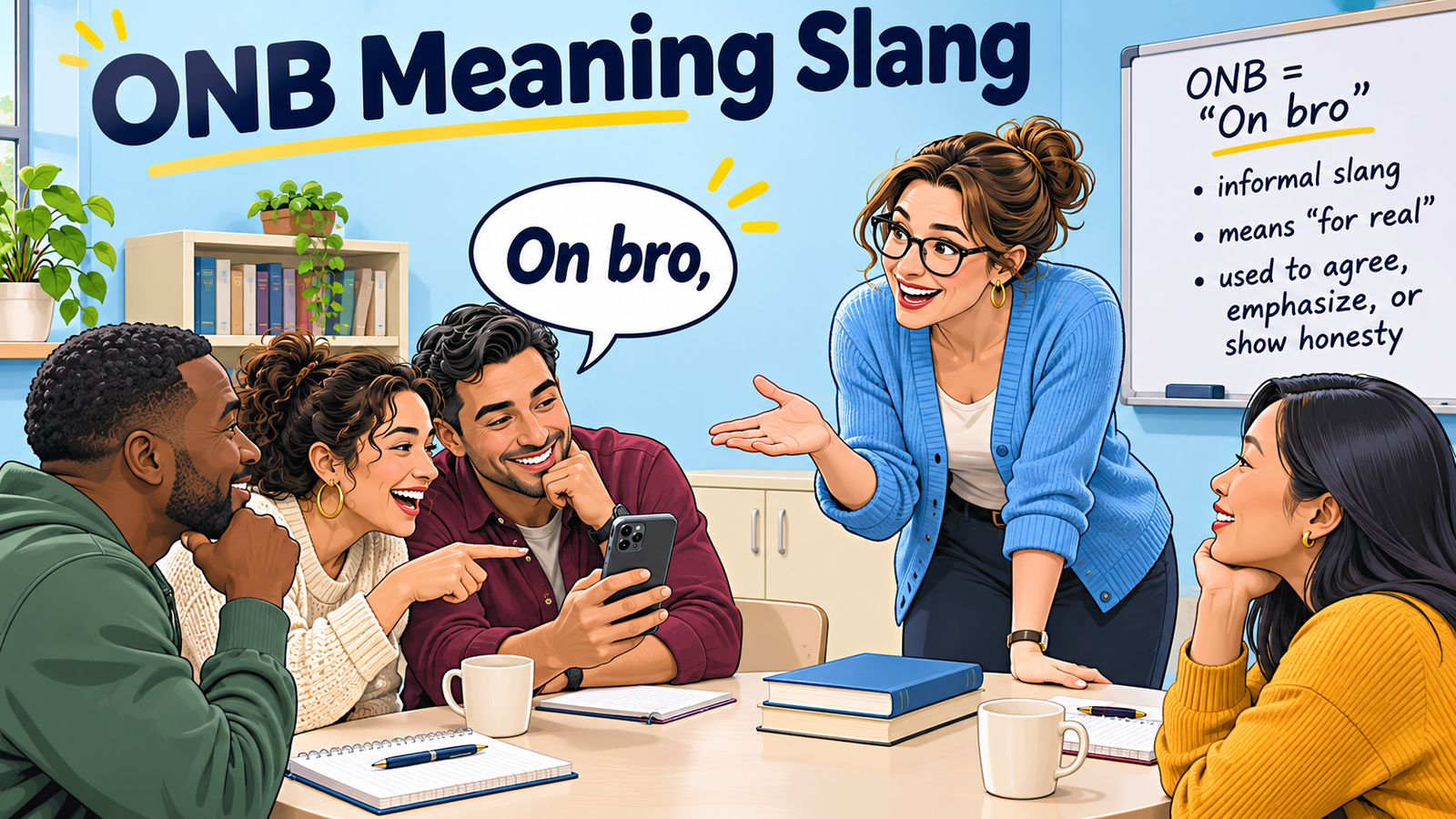
Someone adds “onb” to a claim, and you understand the sentence but not the extra emphasis. Another person uses the same letters after an old joke. Are they saying the same thing?
ONB often means “on bro” in casual slang, adding emphasis similar to “I’m serious” or “I swear.” Other documented uses include old news bro and outward nose breath. The surrounding message determines which reading makes sense.
What On Bro Means
On bro is an informal expression that puts extra weight behind a statement. The speaker is presenting what they say as sincere or emphatic. It can function like a conversational oath rather than adding new factual information.
For example, “ONB, I checked every drawer before finding the keys in my jacket” emphasizes the speaker’s account. Removing ONB leaves the main event unchanged. The extra phrase communicates how strongly the person wants the statement to be taken.
Does ONB Prove That Someone Is Telling the Truth?
No. Emphatic wording tells you about the speaker’s presentation, not whether the claim has been verified. People can use sincere-sounding language accurately, jokingly, carelessly, or dishonestly.
If a claim matters, ask for the relevant detail. “What time did you see the notice?” is more useful than treating an oath as evidence. You can recognize the intended emphasis without accepting every statement simply because it ends with ONB.
Original On Bro Examples
Expressing surprise: “ONB, the tiny café has the biggest sandwiches I’ve seen.” Here, the writer is emphasizing an impression. It is conversational enthusiasm, not a measured comparison of every café.
Reinforcing a promise: “I’ll bring your book tomorrow, onb.” A sensible response is “Thanks—I’ll be at the library after two.” The practical arrangement matters more than repeating the slang back. A promise becomes useful when the timing is clear.
ONB as Old News Bro
Old news bro is a different interpretation. In this use, the person is saying that the information is already familiar or that a joke has been circulating for a while. It may sound teasing or dismissive.
Imagine sharing an announcement and receiving “ONB, they posted that last week.” The reference to an earlier announcement supports old news bro. Reading the same reply as an oath would miss what the rest of the sentence explains.
ONB as Outward Nose Breath
Outward nose breath describes a small amused exhale rather than a full laugh. It can be used as a deliberately understated reaction to something mildly funny. The phrase describes the imagined physical response.
This reading is less obvious if the abbreviation appears alone. A reply beneath a joke could fit, but it is still only a possibility. Ask when needed rather than assuming that every ONB under a humorous post means the same thing.
How to Pick the Right Meaning
Read the words before and after ONB. A strong claim or promise points toward on bro. A reference to something being old or already known points toward old news bro. A discussion of a mild laugh can support outward nose breath.
Next, consider the conversation’s purpose. Is the sender persuading you, correcting your timing, or reacting to humor? These clues are more reliable than the app name. People can use several meanings on the same platform.
How to Reply to ONB
When ONB adds emphasis to an ordinary story, respond to the story itself. “That sounds exhausting” or “How did you find it?” keeps the exchange natural. You do not need to acknowledge every slang term separately.
If ONB means old news bro, you might say “I hadn’t seen it yet” and move on. If you cannot tell, ask “Do you mean on bro or old news?” A short clarification avoids building a whole reply around the wrong interpretation.
Is ONB Rude or Aggressive?
The letters are not automatically rude. On bro can appear in friendly enthusiasm, reassurance, or an argument. The subject, surrounding words, and relationship establish the tone more clearly than the abbreviation alone.
Old news bro can sound dismissive if someone is excited about sharing something. If you want to communicate the same information warmly, try “I saw that earlier too—what did you think?” That acknowledges the timing without shutting down the conversation.
ONB in Formal Writing
ONB is best kept to settings where readers understand the intended slang. A message to a teacher, customer, or unfamiliar colleague benefits from clear wording such as “I can confirm the date” or “I will send the document tomorrow.”
Do not substitute extra emphasis for useful information. “The repair is complete” describes a status; “It is complete, onb” mainly changes the tone. In professional communication, evidence, dates, and specific commitments usually matter more.
Common Interpretation Mistakes
One mistake is inventing an expansion for every letter combination. Another is treating all meanings listed online as equally common in every community. A documented use is a possibility, not a guarantee about your sender’s intention.
Also avoid inferring someone’s background or affiliations from ONB alone. People pick up slang from friends, entertainment, and public posts. A brief expression is not enough to establish personal identity or group membership.
Frequently Asked Questions
What does ONB mean in slang?
It often means on bro, an expression that emphasizes sincerity or seriousness.
Can ONB mean old news bro?
Yes. That interpretation fits messages saying that something is already known or outdated.
What is outward nose breath?
It describes a small amused exhale and is another documented expansion of ONB.
Does ONB mean someone is definitely honest?
No. Emphasis is not proof, so important claims still need relevant evidence.
Does ONB change meaning on Snapchat or TikTok?
The platform alone does not decide. Read the sentence and the surrounding exchange.
What should I say if I do not understand?
Ask what ONB means in that particular message. That is more reliable than guessing.
Conclusion
ONB often adds the emphasis of on bro, but old news bro and outward nose breath are different possible readings. The abbreviation becomes clearer when you identify what the sender is doing in the conversation.
Respond to the claim, correction, or joke rather than the letters alone. When the context is missing, a brief question is enough to get the conversation back on track.








Leave a Reply