

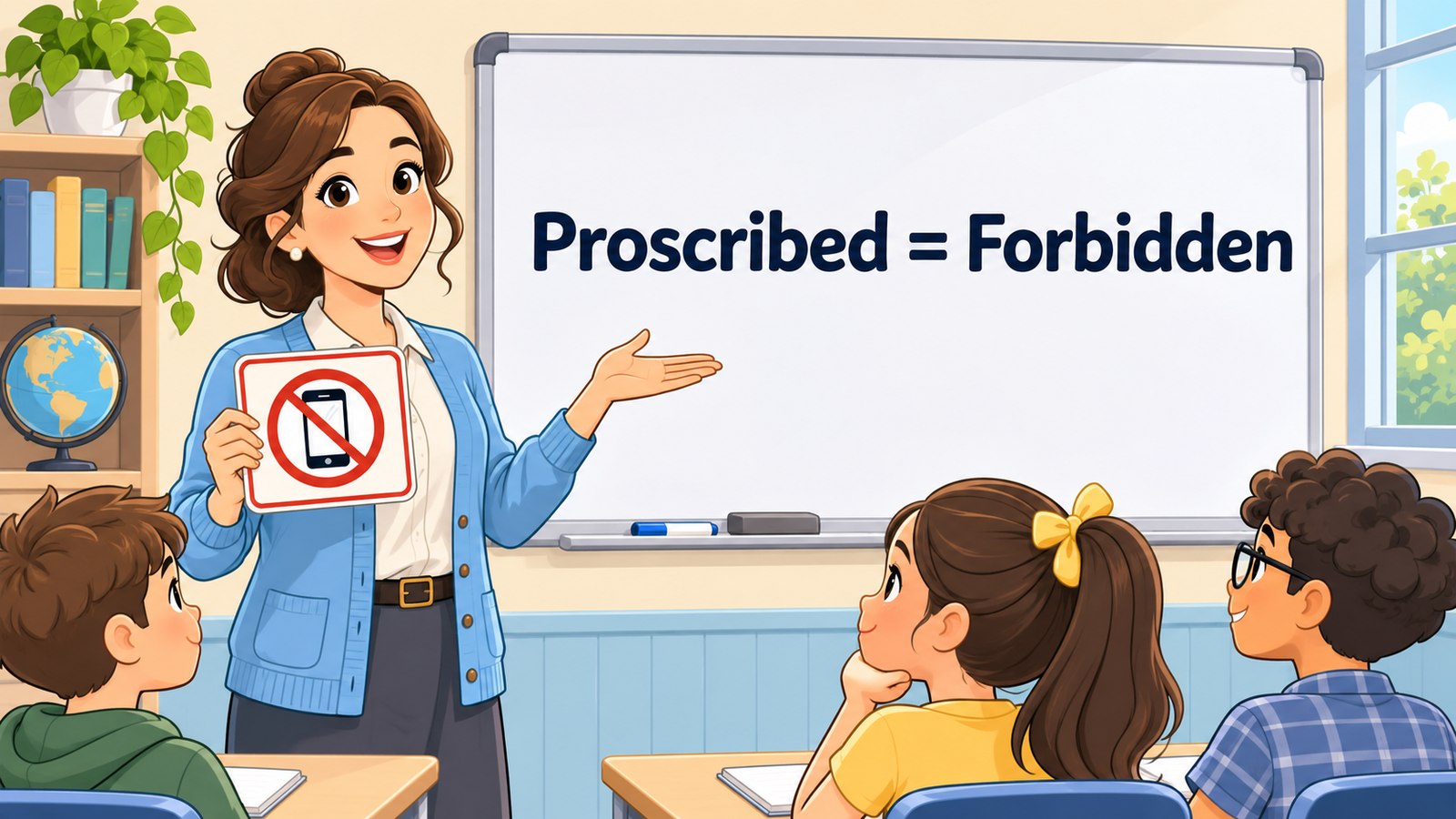
A rulebook says a practice is “proscribed,” but another document describes a “prescribed procedure.” The words look almost identical, yet confusing them can reverse the message you are trying to understand.
Proscribed means forbidden or prohibited, usually by an authority. It comes from the verb proscribe. Prescribed, by contrast, can mean specified, directed, or recommended. This guide explains the vocabulary distinction with original examples rather than treating the two words as interchangeable.
What Does Proscribed Mean?
If an activity is proscribed, a rule or authority forbids it. The word often appears in formal writing because it emphasizes an explicit prohibition. In everyday conversation, banned or not allowed may communicate the same basic point more simply.
Consider an imaginary competition whose rules proscribe outside assistance during a timed round. The meaning is that participants are not allowed to receive that assistance. The sentence does not merely express the organizer’s personal dislike of it.
How to Pronounce Proscribed
Proscribed is pronounced approximately pruh-SKRYBD, with the stress on the second syllable. The ending is a d sound rather than an additional syllable pronounced ed. The base verb proscribe ends with the same long i sound heard in describe.
Because prescribed sounds similar, listening for the surrounding sentence is useful. If the speaker is discussing a restriction, proscribed may fit. If the sentence concerns instructions that someone should follow, prescribed may be the intended word.
Proscribed vs Prescribed
Proscribed points to a prohibition; prescribed points to a direction or specification. “The rules proscribed the shortcut” means the shortcut was forbidden. “The rules prescribed the route” means the route was specified for people to follow.
Prescribed also appears in medical language, where it can describe a treatment ordered by a clinician. That familiar use can make writers accidentally choose it when they mean banned. Read the whole sentence and ask whether the intended action is to forbid or to direct.
Sentence Examples with Proscribed
“The tournament proscribed the use of outside notes during the final round.” Here, the object of proscribed is the use of outside notes. “The old handbook proscribed commercial advertising on the noticeboard.” In this example, the handbook contains the prohibition.
“Such conduct was explicitly proscribed by the club’s rules.” This passive sentence emphasizes the conduct instead of the rule-maker. These are invented language examples, not descriptions of a particular organization’s current policy.
Using Proscribed as a Verb or Modifier
Proscribed can be the simple past tense: “The committee proscribed the practice.” It can also be a past participle in a passive construction: “The practice was proscribed.” The surrounding grammar tells you which role it is playing.
Before a noun, it can describe something forbidden: “a proscribed practice” or “proscribed materials.” In that position, it acts as a modifier. The underlying idea stays the same, although the sentence no longer tells you directly who imposed the restriction.
Proscribe, Proscribes, Proscribing, and Proscription
The basic verb is proscribe. Use proscribes with a singular present-tense subject: “The code proscribes that behavior.” Drop the final e before adding ing: proscribing. The past form and past participle are both proscribed.
The related noun is proscription, meaning a prohibition or the act of prohibiting. Prescription belongs to prescribe, so the same spelling distinction continues in the noun forms. Checking related words is useful when editing a longer paragraph.
Synonyms and the Limits of Substitution
Forbidden, prohibited, and banned are useful synonyms in many sentences. “The practice is prohibited” may be clearer to a general audience than “The practice is proscribed.” Outlawed can fit when the restriction is specifically connected to law.
Do not replace proscribed with discouraged unless you mean to weaken the statement. Discouraging an activity does not necessarily forbid it. Likewise, restricted may mean limited rather than completely banned, so the scope of the original sentence matters.
Common Mistakes to Avoid
A frequent error is writing prescribed when the intended meaning is forbidden. Another is using proscribed merely to mean unpopular or disapproved of. A person can dislike a habit without formally banning it, and that distinction can change what a reader understands.
Be careful with negatives as well. “Not proscribed” means not forbidden by the rule under discussion; it does not automatically mean recommended. Similarly, a requirement can be absent without the action being banned. These are different relationships.
A Quick Editing Exercise
Try choosing the right word: “The event rules ___ the required arrival time.” Because the rules specify a time to follow, prescribed fits. Now consider “The event rules ___ selling tickets at the entrance.” If selling there is forbidden, proscribed fits.
Before finalizing a sentence, substitute plain English. If officially forbidden preserves your meaning, proscribed is likely correct. If specified or instructed preserves it, consider prescribed. This test is more dependable than choosing the word that looks familiar.
Frequently Asked Questions
What does proscribed mean in simple English?
It means forbidden, prohibited, or banned, generally under an explicit rule or authority.
Are proscribed and prescribed opposites?
They often point in opposite directions: forbidding something versus directing or specifying it. They are not exact opposites in every possible sentence.
What is an example of proscribed?
“The contest proscribed assistance from spectators” means spectators were not allowed to help contestants.
Is proscribed always a legal term?
No. It can describe prohibitions in institutional, organizational, or other formal rules as well.
What is the noun form of proscribe?
The noun is proscription. Prescription comes from the different verb prescribe.
Does not proscribed mean approved?
No. It means the relevant prohibition does not apply or is absent. Approval and recommendation are separate claims.
Conclusion
Proscribed describes something forbidden, while prescribed commonly describes something specified or directed. The single-letter difference matters because it changes what the sentence asks people to do.
When editing, replace the word temporarily with forbidden or specified. If the plain-English version matches your meaning, you have a reliable way to choose the correct form.









Leave a Reply