

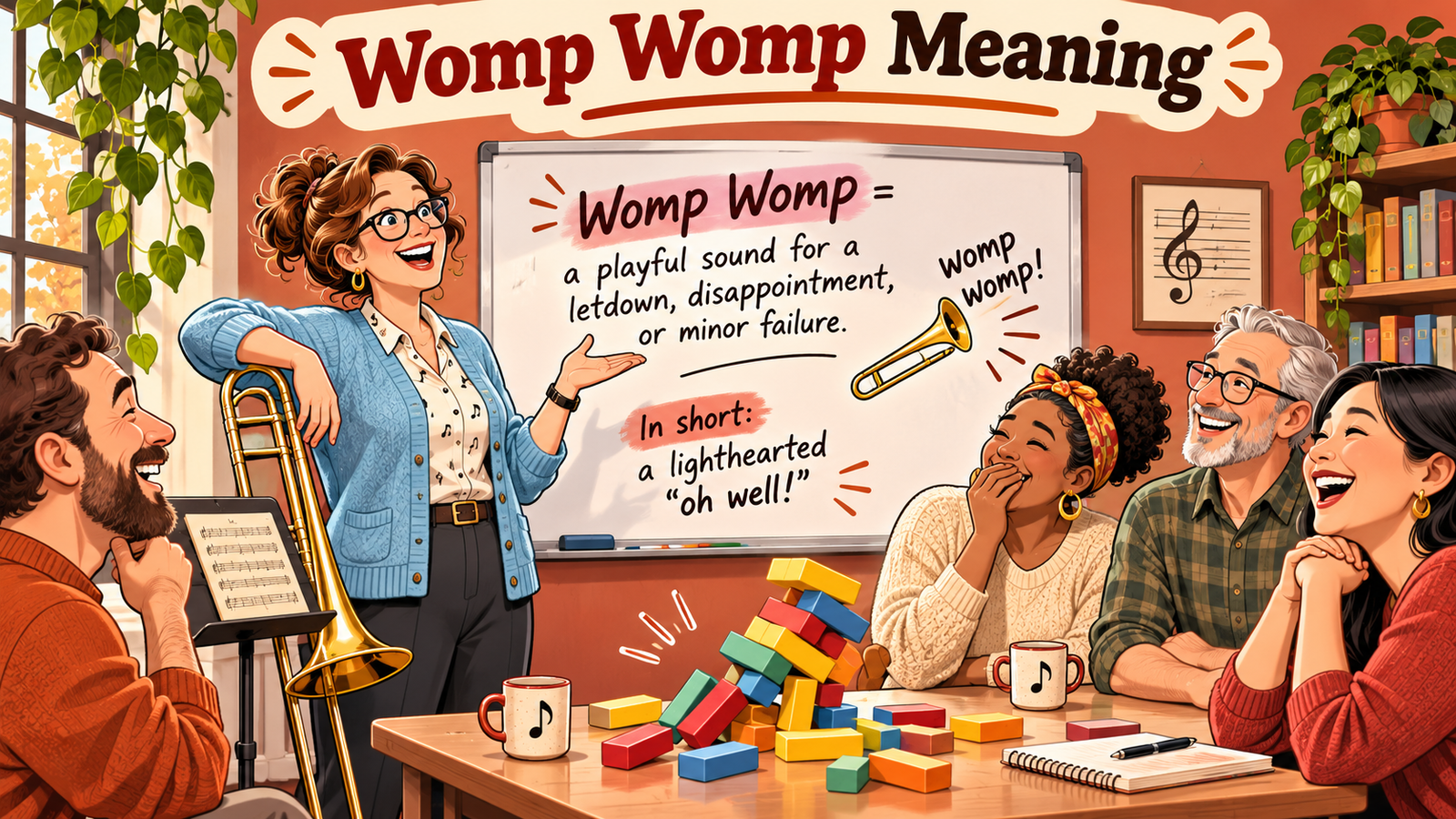
You share a small disappointment, and someone answers “womp womp.” It sounds funny, but the response may leave you unsure whether they are laughing with you or brushing you off.
Womp womp imitates a sad-trombone sound and reacts to a failure, letdown, or awkward moment. It often carries mock sympathy or sarcasm. Depending on the situation, it can be a harmless joke or a dismissive response.
What Womp Womp Means in Plain English
A rough translation is too bad, delivered with a comic sound effect. It does not usually provide sincere reassurance. The speaker is treating the event as a disappointing punchline rather than offering a detailed response.
That difference matters when interpreting the message. “I’m sorry that happened” expresses sympathy directly. Womp womp normally adds irony, teasing, or indifference. Two expressions can refer to the same bad outcome while communicating very different attitudes toward it.
Why It Sounds Like a Trombone
The phrase represents a descending comic sound associated with disappointment. Written out, the repeated syllables let readers imagine that sound even when no audio is playing. It is an example of words imitating a noise.
You do not need to know a particular video or meme to understand the basic joke. The effect is similar to adding a theatrical musical cue after a failed attempt. The event becomes the setup, and the sound becomes the punchline.
Womp Womp in a Text Conversation
Imagine telling a friend, “I saved the last biscuit for later, and then forgot where I put it.” If you are already laughing about the situation, their womp womp may fit the playful mood. The disappointment is small, and the joke follows your own framing.
Now imagine sharing news that seriously worries you. The identical reply could feel cold because it does not acknowledge the importance of what you said. Understanding the phrase requires attention to the event and the speaker’s relationship with you.
Using It About Your Own Mistake
Self-directed humor is often easier to interpret because you are choosing to joke about your own experience. “I spent ten minutes looking for the glasses on my head. Womp womp.” The phrase turns a small personal mishap into a light story.
Even then, the tone depends on the audience. Someone might respond with helpful advice because they do not recognize the joke. You can make your intention clearer through the rest of the sentence instead of expecting everyone to know the same online expressions.
When Friendly Teasing Becomes Dismissive
Friendly teasing generally works when both people welcome it. Knowing someone well does not guarantee that every problem is open to jokes. A minor inconvenience to one person might be upsetting to another, especially after a difficult day.
Look for the person’s actual response. If they say the joke hurt, explain briefly and stop: “Sorry, I misread the mood. I didn’t mean to dismiss you.” Defending the joke at length usually makes the conversation harder to repair.
Does an Emoji Make It Polite?
An emoji can suggest playfulness, but it cannot guarantee that a message will land kindly. A laughing face beside an insensitive reply may make the mockery feel stronger. Tone markers help only when the underlying response fits the situation.
The same applies to punctuation and spelling. Womp-womp, womp womp, and an exaggerated repeated version can convey the same basic joke. No punctuation choice automatically transforms a dismissive comment into genuine support.
How to Reply When the Joke Is Welcome
If you are amused, you can continue lightly: “A dramatic ending to my snack plans” or “I’ll accept that soundtrack.” These original replies treat the phrase as shared humor and avoid escalating a harmless exchange.
You can also move straight to the next step: “Anyway, I’m making tea—want some?” There is no requirement to produce a clever comeback. A brief acknowledgment or a new topic is enough when both people understand the mood.
How to Reply When It Hurts
Name the mismatch calmly: “I’m actually upset about this, so I’d appreciate a serious reply.” This tells the other person what kind of response you need without requiring you to prove that your feelings are justified.
If a stranger is using the phrase to provoke you, you can disengage. Not every dismissive comment deserves a debate. In an ongoing relationship, a clear request about future responses may be more useful than arguing over whether the phrase is always rude.
Better Alternatives for Genuine Sympathy
For a real disappointment, try “That sounds frustrating” or “I’m sorry—were you looking forward to it?” These responses recognize the person’s experience and invite them to say more. They do not assume the problem is trivial.
If you want to help, ask a practical question: “Would you like help finding another option?” Offering support is different from turning the event into a joke. Choose according to what the person appears to need, and clarify if you are unsure.
Womp Womp in Captions and Comments
In a caption, the writer may be joking about their own failed attempt. In a reply, the same words may target someone else’s experience. Who is making the joke and who is affected are important parts of the meaning.
A public audience also changes the situation. A remark that feels comfortable in a private friendship may embarrass someone when many people can see it. Before commenting, consider whether the person has invited that kind of humor.
Frequently Asked Questions
What does womp womp mean?
It is a comic reaction to disappointment or failure, often expressing mock sympathy or sarcasm.
Is womp womp a swear word?
The phrase itself is not a conventional swear word, but it can still be insulting or insensitive in context.
Is it always rude?
No. It can be playful when everyone welcomes the joke, especially for a minor mishap or self-directed humor.
What sound does it imitate?
It imitates a sad-trombone-style sound effect associated with a comic letdown.
How should I answer a rude womp womp?
You can say you want a serious response, set a boundary, or leave the conversation.
Can I use it in a professional email?
A direct, considerate response is usually more appropriate, particularly when someone reports a problem.
Conclusion
Womp womp is a sound-effect joke written as words. Its meaning involves disappointment, but its social effect depends on whether the humor is shared or directed at someone who needs support.
Use context to read it, and respond according to your own comfort. A joke is easiest to enjoy when everyone involved is free to find it funny—or say that they do not.







Leave a Reply