

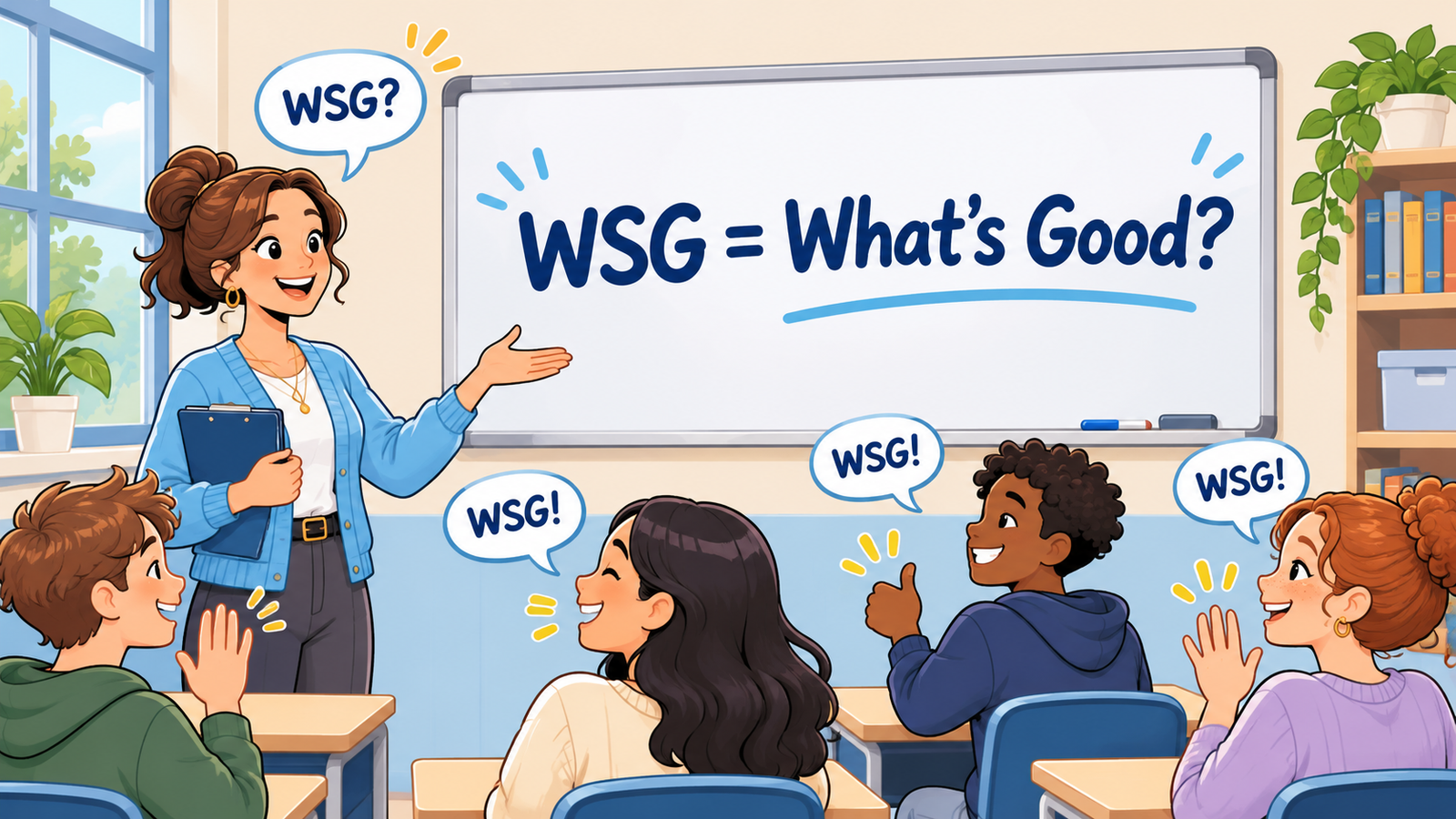
A friend sends “wsg?” with no other explanation. You might wonder whether they are asking a question, suggesting plans, or simply saying hello. In casual messaging, all three can be connected.
WSG usually means “what’s good?” It is an informal conversation opener similar to what’s up or how’s it going. The abbreviation tells you the basic greeting, while the rest of the conversation helps you understand what the person wants to talk about.
What Does WSG Stand For in Text?
The letters shorten what’s good. In an ordinary greeting, the phrase is not asking you to list everything that is objectively good. It functions more like a friendly check-in and gives you an opening to mention your mood, activity, or plans.
For example, “Wsg, haven’t heard from you in a while” invites a general update. “Wsg tonight?” may be asking about evening plans. The extra words narrow the question, so it helps to read beyond the first three letters.
How to Reply to WSG
A brief update followed by a question is an easy response: “Just finished studying. How about you?” If you want to keep the conversation going, mention one detail the other person can ask about. You do not need a rehearsed or clever answer.
If you are busy, say so naturally: “In the middle of dinner; I’ll message you later.” If you do not know what they are asking, try “Hey! Are you asking about tonight?” A clear response is better than guessing and making plans the sender never suggested.
Original WSG Conversation Examples
A casual check-in: “Wsg?” — “Doing well, just got back from a walk. How’s your day going?” This response treats the message as a greeting and returns the interest without adding an invitation.
Making plans: “Wsg after class?” — “I’m free after four. Want to get a snack?” Here, the time reference supports a plans-related reading. The reply turns that possibility into a concrete invitation the other person can accept or decline.
Does WSG Mean Someone Is Flirting?
WSG can appear in a flirty conversation, but the abbreviation itself does not establish romantic interest. Friends, classmates, and acquaintances can all use it as a routine opener. A single greeting provides very little evidence about someone’s intentions.
Look for the broader pattern: personal compliments, an explicit date invitation, or sustained interest in getting to know you may matter more. Even then, clear communication is more useful than treating every emoji or delayed reply as a secret signal.
Friendly, Playful, or Confrontational Tone
Among friends, “what’s good?” usually sounds relaxed. With a warm follow-up, it can be playful. In a tense argument, similar wording may be used as a challenge. The relationship and previous messages do more to establish tone than capitalization alone.
Suppose the message follows a disagreement and says “So wsg with that comment?” The sender may be asking for an explanation. Reply to the actual concern: “I meant the schedule, not you personally.” Treating every WSG message as cheerful would miss that context.
WSG on Snapchat, Instagram, and TikTok
In casual direct messages, the familiar expansion remains what’s good. The platform does not automatically add a romantic, sexual, or confrontational meaning. People carry their conversational habits across apps, so similar greetings can appear in different places.
A public comment may work differently from a private check-in because it addresses a larger conversation. Read the caption and neighboring replies when needed. A cropped screenshot can leave out the very words that explain why the abbreviation was used.
WSG vs WYD, WYA, and What’s Up
WYD means what are you doing and asks more directly about an activity. WYA means where are you at and asks about location. WSG is broader: it can start a conversation without requiring a precise activity or location update.
“What’s up?” is a close everyday equivalent when WSG is used as a greeting. However, you do not have to respond to all of these in the same way. A location question may need a place, while a friendly WSG can be answered with “All good, you?”
When WSG Is Too Informal
Use WSG with people who understand and welcome casual slang. It may be unclear in a job application, customer complaint, or first email to a teacher. A plain “Hello” followed by your question is easier for an unfamiliar recipient to understand.
Even in a relaxed workplace, consider the specific person and purpose. A friendly team chat might allow shorthand, while an important request benefits from complete wording. Being informal is useful only when it helps both sides communicate comfortably.
Common Mistakes and Better Alternatives
Do not assume a sender’s gender changes the definition. WSG from a girl and WSG from a guy can both simply mean what’s good. Also, lowercase wsg is not a separate expression from uppercase WSG; typing habits vary.
If you are starting the conversation, adding a purpose can make your opener easier to answer: “Hey, how’s your week going?” or “Are you free to talk about the project?” These alternatives are especially useful when you want more than a brief greeting back.
Frequently Asked Questions
What is the full form of WSG?
In casual texting, WSG usually expands to what’s good.
What is a good reply to WSG?
Try “Doing well, how about you?” or share a brief update. If the message mentions plans, answer about your availability.
Does WSG mean what is going on?
What’s good is the usual expansion, though it can function similarly to what’s going on as a greeting.
Is WSG flirty?
It can be part of flirting, but it is also a normal friendly opener. The abbreviation alone does not prove attraction.
Is WSG rude?
Not inherently. Its tone depends on the relationship, surrounding words, and whether the conversation is already tense.
Is WSG the same as WYD?
No. WSG is a broad greeting, while WYD more specifically asks what you are doing.
Conclusion
WSG usually means what’s good and works as a casual way to start talking. You can respond with a short update, a question back, or a practical answer when the message asks about plans.
Let context guide the tone. A greeting can be friendly, playful, or part of a more serious exchange, but those meanings come from the conversation rather than the abbreviation alone.







Leave a Reply