

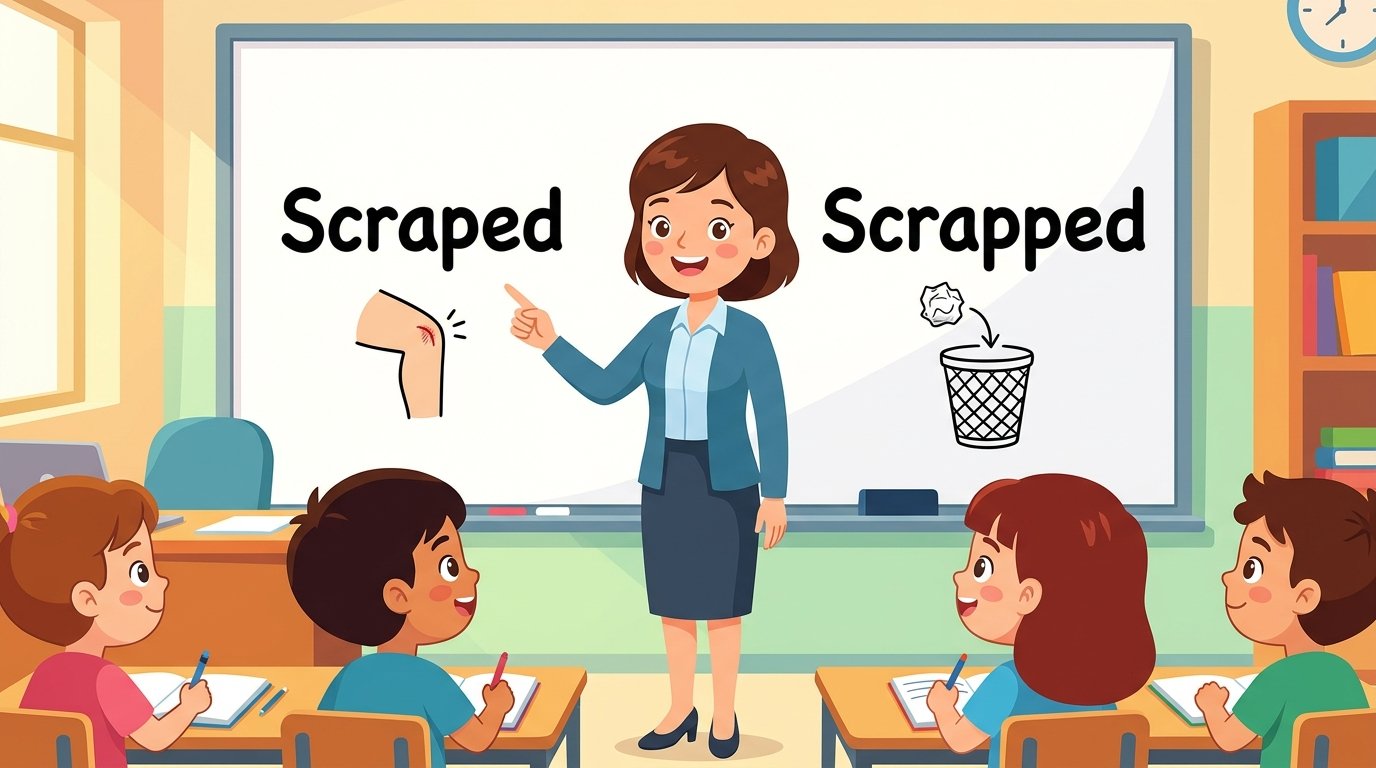
English is full of words that look and sound alike but mean something completely different. One of the trickier examples is scraped vs scrapped. At first glance, these two words differ by just one letter, yet picking the wrong one can completely change what your sentence is saying.
For example, saying a project was “scraped” paints a very different picture than saying it was “scrapped.” One usually involves rubbing or physically removing something, while the other means abandoning or canceling something entirely.
This guide breaks down the scraped vs scrapped meaning, walks through the grammatical differences, shows real examples, and helps you remember which word fits your sentence.
Scraped vs Scrapped: Where the Difference Comes From
The easiest way to understand these two words is to look at their root verbs.
- Scraped comes from the verb “scrape.”
- Scrapped comes from the verb “scrap.”
Even though they sound alike, their meanings have nothing to do with each other.
What Does “Scraped” Mean?
“Scraped” usually refers to rubbing, removing, or barely managing to achieve something.
Common meanings include:
- Rubbing against a surface
- Removing material
- Barely managing to succeed
Examples:
- He scraped his knee while falling off the bike.
- She scraped paint off the wall.
- The team scraped through the final round.
In each case, the idea involves friction, removal, or a narrow success.
What Does “Scrapped” Mean?
“Scrapped” means discarded, canceled, or abandoned.
Examples:
- The company scrapped the project.
- Our travel plans were scrapped because of the storm.
- They scrapped the old machine.
Here, the word points to getting rid of something completely.
Breaking Down the Scraped vs Scrapped Meaning
The confusion often comes from the fact that both words are past-tense verbs ending in “-ed,” and they sound very similar when spoken quickly.
Once you focus on context, though, the meanings separate easily.
Scraped = Rubbed or Barely Achieved
Think about:
- Scraping a surface
- Scraping food from a plate
- Scraping through an exam
The action usually involves friction or a close, narrow result.
Scrapped = Thrown Away or Canceled
Think about:
- Canceling plans
- Abandoning ideas
- Discarding equipment
The action involves rejection or removal from use entirely.
Real Examples of “Scraped”
Seeing real-world examples makes the difference much easier to remember.
Physical Action Examples
- He scraped mud off his shoes.
- The car scraped against the wall.
- She scraped ice from the windshield.
These involve direct contact with a surface.
Figurative Examples
“Scraped” can also mean barely succeeding.
- The student scraped a passing grade.
- We scraped together enough money for the trip.
In these cases, the result was achieved with real difficulty.
Real Examples of “Scrapped”
“Scrapped” shows up often in business, planning, and project discussions.
Cancellation Examples
- The event was scrapped due to bad weather.
- They scrapped the marketing campaign.
- The update was scrapped before launch.
Disposal Examples
- The factory scrapped outdated equipment.
- He scrapped the broken bicycle.
In every case here, something is abandoned or discarded completely.
Why Do People Mix Up Scraped and Scrapped?
A few reasons explain why this mix-up happens so often.
1. Similar Pronunciation
When spoken quickly, both words can sound nearly identical.
2. Nearly Identical Spelling
Only one letter separates the two words, which makes typing mistakes easy to make.
3. Fast Reading Habits
Readers often skim quickly and overlook the extra “p” in “scrapped.”
A Simple Trick to Remember the Difference
Here’s a memory trick that helps.
Scraped = Surface
Both associations here involve touching or rubbing a surface.
Examples:
- Scraped paint
- Scraped skin
- Scraped ice
Scrapped = Stopped
“Scrapped” has an extra “p,” which you can link to stopping plans or projects for good.
Examples:
- Scrapped the proposal
- Scrapped the idea
- Scrapped production
Scraped vs Scrapped in Business Writing
This mix-up shows up often in professional writing and news headlines.
Correct Usage in a Business Context
- The company scrapped its expansion plans.
- The startup scrapped the original app design.
Using “scraped” here would be wrong, since the projects were abandoned entirely, not physically rubbed or lightly removed.
Correct Usage in a Physical Context
- Workers scraped old paint from the building.
- The machine scraped metal during operation.
Here, physical contact or removal is genuinely involved.
Scraped vs Scrapped in Technology and Internet Usage
Modern technology has introduced yet another meaning for “scraped.”
Web Scraping
In tech terminology, “scraped” often refers to automatically collecting data from websites.
Example:
- The software scraped information from online databases.
This use is entirely different from “scrapped,” which still means discarded or canceled.
Common Grammar Mistakes to Watch For
Small spelling slips can completely change what a sentence means.
Incorrect Example
- The company scraped the project last month.
This reads like they physically rubbed the project, rather than canceled it.
Correct Example
- The company scrapped the project last month.
Another Incorrect Example
- He scrapped mud off his shoes.
Correct Example
- He scraped mud off his shoes.
Since mud is physically removed here, “scraped” is the right word.
How Context Helps You Pick the Right Word
If you’re ever unsure which word applies, ask yourself this question:
Is Something Being Rubbed Away or Barely Achieved?
Use “scraped.”
Examples:
- Scraped his elbow
- Scraped paint off
- Scraped through the exam
Is Something Being Canceled or Discarded?
Use “scrapped.”
Examples:
- Scrapped the event
- Scrapped the proposal
- Scrapped the old equipment
This quick check clears up most of the confusion almost instantly.
Why Getting the Right Word Matters
Using the wrong word can make your writing confusing or unintentionally funny.
Using the correct word improves:
- Professionalism
- Clarity
- Grammar accuracy
- Reader trust
- Communication quality
This matters especially in emails, business reports, blogs, and academic writing.
FAQs About Scraped vs Scrapped
What’s the difference between “scraped” and “scrapped”?
“Scraped” usually means rubbed, removed, or barely achieved, while “scrapped” means canceled, abandoned, or discarded.
Is it “scraped plans” or “scrapped plans”?
The correct phrase is “scrapped plans,” since plans are canceled or abandoned.
What does “scraped” mean in technology?
In technology, “scraped” often refers to automatically collecting data from websites or online sources.
Why do people confuse “scraped” and “scrapped”?
The words sound similar, look nearly identical, and both show up frequently in writing and news headlines.
How can I remember the difference easily?
Remember that “scraped” relates to surfaces or friction, while “scrapped” relates to stopping or throwing something away.
Conclusion
Understanding the scraped vs scrapped difference gets much easier once you focus on context and meaning. Even though the words look and sound similar, they describe entirely different actions. “Scraped” relates to rubbing, removing, or barely succeeding, while “scrapped” refers to canceling, discarding, or abandoning something.
Small grammar distinctions like this one can dramatically improve writing clarity and professionalism. Whether you’re writing emails, business reports, blog posts, or everyday messages, using the correct word helps avoid confusion and makes your communication stronger.
The next time you hesitate between these two words, remember the simplest rule: if something is physically removed or barely achieved, use “scraped.” If something is canceled or thrown away, use “scrapped.”


Leave a Reply