

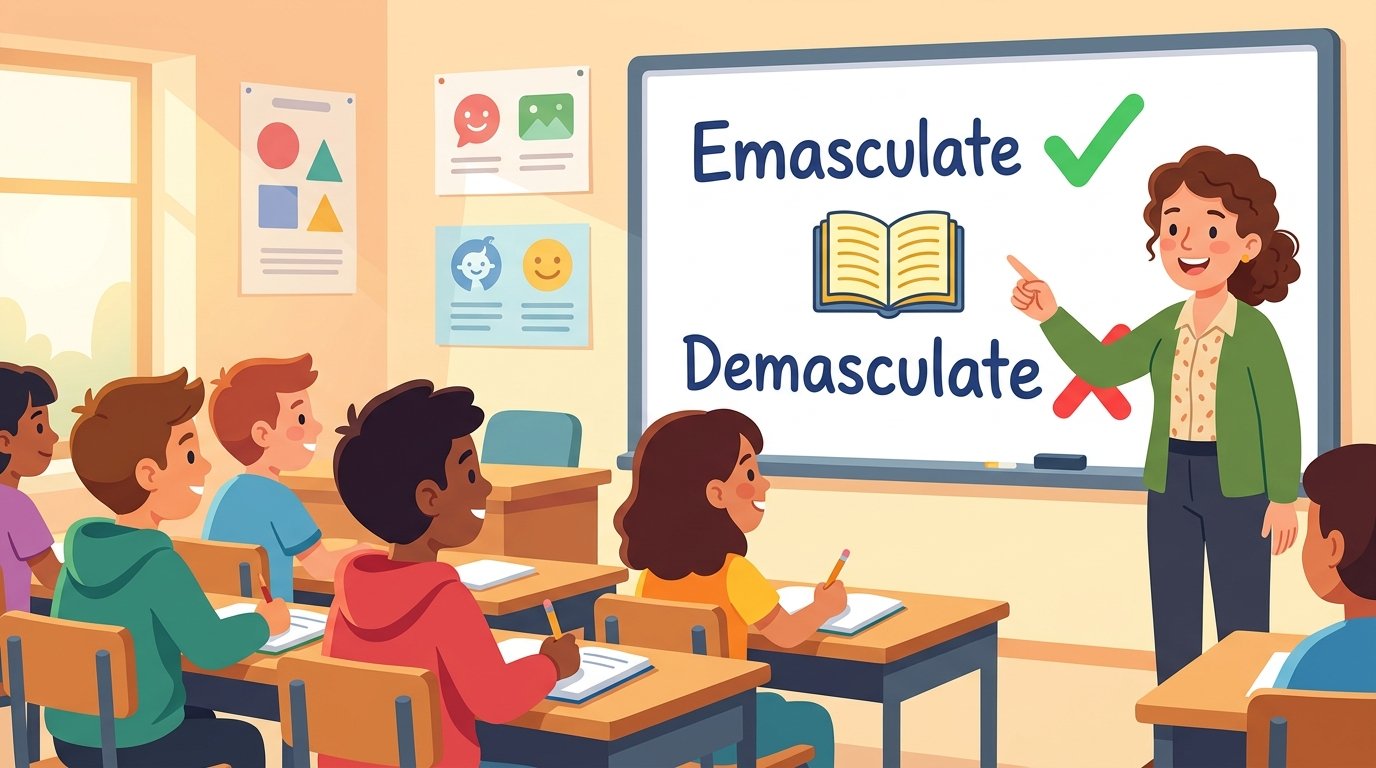
English sometimes tempts writers into inventing words that sound logical but simply don’t exist. Emasculate or demasculate is a perfect example of this. If you’ve ever paused while writing and wondered which spelling belongs in a serious sentence, this guide will settle the question clearly.
The short answer: “emasculate” is the correct, standard English word, while “demasculate” is not recognized as proper English. Understanding why can help you write with more confidence in academic, professional, and everyday communication.
Emasculate or Demasculate: The Quick Answer
When comparing emasculate or demasculate, only one word passes the standard English test.
- Emasculate — Correct
- Demasculate — Incorrect / nonstandard
“Demasculate” might look like a reasonable opposite of “masculate,” but native English speakers and major dictionaries simply don’t use it that way.
What Does “Emasculate” Actually Mean?
The emasculate meaning centers on weakening someone’s power, confidence, or authority.
It typically describes:
- Reducing someone’s strength or influence
- Making a man feel less confident or capable
- Weakening the effectiveness of a law, policy, or idea
- In rare, literal use, removing male reproductive organs
Examples
- Critics said the amendment would emasculate existing protections.
- He felt emasculated after losing his leadership role.
- The revised policy emasculated the original safety rules.
In every case, the word signals a loss of strength, authority, or influence.
What Does “Demasculate” Mean?
The demasculate meaning, where it appears at all, roughly points to removing masculine traits or identity from someone. But this word carries no real dictionary backing and shows up mostly in informal or mistaken usage online.
Because English often uses “de-” to reverse an action, some writers assume “demasculate” should logically exist. In practice, though, “emasculate” already fully covers this meaning, leaving “demasculate” without a real grammatical role.
Emasculate vs Demasculate: Where They Actually Differ
| Feature | Emasculate | Demasculate |
|---|---|---|
| Standard English word | Yes | No |
| Found in major dictionaries | Yes | Rarely, informal only |
| Used in formal writing | Yes | No |
| Meaning | Weaken power, confidence, authority | Attempted meaning: remove masculinity |
This comparison makes the choice obvious: emasculate is the only word suited for professional or academic writing.
Literal vs Figurative Uses of “Emasculate”
The word carries both a literal and a figurative sense.
Literal Meaning
Historically, “emasculate” referred to the removal of male reproductive organs. This usage is rare today and mostly appears in older or medical texts.
Figurative Meaning
Far more common in modern English, the figurative sense describes weakening someone’s power, confidence, or effectiveness.
Example:
- “Smartphones are emasculating,” some critics argue, suggesting technology weakens traditional ideas of masculinity.
Emasculate in Legal and Institutional Language
The word also shows up frequently in law, policy, and organizational discussions.
Example:
- “The new regulation emasculated the agency’s enforcement powers.”
Here, “emasculate” describes stripping an institution or law of its force, not a person’s identity.
Emasculate in Botany
Interestingly, “emasculate” carries a specific technical meaning in plant science too. In botany, it refers to removing the male part of a flower (the androecium) to prevent self-pollination during controlled breeding.
This shows the word’s meaning extends well beyond gender and masculinity, into precise scientific terminology.
Emasculate and Gender Dynamics
In everyday conversation, “emasculate” often connects to masculinity, power, and social expectations.
Common contexts include:
- A man feeling emasculated by a shift in workplace roles
- Someone in a relationship expressing feeling emasculated by a power imbalance
- Discussions around evolving gender roles and identity
Some writers now question whether the gendered root of “emasculate” makes it less suitable in gender-neutral writing. In those cases, alternatives like disempower, undermine, or weaken may fit better.
Is “Demasculate” Ever Acceptable?
Technically, “demasculate” appears in a few informal online glossaries, but it holds no meaningful place in standard dictionaries or professional writing.
Common mistakes include:
- Incorrect: “The article demasculated his public image.”
- Correct: “The article emasculated his public image.”
If you’re writing for publication, business, or academic purposes, “emasculate” is always the safer, correct choice.
What’s the Opposite of “Emasculate”?
If you need a word that means the reverse, consider:
- Empower
- Enable
- Invigorate
- Strengthen
These words describe building someone up rather than weakening them.
A Simple Way to Remember the Difference
Think of emasculate as “taking power away.” There’s no need for a separate word like “demasculate,” since “emasculate” already covers that meaning completely.
If you’re ever unsure while writing emasculate or demasculate, default to “emasculate” — it’s the only version recognized by dictionaries and style guides.
FAQs About Emasculate or Demasculate
Is “demasculate” a real word?
Not in standard English. It appears occasionally in informal sources, but major dictionaries don’t recognize it.
Which is correct, emasculate or demasculate?
Emasculate is always the correct choice for formal, academic, or professional writing.
Can “emasculate” apply to women or general situations?
Yes. While rooted in masculinity, the word is commonly used to describe anyone or anything losing power, confidence, or effectiveness.
Why do people confuse emasculate and demasculate?
The words look similar and share a prefix-like structure, leading some to assume both are valid.
What’s the opposite of emasculate?
Words like empower, enable, and invigorate work well as opposites.
Conclusion
When it comes to emasculate or demasculate, the answer is clear: emasculate is the correct, dictionary-recognized English word, while “demasculate” remains nonstandard and best avoided in serious writing. Understanding the emasculate meaning — both literal and figurative — helps you use the word accurately across legal, cultural, and everyday contexts.
The next time you’re unsure which spelling to use, remember: only emasculate carries real linguistic weight.




Leave a Reply