

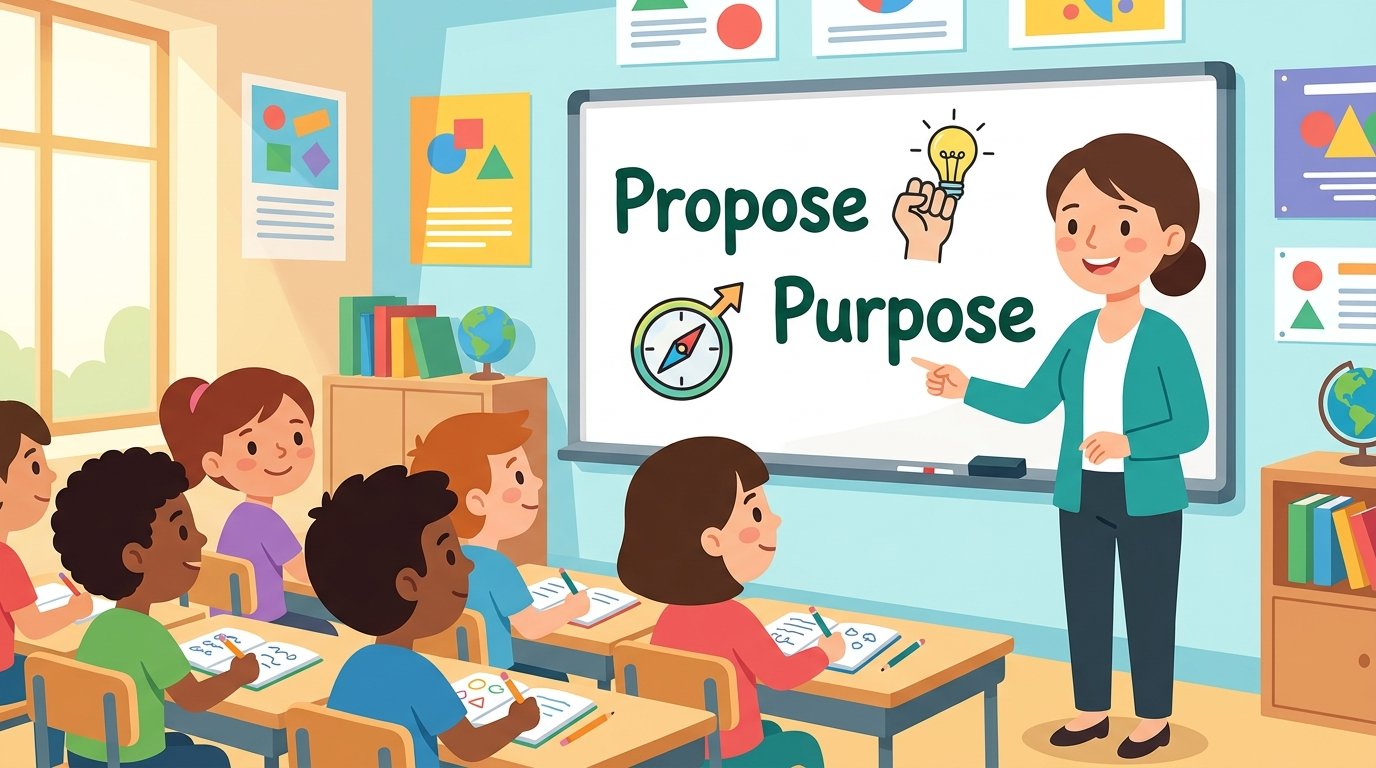
Two words that look and sound alike but carry entirely different meanings — propose or purpose trips up plenty of English learners and even confident writers. Getting this pair right can make a real difference in how clear and professional your writing sounds.
Propose or Purpose: The Quick Answer
- Propose is a verb, meaning to suggest or offer an idea.
- Purpose is a noun, meaning the reason behind an action.
Example Comparison
- “I propose we meet tomorrow.” (suggesting an action)
- “The purpose of this meeting is to plan next week’s schedule.” (explaining a reason)
Once you see them side by side, the difference becomes much easier to spot.
What Does “Propose” Mean?
Propose means to offer or suggest an idea, plan, or intention for others to consider.
Examples of “Propose” in Sentences
- She proposed a new method to reduce waste.
- He proposed to his girlfriend last night.
- The manager proposed extending office hours.
“Propose” describes an action — something you actively do, whether it’s suggesting a plan, a change, or even marriage.
What Does “Purpose” Mean?
Purpose refers to the reason or goal behind an action, decision, or object.
Examples of “Purpose” in Sentences
- The purpose of education is to empower people.
- Every tool serves a unique purpose.
- Her life purpose is to help others.
In short: propose is about offering something, while purpose is about explaining why something happens.
Propose or Purpose: Grammar Differences
Grammatically, the distinction is simple but important.
| Word | Part of Speech | Example |
|---|---|---|
| Propose | Verb | She proposed we start early. |
| Purpose | Noun | The purpose of this rule is fairness. |
Usage Tips
- You propose an idea.
- You explain the purpose of something.
Common Mistakes
Incorrect: She purposed a meeting. Correct: She proposed a meeting.
Incorrect: The propose of this rule is safety. Correct: The purpose of this rule is safety.
Propose or Purpose in Real-Life Contexts
“Propose” in Business
- “The CEO proposed a new digital strategy.” — formally suggesting a plan for consideration.
“Propose” in Education
- “The researcher proposed a new hypothesis.” — putting forward an idea for testing.
“Propose” in Relationships
- “He proposed marriage at sunset.” — a personal suggestion asking someone to marry.
“Purpose” in Daily Life
- “The purpose of a key is to open a lock.”
- “The purpose of a meeting is to make decisions.”
“Purpose” in Career and Life
- A company’s purpose defines its vision and direction.
- People often talk about “finding purpose” when searching for meaning in life.
How to Instantly Know Which Word to Use
Ask yourself one simple question:
“Am I suggesting something, or explaining why?”
- If you’re suggesting → use propose
- If you’re explaining a reason → use purpose
Quick Practice
- The ___ of education is to prepare students for life. → Purpose
- I’d like to ___ a solution to this issue. → Propose
- Every invention serves a ___. → Purpose
- He ___ to his partner during dinner. → Proposed
Pronunciation Differences
Even though the spellings look close, the pronunciation differs slightly:
- Propose → ends with a “z” sound (/pruh-POHZ/)
- Purpose → ends with an “s” sound (/PUR-puhs/)
That small sound difference can help you catch the right word while speaking or reading aloud.
Other Confusing Word Pairs Like Propose or Purpose
English has several similar pairs where one word is a noun and the other a verb.
| Pair | Difference |
|---|---|
| Affect vs. Effect | Affect is a verb (to influence); effect is a noun (a result). |
| Advice vs. Advise | Advice is a noun; advise is a verb. |
| Complement vs. Compliment | Complement completes something; compliment praises someone. |
Recognizing this noun-versus-verb pattern helps with plenty of other tricky word pairs too.
A Simple Way to Remember the Difference
Here’s an easy trick:
You PROPOSE to act; you have a PURPOSE to act.
That small phrase captures the core difference — propose is the action, purpose is the reason behind it.
FAQs About Propose or Purpose
What does “propose” mean in English?
To propose means to suggest an idea, plan, or action for others to consider. For example, “I propose we meet tomorrow.”
What does “purpose” mean?
Purpose refers to the reason behind an action or decision. It answers the “why” question, as in “the purpose of this meeting is to share updates.”
Why do people confuse propose and purpose?
Because the two words look and sound similar, people often mix them up — even though “propose” is an action and “purpose” defines the reason behind that action.
How can I remember the difference easily?
Think of it this way: you propose an idea to start something, but you need a purpose to explain why you’re doing it.
Is it common to misuse propose and purpose in formal writing?
Yes, even experienced writers occasionally slip up. Mixing up the two can confuse the reader and shift the meaning of a sentence.
Conclusion
Understanding the real difference between propose or purpose sharpens your writing and boosts your confidence in both speaking and writing. Purpose provides direction, while propose offers a suggestion — one explains the reason, the other sparks the action. Once this distinction clicks, using both words correctly becomes second nature.







Leave a Reply