

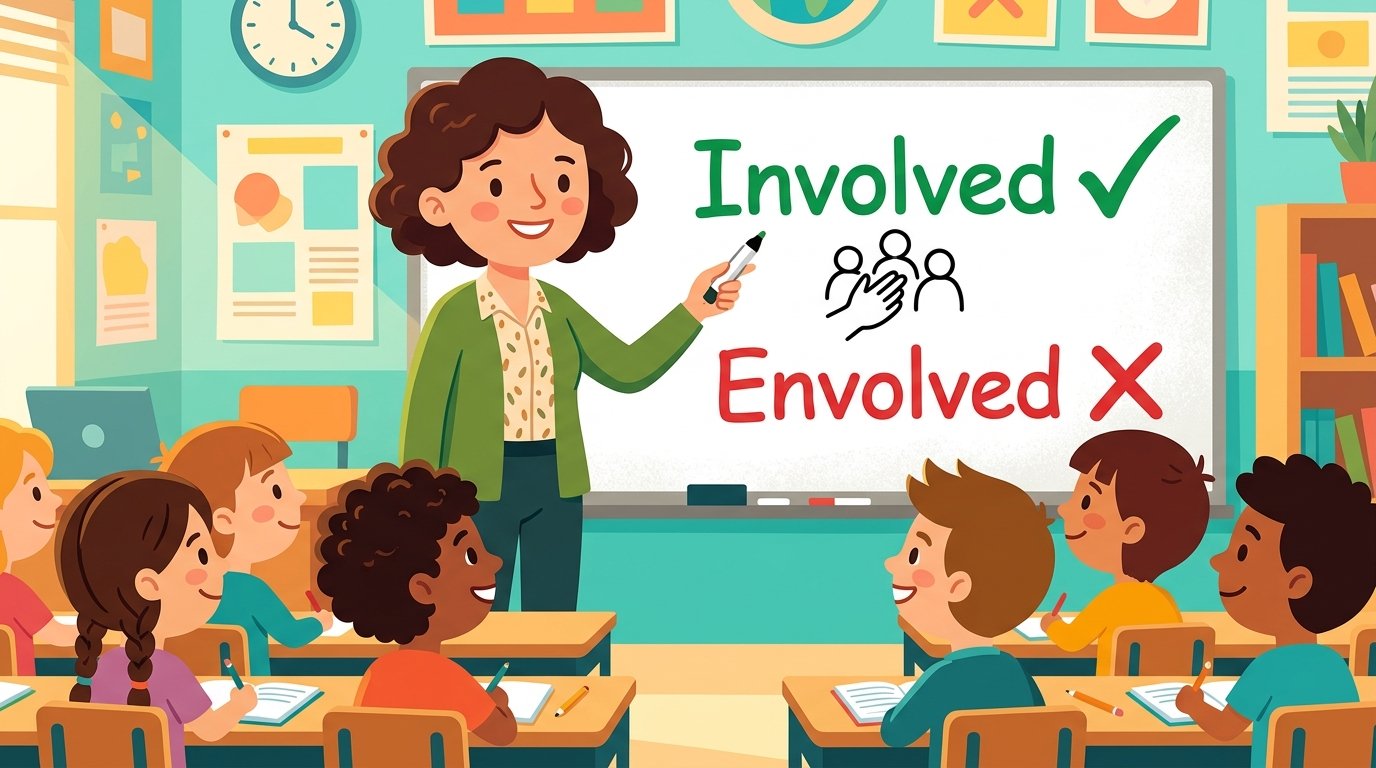
Two words that sound almost identical often trip people up in everyday writing: involved or envolved. If you’ve ever typed “envolved” and had your spell-checker flag it, you’re far from alone. This guide clears up the confusion once and for all.
Involved or Envolved: The Quick Answer
- Involved — Correct, standard English word
- Envolved — Incorrect, not a recognized word in any major dictionary
The correct choice is always “involved,” which means having a part in something, being engaged in an activity, or showing connection and participation.
Why Do People Confuse These Two Words?
The mix-up mostly comes down to how similar “involved” and “evolved” sound when spoken quickly.
- “Involved” comes from “involve” — to include or engage.
- “Evolved” comes from “evolve” — to develop or change over time.
When these two words blend together in someone’s mind, the result is the mistaken spelling “envolved.” In short, you can’t be “envolved in a project” — you’re “involved in a project.”
What Does “Involved” Actually Mean?
According to major dictionaries, involved means:
- Taking part in something; being included in an activity or situation
- Complicated or intricate in detail
Origin
The word traces back to the Latin root “involvere,” meaning “to roll into” or “to enfold.” Over time, it evolved into the modern English word “involve,” describing being part of something — emotionally, physically, or intellectually.
Examples
- “She’s deeply involved in environmental work.”
- “The instructions were too involved for beginners.”
Both usages are correct, showing just how flexible the word can be depending on context.
Why “Envolved” Doesn’t Exist
Despite showing up occasionally in social media posts, resumes, and even business emails, “envolved” has no linguistic basis in English.
Why People Write It Anyway
The spelling confusion happens because of overlapping patterns:
- “Involved” → from “involve” (to include)
- “Evolved” → from “evolve” (to develop)
When people mentally combine these two, “envolved” is the accidental result — but no major dictionary, including Cambridge, Oxford, Merriam-Webster, or Collins, recognizes it as a real word.
The Different Uses of “Involved”
“Involved” is versatile, functioning as both a verb and an adjective.
As a Verb (Past Tense of “Involve”)
When used as a verb, “involved” means to include or engage someone in an activity or process.
Examples:
- “The manager involved his team in every major decision.”
- “The study involved more than 500 participants.”
As an Adjective
As an adjective, “involved” can describe something complex, detailed, or emotionally engaged.
Examples:
- “The plan was too involved to understand.” (complexity)
- “They’re in an involved relationship.” (emotional connection)
Involved or Envolved: Different Contexts of Use
Describing Complexity
“Involved” often describes situations or processes that are complicated or detailed.
Example:
- “The tax filing process can be quite involved for new business owners.”
Synonyms in this sense include complex, intricate, elaborate, and detailed.
Emotional or Relational Context
The word also expresses emotional connection or participation in a relationship.
Example:
- “They’re emotionally involved in each other’s lives.”
Professional or Social Engagement
“Involved” can describe actively participating in a group, event, or activity.
Example:
- “She’s heavily involved in community development projects.”
In workplaces, being described as “involved” is generally a positive trait, signaling responsibility and commitment.
Involved vs Envolved vs Evolved: A Quick Comparison
| Word | Correct? | Meaning | Example |
|---|---|---|---|
| Involved | Yes | Taking part, engaged, or complex | “He’s involved in the project.” |
| Envolved | No | Not a real word | “He’s envolved in the project.” (wrong) |
| Evolved | Yes | Developed or transformed | “Society has evolved over time.” |
Remember: you get “involved” in something, but things “evolve” over time.
Common Prepositions Used With “Involved”
| Preposition | Example | Meaning |
|---|---|---|
| In | “He’s involved in politics.” | Participation |
| With | “She’s involved with the team.” | Association |
| At | “They were involved at every stage.” | Specific involvement |
How to Avoid Writing “Envolved” by Mistake
Avoiding this mistake becomes simple once you understand the difference.
1. Remember the Root Meaning
If you mean “participate,” use involve — never “envolve.”
2. Try This Memory Trick
“You’re IN something when you’re INvolved, not EN something.”
That small phrase can help lock the correct spelling into memory.
3. Read Your Sentence Aloud
If it sounds off, it probably is. “I got envolved in the project” reads awkwardly compared to “I got involved in the project.”
4. Watch Out for Spell-Check Gaps
Spell-check tools sometimes autocorrect “envolved” to either “involved” or “evolved,” depending on context — both of which carry very different meanings, so always double-check manually.
Why the Involved or Envolved Mistake Can Hurt Your Writing
Using “envolved” instead of “involved” might seem like a small slip, but it can genuinely affect how professional your writing appears — especially in formal emails, social posts, or business communication, where a single spelling error can raise questions about attention to detail.
FAQs About Involved or Envolved
Is “envolved” ever used in English?
No. “Envolved” isn’t an accepted or valid word in the English language. You won’t find it in any major dictionary, because it doesn’t officially exist.
Why do people confuse “involved” and “envolved”?
The confusion happens because the two words sound similar when spoken, and many learners assume they’re interchangeable. Only “involved” is correct.
What does “involved” actually mean?
“Involved” means being part of something, engaged in an activity, or connected to a situation or project. For example: “She’s involved in community service.”
How can I remember which one to use?
Think of the word “involve” as something that draws you in. If you’re ever unsure, check a dictionary — you’ll only find “involved,” never “envolved.”
What’s the best way to avoid this spelling mistake?
Read more, practice spelling, and remember that “en” doesn’t belong at the start of “involved.” With repetition, the correct form sticks naturally.
Conclusion
The debate over involved or envolved has a clear answer. “Involved” is the grammatically correct, widely accepted term, while “envolved” is simply a misspelling that should be avoided in all forms of writing or communication. Understanding this distinction sharpens your language skills, helps you avoid mistakes, and lets you write with more clarity and confidence.




Leave a Reply