

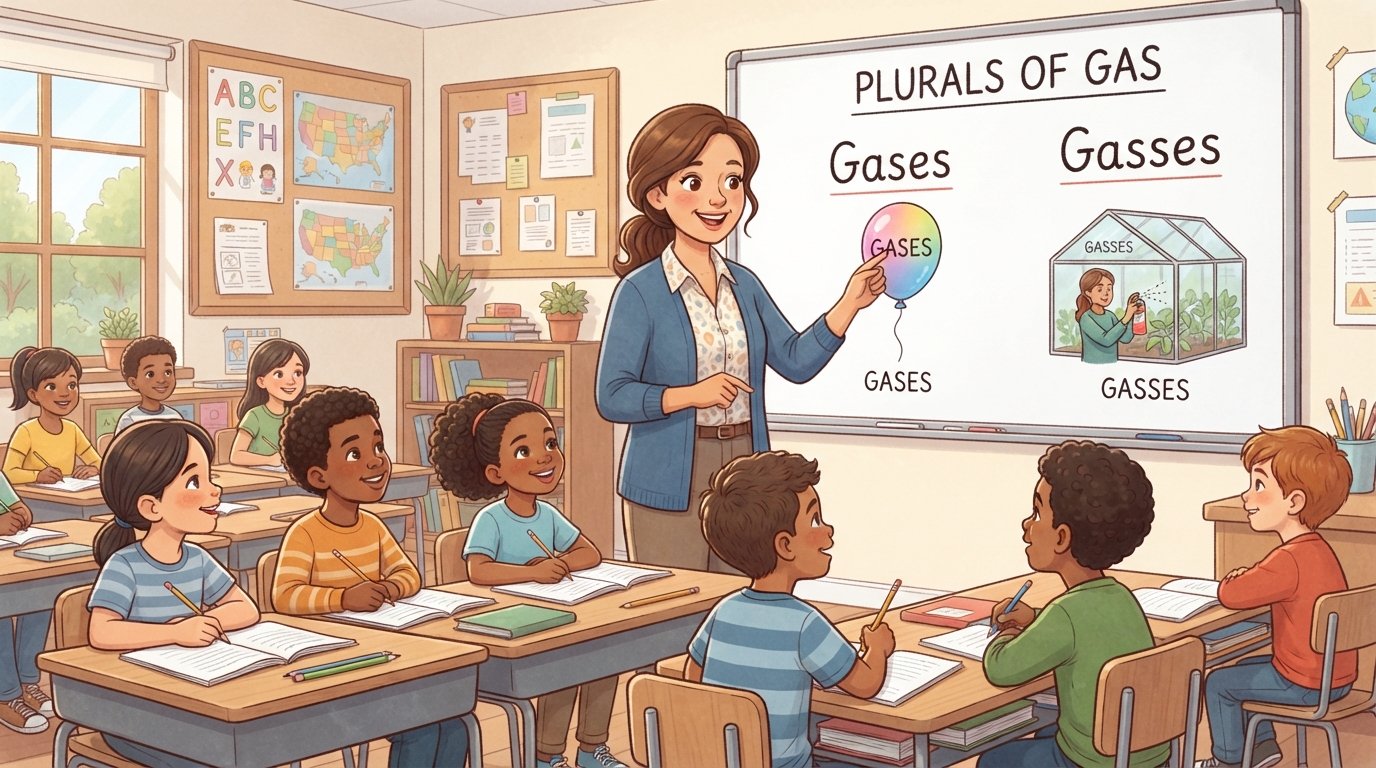
When picking up English, plenty of learners get stuck on the spelling and meaning behind lookalike words such as gases and gasses. The real difference comes down to context and grammatical role. Gases typically refers to substances like oxygen or carbon dioxide, terms you’d expect to hear during a science class or lab discussion. Gasses, on the other hand, functions as a verb describing the act of releasing or applying gas to something. Through years of teaching, I’ve found that pairing this concept with hands-on writing practice and reading sentences aloud helps learners notice how two nearly identical-sounding words can carry such different meanings. This kind of practical approach makes the lesson stick far better than simple memorization ever could.
With the right guidance, learners can write with more precision, sharpen their spelling, and build stronger overall language skills. Working through these small distinctions builds confidence and makes telling gases and gasses apart feel genuinely rewarding. By combining writing practice, repetition, and real examples, the contrast becomes clear — scientific, lab-based usage on one side, and action-based, process-driven usage on the other. Even a few minutes of consistent practice each day can help this concept become second nature.
The Core Difference: Gases vs. Gasses
Here’s a quick side-by-side comparison to clarify how each word functions:
| Word | Part of Speech | Meaning | Example Sentence |
|---|---|---|---|
| Gases | Noun | Plural of gas; substances existing in a gaseous state | “Oxygen and nitrogen are essential gases for life.” |
| Gasses | Verb | Third-person singular of “to gas”; to expose to gas | “The technician gasses the furnace to check for leaks.” |
Keeping this table in mind will help you instantly know which spelling to reach for, depending on whether the word is functioning as a noun or a verb.
Getting to Know “Gases”
A Scientific Point of View
Gases make up one of the fundamental states of matter, alongside solids and liquids. Unlike solids, which hold a fixed shape, or liquids, which take on the shape of whatever container holds them, gases spread out to fill any available space.
A few well-known examples of gases include:
- Oxygen (O₂): Essential for breathing in humans and animals
- Nitrogen (N₂): Makes up roughly 78% of Earth’s atmosphere
- Carbon dioxide (CO₂): Produced through respiration and combustion, and essential for photosynthesis
- Helium (He): Commonly used in balloons and cooling systems
Within scientific writing, using gases correctly really matters. A chemistry report that states “the reaction produces harmful gasses” would be flagged as incorrect. The proper plural noun is always gases.
How We Encounter It in Daily Life
In everyday situations, gases show up in plenty of familiar forms:
- Cooking: Natural gas powering a kitchen stove
- Vehicles: Exhaust gases released from engines
- Industry: Compressed gases used in welding or stored in medical oxygen tanks
A few example sentences:
- “Vehicles release toxic gases into the atmosphere.”
- “Natural gases serve as a major source of energy across the globe.”
The Rule Behind Its Plural Form
The word gas forms its plural simply by adding -es, giving us gases. Unlike a lot of irregular English plurals, this one follows a very predictable pattern. A few similar examples include:
- Glass → Glasses
- Class → Classes
Getting to Know “Gasses”
Breaking Down the Verb Form
While gases functions as a noun, gasses works as a verb. It describes the act of applying or exposing something to gas. In the present tense, third-person singular form, we use gasses:
- “She gasses the plants to eliminate pests.”
- “The technician gasses the furnace to check its efficiency.”
This usage doesn’t come up nearly as often, but it still matters in scientific, agricultural, and industrial settings.
Where You’ll Typically Find It
Gasses tends to appear in contexts like:
- Agriculture: Fumigating crops or greenhouses
- Energy and industrial work: Filling or testing gas-powered equipment
- Medical labs: Running controlled experiments involving gas
A word of caution: Never use gasses to refer to emissions or substances themselves. It is never a valid plural form of “gas” in scientific or everyday writing.
Understanding the Grammar Rule Behind It
The verb to gas follows a familiar English pattern: when a short, single-syllable verb ends in a single vowel followed by a consonant, that consonant often doubles before adding the third-person singular ending. A few examples of similar patterns:
| Verb | Third-Person Singular | Example Sentence |
|---|---|---|
| Gas | Gasses | “He gasses the machine every morning.” |
| Run | Runs | “She runs every day.” |
| Sit | Sits | “The cat sits on the windowsill.” |
Frequent Mix-Ups and How to Avoid Them
Plenty of learners confuse gases and gasses simply because they sound exactly alike when spoken. Here are a few common errors, along with their corrections:
| Incorrect Usage | Correct Usage | Why It’s Wrong |
|---|---|---|
| “The car emits dangerous gasses.” | “The car emits dangerous gases.” | The plural noun should always be gases. |
| “She gases the air in the classroom.” | “She gasses the air in the classroom.” | This calls for the correct verb form. |
| “All living things need gasses to survive.” | “All living things need gases to survive.” | This is a noun, not a verb. |
A few tips to help you avoid these slip-ups:
- Ask yourself: is this word describing a thing (noun) or an action (verb)?
- If it’s a thing, always reach for gases.
- If it’s an action, reach for gasses instead.
A Look at Where These Words Came From
The word gas was actually coined back in the 17th century by the Flemish chemist Jan Baptist van Helmont, who adapted it from the Greek word chaos to describe a substance that was neither fully solid nor liquid.
As English spelling conventions developed over time, the consonant-doubling pattern seen in gasses followed the same standard rules used for other third-person verb forms. This bit of history helps explain why two words that sound so alike ended up serving completely different grammatical roles.
Handy Tips and Memory Tricks
Here are a few quick tricks to help this distinction stick.
- Gases = things you can see or sense around you (plural noun). Think “substances floating in the air.”
- Gasses = the action of doing something with gas (verb). Think “he gasses the room.”
A simple mnemonic:
“Single s in gases points to Substances; the double s in gasses signals Some Action taking place.”
A helpful visual: picture a bottle labeled “gases” representing the noun, and a person spraying a greenhouse labeled “gasses” representing the verb.
Real Examples and a Quick Practice Round
Here’s a table showing correct versus incorrect usage in action:
| Sentence Type | Incorrect | Correct |
|---|---|---|
| Scientific | “The experiment releases dangerous gasses.” | “The experiment releases dangerous gases.” |
| Industrial | “The technician gases the pipeline.” | “The technician gasses the pipeline.” |
| Everyday | “Cooking emits gasses.” | “Cooking emits gases.” |
A quick quiz to test yourself:
- The volcano emitted sulfur dioxide (gases/gasses).
- The pest control officer (gases/gasses) the greenhouse.
- Students learned about oxygen and nitrogen (gases/gasses) in chemistry class.
Answers: 1. gases, 2. gasses, 3. gases
Wrapping Up
Getting comfortable with the difference between gases and gasses might feel tricky at first, but focusing on context and grammatical role makes it much easier to sort out. Gases refers to substances like oxygen or carbon dioxide, terms you’ll often encounter in scientific and lab settings, while gasses is a verb describing the act of applying or releasing gas as part of an action or process. Through consistent writing practice, reading examples aloud, and steady repetition, learners can write with more precision, sharpen their overall language skills, and build real confidence in telling these lookalike words apart. This kind of practical approach turns memorization into something genuinely enjoyable and makes mastering the distinction feel truly rewarding.
Frequently Asked Questions
Are “gases” and “gasses” pronounced the same way?
Yes, both words sound identical when spoken aloud, but their meaning and grammatical role are completely different.
Can I use “gasses” in place of “gases” in scientific writing?
No. “Gasses” is a verb describing the act of emitting or applying gas, while “gases” refers to substances like oxygen or carbon dioxide.
What’s an easy way to remember the difference?
Pair the concept with writing practice and reading sentences aloud, pay attention to how each word functions in a sentence, and the distinction will gradually become second nature.
Does practicing this regularly actually help?
Yes, even a little consistent practice each day helps this distinction stick and builds real confidence in using both words correctly.
References & Further Reading
- Merriam-Webster Dictionary – Gas
- Zumdahl, Steven S. Chemistry, 10th Edition, Cengage Learning
- Atkins, P., & de Paula, J. Physical Chemistry, 11th Edition, Oxford University Press









Leave a Reply