

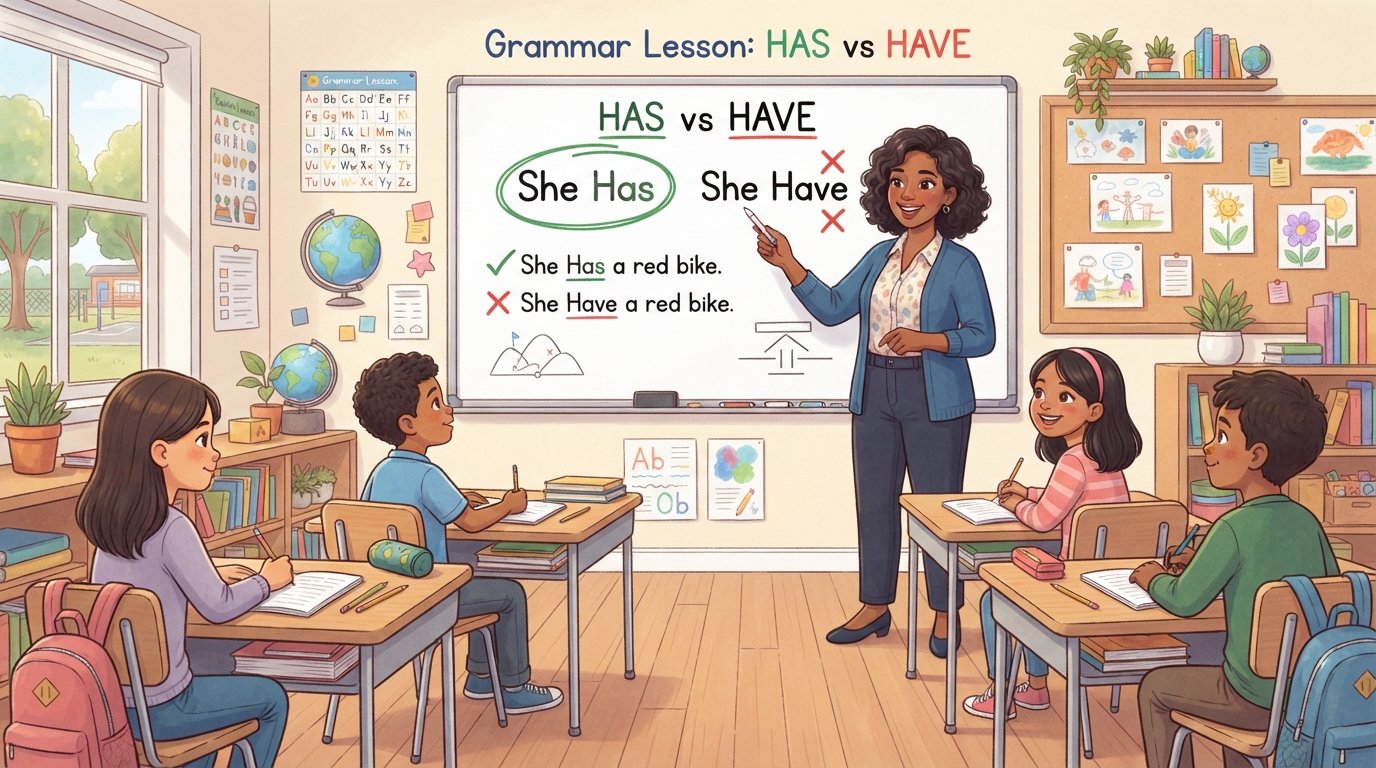
Plenty of English learners find themselves second-guessing whether to write she has or she have. The right verb form really comes down to the subject of the sentence. With singular, third-person subjects like he, she, or it, “has” is always the correct choice. With plural subjects, or with I and you, “have” is the one you want. For instance, you’d say “She has a car,” but you’d say “They have a car.” Once this simple rule clicks, your English starts sounding noticeably more fluent and confident, helping you sidestep one of the most common errors learners run into with subject-verb agreement.
Getting comfortable with verb conjugation and tense rules genuinely matters here. Subject-verb agreement can feel tricky at first, but with consistent practice and real examples, this piece of grammar becomes second nature. Even experienced English speakers slip up here occasionally, so it’s worth double-checking. Paying close attention to whether your subject is singular or plural — and remembering which verb pairs with which — makes your writing simple, effective, and confident. Over time, understanding verb conjugation, following clear examples, and practicing regularly all add up to a solid grammar foundation that helps you avoid these common slip-ups.
Breaking Down “Has” vs “Have”
At the heart of this confusion sits one simple rule: subject-verb agreement.
- Has pairs with third-person singular subjects: he, she, it, or a singular noun.
- Have pairs with I, you, we, they, or plural nouns.
Here’s a quick reference table:
| Subject | Correct Verb | Example |
|---|---|---|
| I | have | I have a meeting today. |
| You | have | You have a point to make. |
| He/She/It | has | She has finished her homework. |
| We/They | have | They have completed the project. |
Notice that she has is always correct in standard English, while she have is grammatically wrong outside of certain dialects or very casual speech.
The Basics of Subject-Verb Agreement
Subject-verb agreement simply means that the verb needs to match the subject in both person and number.
- Third-person singular subjects always pair with has in the present tense.
- Plural subjects, along with first- and second-person singular subjects, always pair with have.
Mistakes here often happen because writers focus on the noun itself rather than the underlying pronoun. For example:
- Incorrect: She have a new laptop.
- Correct: She has a new laptop.
A helpful habit: before writing, always ask yourself, “Who is performing the action?” Pin down the subject first, and the correct verb naturally follows.
Using “Has” the Right Way
Has pairs with:
- Third-person singular pronouns: he, she, it
- Singular nouns and proper names: John, the company, the cat
A few everyday examples:
- She has a car.
- John has completed the task.
- The dog has eaten its breakfast.
Common idiomatic phrases using “has”:
- She has a point.
- He has a knack for storytelling.
- She has a lot on her plate.
These kinds of expressions show just how often has shows up naturally across both formal and casual English.
Using “Have” the Right Way
Have pairs with:
- I, you, we, they
- Plural nouns
A few examples:
- We have a plan.
- They have many responsibilities.
- I have finished my homework.
- You have been very helpful.
Using “have” in questions and negative sentences:
- Do you have time?
- I don’t have the answer.
Notice that after “do” or “does,” the verb have always stays in its base form. This is one of the more common trip-ups for English learners.
Collective Nouns and a Few Special Cases
English gets a little trickier when dealing with collective nouns — words like teams, groups, or companies.
- Singular emphasis: Use has when the group is being treated as a single unit.
- The team has won the championship.
- Plural emphasis: Use have when the focus is on individual members within the group.
- The team have different opinions about strategy.
An example involving a company:
- Apple has released a new iPhone model. (Apple = a single entity)
- The employees of Apple have different work schedules. (employees = individual people)
This subtle distinction trips up a lot of writers, but getting it right really matters for polished, professional English.
Modal Verbs and “Has/Have”
Modal verbs like should, could, would, might, and must always pair with have, never with has.
- Correct: She should have studied more.
- Incorrect: She should has studied more.
Why this happens: modal verbs are followed by the base form of the next verb, and the base form of “have” doesn’t change no matter what the subject is.
A few more examples:
- He could have helped us.
- They might have missed the train.
- I would have called you if I had known.
Keep this in mind: whenever a modal verb is involved, always use “have,” regardless of whether the subject is singular or plural.
Perfect Tenses: Sorting Out Has and Have
Perfect tenses often cause hesitation since they rely on either has or have, combined with the past participle of a verb.
Present Perfect:
- Third-person singular: She has visited Paris.
- Plural subjects: They have completed their homework.
Past Perfect:
- All subjects: She had eaten before leaving.
Future Perfect:
- All subjects: They will have finished the project by Monday.
| Tense | Subject | Correct Form | Example |
|---|---|---|---|
| Present Perfect | He/She/It | has | She has eaten lunch. |
| Present Perfect | I/You/We/They | have | We have seen that movie. |
| Past Perfect | All | had | He had left before noon. |
| Future Perfect | All | will have | They will have completed it. |
Notice how has stays reserved specifically for third-person singular subjects within present perfect tense.
Common Mistakes and How to Steer Clear of Them
Here’s a rundown of frequent errors tied to she has or she have:
- Mixing up singular and plural forms:
- Incorrect: She have a new idea.
- Correct: She has a new idea.
- Misusing modal verbs:
- Incorrect: She should has come earlier.
- Correct: She should have come earlier.
- Overlooking the subject type:
- Incorrect: The committee have decided. (unless you’re specifically emphasizing individual members)
- Correct: The committee has decided.
A few tips to avoid these slip-ups:
- Identify the subject before anything else.
- Remember the core rule: third-person singular = has.
- Stay consistent with modal + have.
- Read your sentences out loud — your ear often catches mistakes your eyes might miss.
Practical Ways to Build Mastery
Getting comfortable with she has or she have takes a bit of practice, but a few simple strategies can speed things up:
- Always identify the subject first: ask yourself who’s performing the action.
- Remember the third-person rule: He/She/It always pairs with has.
- Use a memory trick: something like “She HAS the power” — third-person singular equals HAS.
- Practice modal constructions: compare “she could have” versus the incorrect “she could has.”
- Try daily writing exercises: work sentences using different pronouns and tenses into your regular practice.
A short practice exercise: Fill in the blanks below.
- She ___ (have/has) already eaten breakfast.
- I ___ (have/has) finished my report.
- They ___ (have/has) been to London twice.
- He should ___ (have/has) studied harder.
Answers: 1) has 2) have 3) have 4) have
Wrapping Up
In English, matching the correct verb to its subject is a fundamental part of clear writing. Keep in mind that she has is always the correct choice for singular, third-person subjects like he, she, or it, while have belongs with plural subjects or with I and you. By sticking to the rules of subject-verb agreement, paying attention to verb conjugation, and practicing with real examples, you can avoid common mistakes, write with more confidence, and make your English sound genuinely fluent and natural. Focusing on this small but essential piece of grammar keeps your writing simple, clear, and accurate.
Frequently Asked Questions
Is “she have” ever correct?
No, “she have” is always incorrect in standard English. For singular, third-person subjects, the correct verb is always “has.”
Can “has” ever be used with plural subjects?
No, “has” only pairs with singular, third-person subjects. Plural subjects always take “have.”
Why do learners commonly make this mistake?
Many English learners mix up singular and plural subjects, or get confused about verb conjugation, which leads to common errors in subject-verb agreement.
What’s a simple way to remember the correct usage?
Start by identifying the subject: if it’s he, she, or it, use “has.” If it’s I, you, or they, use “have.” Practicing with real examples helps this rule stick.
Does this distinction really matter for sounding fluent?
Yes, using “has” and “have” correctly plays a real role in sounding fluent and confident, and it helps you avoid one of the more common mistakes learners make in everyday English.



Leave a Reply