

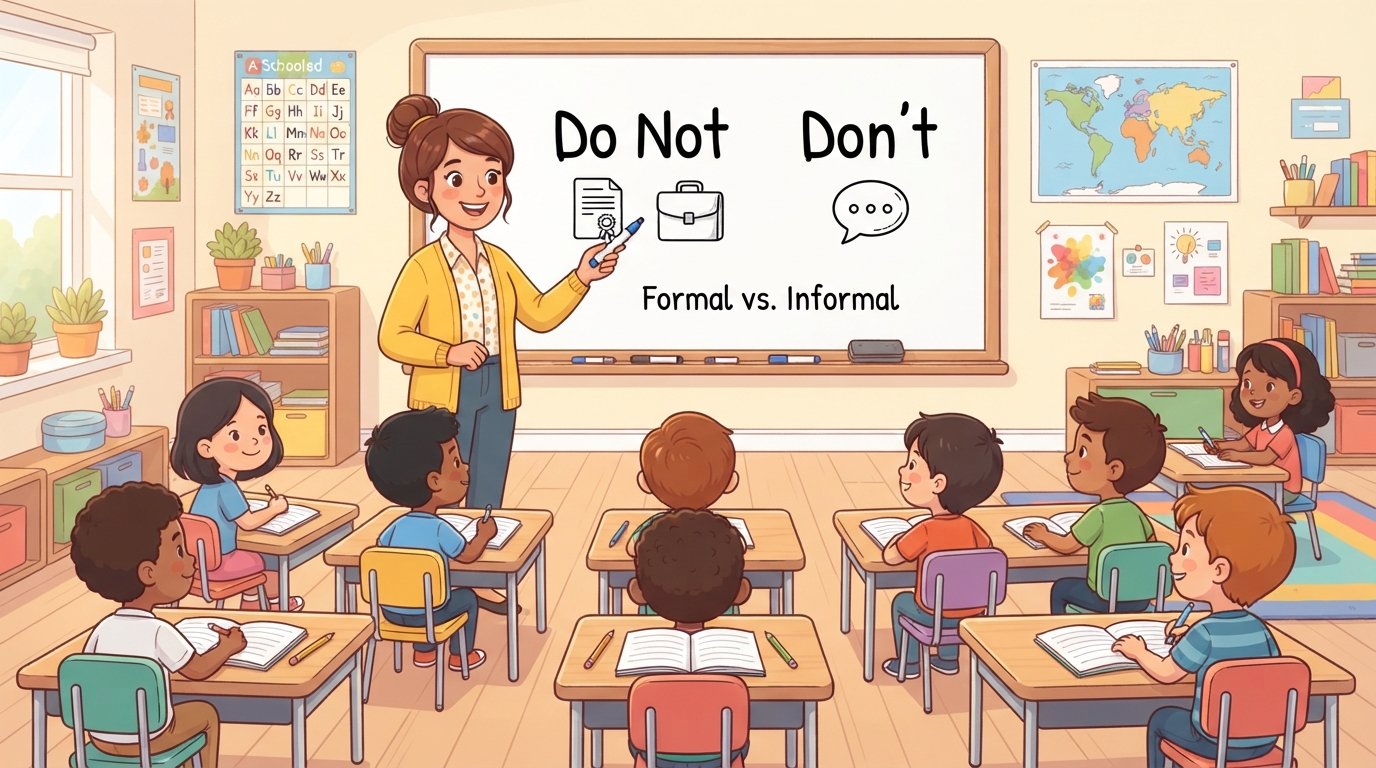
Both mean exactly the same thing, yet picking the wrong one can make your writing sound stiff — or too casual for the moment. Do not vs don’t comes down to tone, context, and audience rather than grammar rules. Here’s how to choose correctly every time.
Do Not vs Don’t: The Quick Answer
- Do not — the full form, more formal, adds emphasis and authority.
- Don’t — the contraction, informal, conversational, and natural in everyday speech.
Both are grammatically correct. The real difference lies in formality and tone.
| Feature | Do Not | Don’t |
|---|---|---|
| Tone | Formal, strong | Informal, conversational |
| Usage | Academic, professional, emphatic | Everyday speech, casual writing |
| Emphasis | High | Moderate |
| Example | “Do not submit late assignments.” | “Don’t forget your homework.” |
Think of “do not” as a teacher giving instructions, and “don’t” as a friend offering a casual reminder.
When Should You Use “Do Not”?
Formal contexts call for careful word choice. Using “do not” signals professionalism, clarity, and authority.
Academic Writing
Research papers, essays, and assignments generally expect the full form.
- “Students do not submit assignments after the deadline.”
Professional Communication
Emails, reports, and memos benefit from precise, unambiguous language.
- “We do not accept incomplete applications.”
Strong Instructions and Warnings
When a command needs weight behind it, the full form adds emphasis.
- “Do not touch the laboratory equipment without permission.”
In each case, “do not” communicates seriousness — exactly what you want in official announcements, teaching materials, or professional settings.
When Does “Don’t” Work Better?
“Don’t” shines in everyday communication, keeping sentences smooth, natural, and approachable.
Casual Conversation
- “Don’t be late to class.”
Informal Emails and Messages
- “Don’t forget to bring your notes.”
Social Media and Online Writing
- “Don’t miss the event tonight!”
A quick tip: overusing “do not” in casual settings can make you sound stiff or robotic. On the flip side, leaning too heavily on “don’t” in formal documents can come across as unprofessional.
How Tone Shapes Your Choice
Your choice between these forms directly shapes how readers perceive your message.
- Formal tone projects authority and credibility — ideal for teachers, professionals, and official documents.
- Informal tone feels friendly and approachable — better suited to peers, colleagues, and casual writing.
Compare these two:
- Formal: “Do not hesitate to contact me for further details.”
- Informal: “Don’t hesitate to call me if you need anything.”
Same meaning, very different feel.
Do Not vs Don’t: The Grammar Rules
Grammatical correctness here depends on subject-verb agreement. Here’s the breakdown by pronoun:
| Pronoun | Full Form | Contraction |
|---|---|---|
| I | I do not | I don’t |
| You | You do not | You don’t |
| He / She / It | He / She / It does not | He / She / It doesn’t |
| We | We do not | We don’t |
| They | They do not | They don’t |
The key thing to remember: third person singular always uses “does not” or “doesn’t” — never “don’t.”
- Correct: “He does not play soccer.”
- Incorrect: “He don’t play soccer.”
Contractions and When to Avoid Them
Contractions make speech sound natural and fluent, but they aren’t always appropriate.
Avoid contractions in: academic papers, professional reports, official memos, and legal documents.
Contractions work well in: conversations, casual emails, blog posts, and social media.
That said, even in informal speech, you can switch to “do not” when you want extra emphasis — “I do not want to talk about this” hits harder than the contracted version.
Common Mistakes to Watch For
| Mistake | Correction |
|---|---|
| “He don’t like pizza.” | “He doesn’t like pizza.” |
| “I doesn’t agree.” | “I don’t agree.” |
| “They doesn’t understand.” | “They don’t understand.” |
When in doubt for written work, defaulting to “do not” is generally the safer choice.
Common Misconceptions About Do Not vs Don’t
Myth 1: “Don’t” Is Always Informal
Not quite. “Don’t” appears regularly in professional speech and friendly business emails when used appropriately.
Myth 2: “Do Not” Sounds Outdated
Far from it. The full form remains strong and widely used across formal writing, instructions, and official communication.
Myth 3: Third Person Always Uses “Don’t”
Incorrect. He, she, and it always take “doesn’t” or “does not.”
Practical Tips for Choosing Between the Two
Here’s a quick checklist to guide your decision:
- Formal context? → Use “do not”
- Informal context? → Use “don’t”
- Third person singular? → Use “does not” or “doesn’t”
- Need emphasis? → Use “do not”
- Conversational tone? → Use “don’t”
One more useful habit: read your sentence out loud. If it sounds unnatural or overly stiff for the setting, adjust accordingly.
Do Not vs Don’t in Real-Life Contexts
Academic Writing
- “Students do not submit late assignments without prior approval.”
- “We do not condone plagiarism in any form.”
Professional Writing
- “Please do not forward confidential information.”
- “Employees do not have access to restricted areas without authorization.”
Conversational English
- “Don’t forget your lunch today!”
- “Don’t worry about the meeting; it’s been rescheduled.”
| Context | Do Not Example | Don’t Example |
|---|---|---|
| Academic | “Students do not copy homework.” | “Students don’t copy homework.” |
| Professional | “Employees do not leave early.” | “Employees don’t leave early.” |
| Conversational | “Do not forget your keys.” | “Don’t forget your keys.” |
Key Takeaways
- “Do not” is formal, emphatic, and suited to academic and professional writing.
- “Don’t” is informal, conversational, and natural in daily communication.
- Third person singular always takes “does not” or “doesn’t.”
- Tone and context determine your choice — not grammar rules.
- Reading your writing aloud helps you catch anything that sounds off.
FAQs About Do Not vs Don’t
Can I use “don’t” in formal writing?
While “don’t” is grammatically correct, it suits informal speech and casual writing better. For academic papers or professional emails, “do not” is the safer choice.
Are “do not” and “don’t” interchangeable?
In most cases, yes — they carry the same basic meaning. The difference comes down to tone and formality, which depend entirely on your context.
How do I decide which form to use?
Consider your audience, the setting, and whether you want your writing to sound formal and authoritative or natural and approachable.
Does using “do not” make writing sound stiff?
Not necessarily. In formal or academic contexts, it adds clarity and emphasis, making your message feel precise and professional.
Can “don’t” appear in professional emails?
Yes, in friendly or conversational professional emails. For strict formal communication, stick with “do not.”
Conclusion
Choosing between do not vs don’t is about more than grammar — it’s about tone, context, and how you want your writing to land. “Do not” fits formal writing, academic papers, and professional emails, delivering clarity and emphasis. “Don’t” works perfectly in informal speech, casual writing, and everyday conversation, keeping your communication natural and relaxed. Recognizing these differences lets you communicate clearly and confidently in any situation.








Leave a Reply