

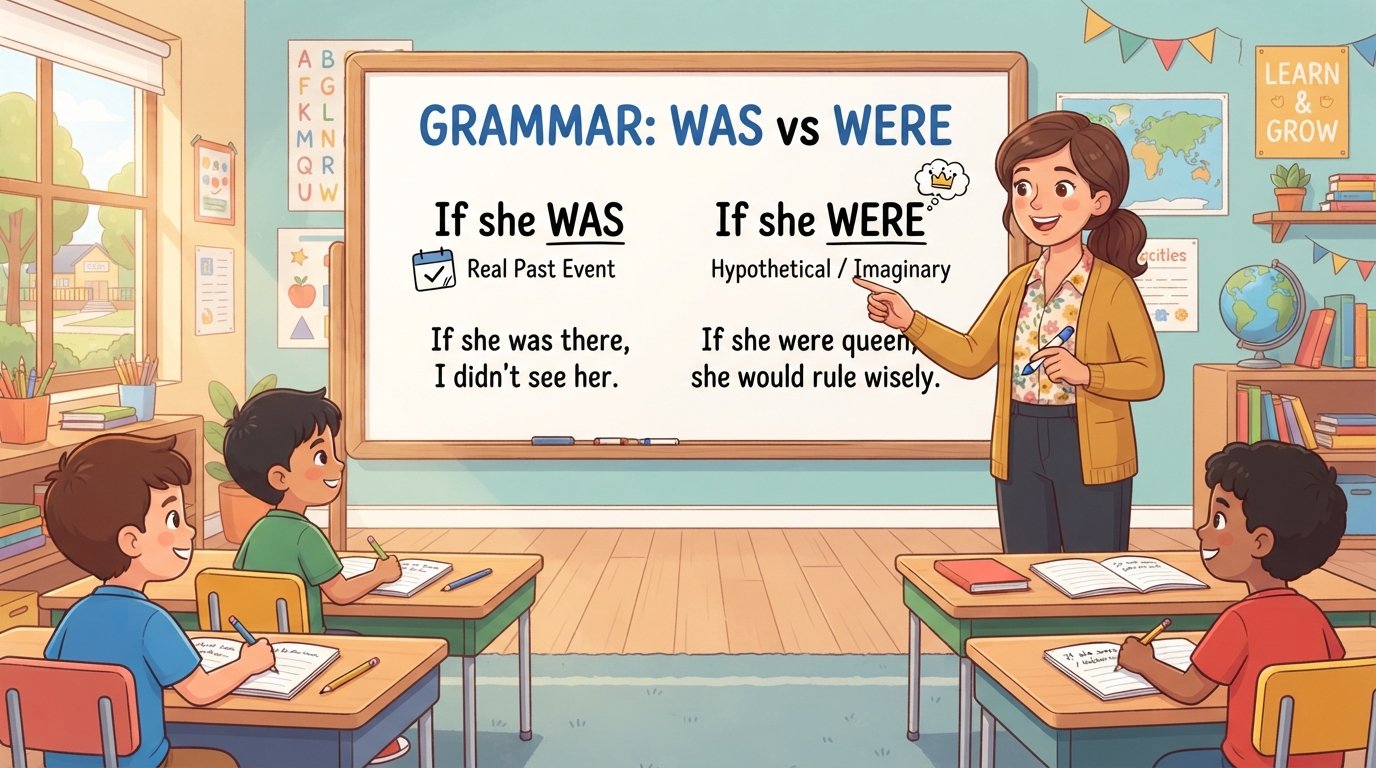
One tiny word change, and the entire meaning of a sentence shifts. If she was or if she were is one of the most common grammar questions English learners face, and the answer comes down to one thing: whether the situation is real or imagined.
If She Was or If She Were: The Quick Answer
- “If she were” — used for hypothetical, imaginary, or contrary-to-fact situations (subjunctive mood).
- “If she was” — used for real past events or factual situations (indicative mood).
Simple Rule
Unreal = “were.” Real = “was.”
Examples
- “If she were taller, she could reach the shelf.” (imaginary — she isn’t taller)
- “If she was at the meeting, I didn’t see her.” (real possibility about the past)
Understanding Conditional Sentences
Conditional sentences express possibilities, hypotheticals, or cause-and-effect relationships. They typically contain two parts: the “if clause” and the main clause.
English has four main types:
| Type | Use | Example |
|---|---|---|
| Zero | Facts and general truths | “If water reaches 100°C, it boils.” |
| First | Real future possibilities | “If she finishes her work, she will join us.” |
| Second | Unreal or hypothetical present/future | “If she were rich, she would travel the world.” |
| Third | Unreal past events | “If she had studied harder, she would have passed.” |
The “was” versus “were” question mostly appears in the second and third conditionals, where hypothetical or contrary-to-fact situations get described.
Real vs Unreal Conditions
Figuring out whether a condition is real or unreal is the entire key to choosing correctly.
Real Conditions
These refer to situations that actually happened or genuinely could have. They use the indicative mood, which expresses facts.
- “If she was at the meeting, she received the email.”
Unreal Conditions
These describe imaginary or hypothetical scenarios. They use the subjunctive mood, which expresses wishes, suggestions, or situations contrary to reality.
- “If she were at the meeting, she would have seen the announcement.”
| Condition | Mood | Example |
|---|---|---|
| Real (possible/past) | Indicative | “If she was on time, she got the promotion.” |
| Unreal (hypothetical) | Subjunctive | “If she were on time, she would have avoided the warning.” |
The Grammar Behind “Was” and “Were”
The distinction lives entirely in mood and context.
When to Use “Was”
Used in the indicative mood to describe something that actually happened.
- “If she was nervous, she explained her point clearly.”
Context: a past event or a factual situation.
When to Use “Were”
Used in the subjunctive mood for hypotheticals, wishes, or imaginary scenarios.
- “If she were a doctor, she could treat her patients herself.”
Context: unreal, imagined, or contrary-to-fact situations.
A Closer Look at the Subjunctive Mood
The subjunctive mood in English expresses situations that aren’t real. You’ll spot it in wishes (“I wish she were here”), hypotheticals (“If she were president, she would change the law”), and demands or suggestions (“It’s essential that she be informed”).
Many learners default to “was” even when a hypothetical clearly calls for “were.” Using “were” correctly signals a strong command of English, especially in professional or academic writing.
Using “If She Was” for Real Past Scenarios
“If she was” fits when you’re referring to something that actually happened. This works in both casual and professional English.
Examples:
- “If she was late to the seminar, she probably missed the introduction.”
- “If she was the team leader, she handled the project efficiently.”
Quick test: ask yourself, “Did this event really happen, or could it have?” If yes, use “was.”
A manager writing to a team might say: “If she was involved in the client meeting, she knows the details.” That’s correct — it refers to an actual event, not a hypothetical one.
Using “If She Were” for Hypothetical Situations
“If she were” applies to situations that are imaginary, wishful, or contrary to fact.
Examples:
- “If she were the CEO, she would increase employee benefits.”
- “If she were taller, she could reach the top shelf.”
Hypothetical scenarios show up constantly in reports, presentations, and academic writing. Using “were” here conveys a polished, precise grasp of English.
In education: “If she were the principal, she would implement a new curriculum.” The sentence is clearly hypothetical, not factual.
If She Was or If She Were: Are They Ever Interchangeable?
In casual spoken English, some overlap exists.
- “If she was late, she probably got stuck in traffic.” (real past)
- “If she were late, she would have missed the meeting.” (hypothetical)
Both sound acceptable informally, but mixing them can genuinely confuse your meaning — especially in formal writing.
| Sentence | Context | Correct Mood |
|---|---|---|
| “If she was at the meeting, she got the notes.” | Real past | Indicative |
| “If she were at the meeting, she would see the notes.” | Hypothetical | Subjunctive |
| “If she was the CEO, she increased profits.” | Ambiguous | Better as “were” for clarity |
Common Misconceptions
Myth 1: “Were” Sounds Old-Fashioned
False. The subjunctive “were” remains widely used across professional, academic, and formal English.
Myth 2: Only Formal English Uses “Were”
False. While less common in casual speech, correct usage still prevents confusion.
Myth 3: “Was” Can Always Replace “Were”
False. Doing so can make a hypothetical statement read like a factual one.
| Mistake | Corrected Version | Why |
|---|---|---|
| “If she was taller, she would help.” | “If she were taller, she would help.” | Hypothetical, so subjunctive applies |
| “If she was on time, she got the job.” | Correct as written | Refers to a real past event |
Practical Tips to Master the Difference
Identify the context — real past versus hypothetical. Ask yourself whether the situation is fact or imagination. And practice actively by rewriting sentences using both forms until the pattern feels natural.
Quick Exercise
Choose the correct form:
- If she ___ (was/were) the president, she would reform education.
- If she ___ (was/were) late, she missed the lecture.
- If she ___ (was/were) smarter, she would have solved the problem.
Answers: 1) were, 2) was, 3) were
If She Was or If She Were Across Different Fields
Education: “If she were the principal, she would introduce new policies.” (hypothetical) / “If she was on the faculty committee, she participated actively.” (real)
Business: “If she were the CEO, she could restructure the company.” (hypothetical) / “If she was at the client meeting, she signed the contract.” (real)
The distinction between hypothetical and real scenarios stays clear in every case, depending entirely on which form you choose.
FAQs About If She Was or If She Were
When should I use “if she were”?
Use “if she were” for hypothetical or unreal situations, typically in the subjunctive mood — as in “If she were taller, she could reach the shelf.”
When is “if she was” correct?
“If she was” applies to real situations or actual past events, such as “If she was at the meeting, I didn’t see her.”
How can I remember the difference?
Keep this simple rule in mind: unreal = “were,” real = “was.” Regular practice in speaking and writing makes it stick.
Does one form sound more formal than the other?
Yes. “If she were” carries a more formal, polished tone, while “if she was” feels more casual and conversational.
Can practicing examples really help?
Absolutely. Applying these structures in everyday sentences builds confidence, prevents common mistakes, and sharpens both your writing and speaking.
Conclusion
Knowing when to use if she was or if she were matters for clear, correct English. The key is recognizing whether the situation is real or unreal, past or hypothetical, and applying the right grammatical mood. Mastering this small rule builds confidence in both speaking and writing, helps you avoid common mistakes, and keeps your sentences sounding correct in formal and casual settings alike.




Leave a Reply