

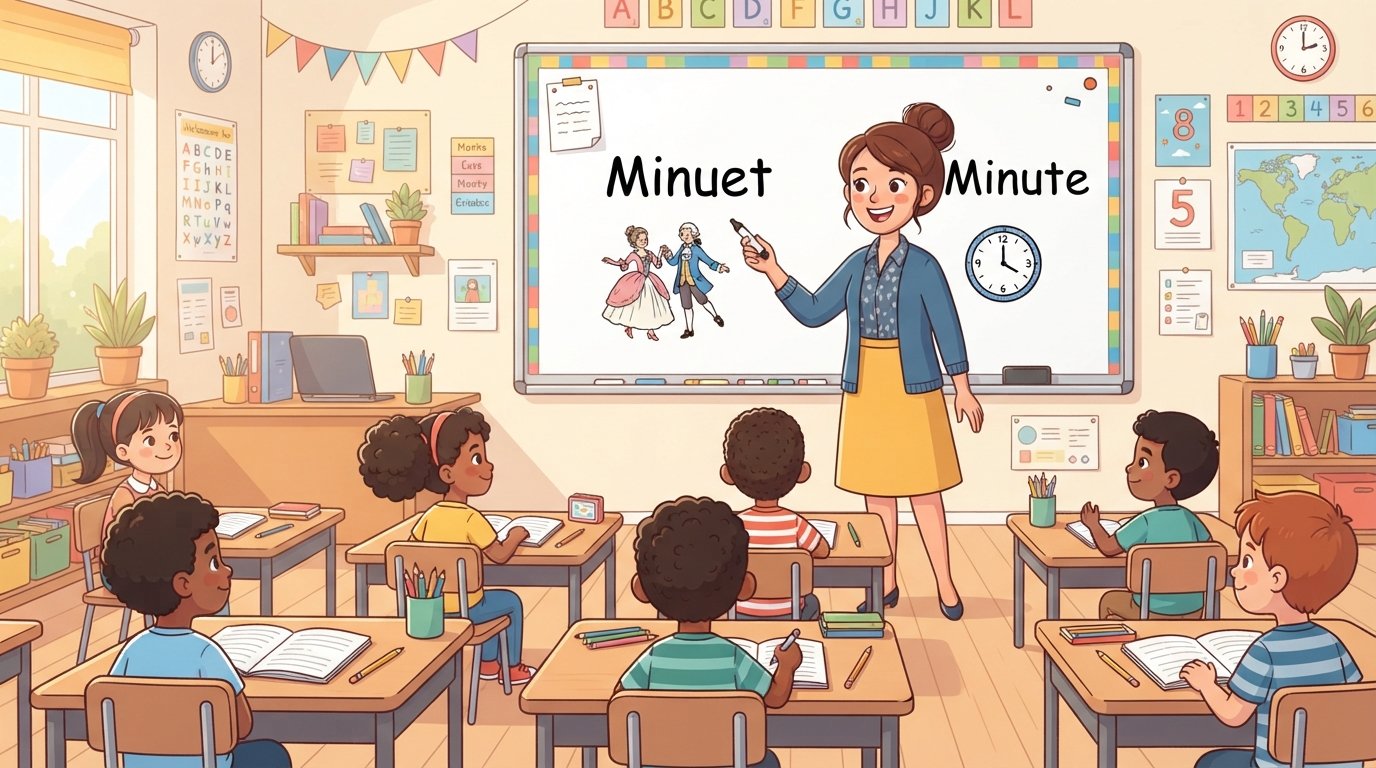
Two words that sound almost the same when spoken quickly, yet belong to entirely different worlds: minuet vs minute. One takes you to a candlelit ballroom in 18th-century France; the other simply tells you how long you’ve been waiting for your coffee. Here’s how to keep them straight for good.
Minuet vs Minute: The Quick Answer
- Minuet — a slow, graceful dance (or its musical accompaniment) from 17th-century France.
- Minute — a unit of time equal to 60 seconds, or an adjective meaning “extremely small.”
Quick Comparison
| Feature | Minuet | Minute |
|---|---|---|
| Meaning | Dance or musical form | Unit of time, or “very small” |
| Origin | French, 17th century | Latin minuta, meaning “small” |
| Pronunciation | /ˌmɪn.juˈɛt/ | /ˈmɪn.ɪt/ (time) or /maɪˈnjuːt/ (small) |
| Common Use | Music, dance, history | Everyday time, scientific precision |
What Is a Minuet?
A minuet is a graceful, slow, stately dance that originated in France during the 17th century. The word also refers to the musical composition written to accompany that dance.
It comes from the French word menuet, meaning “small” or “delicate” — a nod to the dance’s tiny, precise steps.
Where the Minuet Came From
The minuet rose to popularity in European royal courts during the Baroque and Classical periods. Kings, queens, and nobles performed it at formal balls and gatherings, and it became closely associated with refinement and social etiquette.
Famous composers including Bach, Mozart, and Beethoven wrote minuets into their larger works, often as the third movement in a four-movement symphony.
Musical Characteristics of a Minuet
A minuet is typically written in 3/4 time, giving it a smooth, triple-meter rhythm at a moderate tempo. Key features include:
- Three beats per measure
- A controlled, elegant pace
- Symmetrical, structured phrasing
- Light ornamentation for sophistication
Mozart’s Minuet in G Major is a well-known example of this balanced, flowing style.
The Minuet as a Dance
As a dance, the minuet called for upright posture, small precise steps, and close coordination between partners. It was considered a genuine social skill — dancers were taught proper form, bowing, and hand placement as part of court etiquette.
What Does “Minute” Mean?
Minute (pronounced /ˈmɪnɪt/) is most commonly known as a unit of time equal to 60 seconds. It’s the standard measure used in scheduling, cooking, sports, and everyday conversation.
Example: “The lecture will begin in ten minutes.”
“Minute” as an Adjective
Pronounced differently — /maɪˈnjuːt/ — “minute” can also describe something extremely small, precise, or insignificant.
Examples:
- “The differences in the results were minute but important.”
- “Pay close attention to the minute details in the contract.”
This usage shows up often in academic, scientific, and technical writing, where precision matters.
“Minute” in Professional Settings
“Minute” also appears in business language as a noun referring to official records of a meeting — as in “the minutes of the meeting.”
Example: “Please review the minutes before Friday’s follow-up.”
Minuet vs Minute: Pronunciation Matters
Since these words look somewhat alike on paper, pronunciation is often what actually separates them in speech.
| Word | Pronunciation | Context |
|---|---|---|
| Minute | /ˈmɪn.ɪt/ | Time or small amount |
| Minute (adj.) | /maɪˈnjuːt/ | Extremely small or precise |
| Minuet | /ˌmɪn.juˈɛt/ | Dance or musical piece |
Getting the pronunciation right matters, especially in teaching, presenting, or performing in professional settings.
Minuet vs Minute in Everyday Use
Using “Minuet” Correctly
- “The couple danced a minuet gracefully at the historical reenactment.”
- “Beethoven’s symphony includes a minuet in its third movement.”
Using “Minute” Correctly
- “The meeting will start in five minutes.”
- “She noticed the minute variations in the chemical reaction.”
A Common Mistake
Incorrect: “I studied the minuet details in the report.” Correct: “I studied the minute details in the report.”
Since “minuet” only relates to music and dance, it should never substitute for “minute” when describing time or small details.
Why These Words Get Confused
Both words are close in spelling and share a similar rhythm when spoken quickly, which makes them easy to mix up — especially for non-native English speakers encountering both for the first time. Since they’re essentially near-homophones with completely unrelated meanings, context becomes the only reliable way to tell them apart.
A Simple Way to Remember the Difference
Here’s an easy trick: “Minuet is movement; minute is measurement.”
If the sentence involves music, dance, or historical performance, you need “minuet.” If it involves time, precision, or scheduling, you need “minute.”
Fun Facts About Both Words
- King Louis XIV reportedly danced the minuet himself as a display of royal elegance.
- Many classical composers treated the minuet as an optional movement, giving performers creative flexibility.
- The word “minute” traces back to the Latin phrase pars minuta prima, meaning “first small part” — originally used in astronomy to measure degrees of a circle.
FAQs About Minuet vs Minute
What’s the main difference between minuet and minute?
A minuet is a classical dance in triple time, often found in symphonies by composers like Bach or Mozart, while a minute is a unit of time equal to sixty seconds.
Can I use “minuet” when talking about time?
No. “Minuet” relates strictly to music and dance, not time. Use “minute” instead.
Why do learners often confuse these two words?
Both words sound somewhat similar when spoken quickly, which creates confusion — especially for non-native English speakers encountering them for the first time.
How can I remember the difference?
Think “minuet” for music and dance, and “minute” for time, schedules, or intervals. Linking each word to its own context makes the distinction stick.
Does “minute” have more than one pronunciation?
Yes. As a unit of time, it’s pronounced /ˈmɪnɪt/. As an adjective meaning “very small,” it’s pronounced /maɪˈnjuːt/.
Conclusion
Understanding the difference between minuet vs minute becomes much clearer once you focus on context. A minuet belongs to the world of music, dance, and artistic performance, while a minute is a precise, measurable unit of time used for counting, scheduling, or describing something small. Paying attention to sound, spelling, and context lets you use both words correctly and confidently.







Leave a Reply