

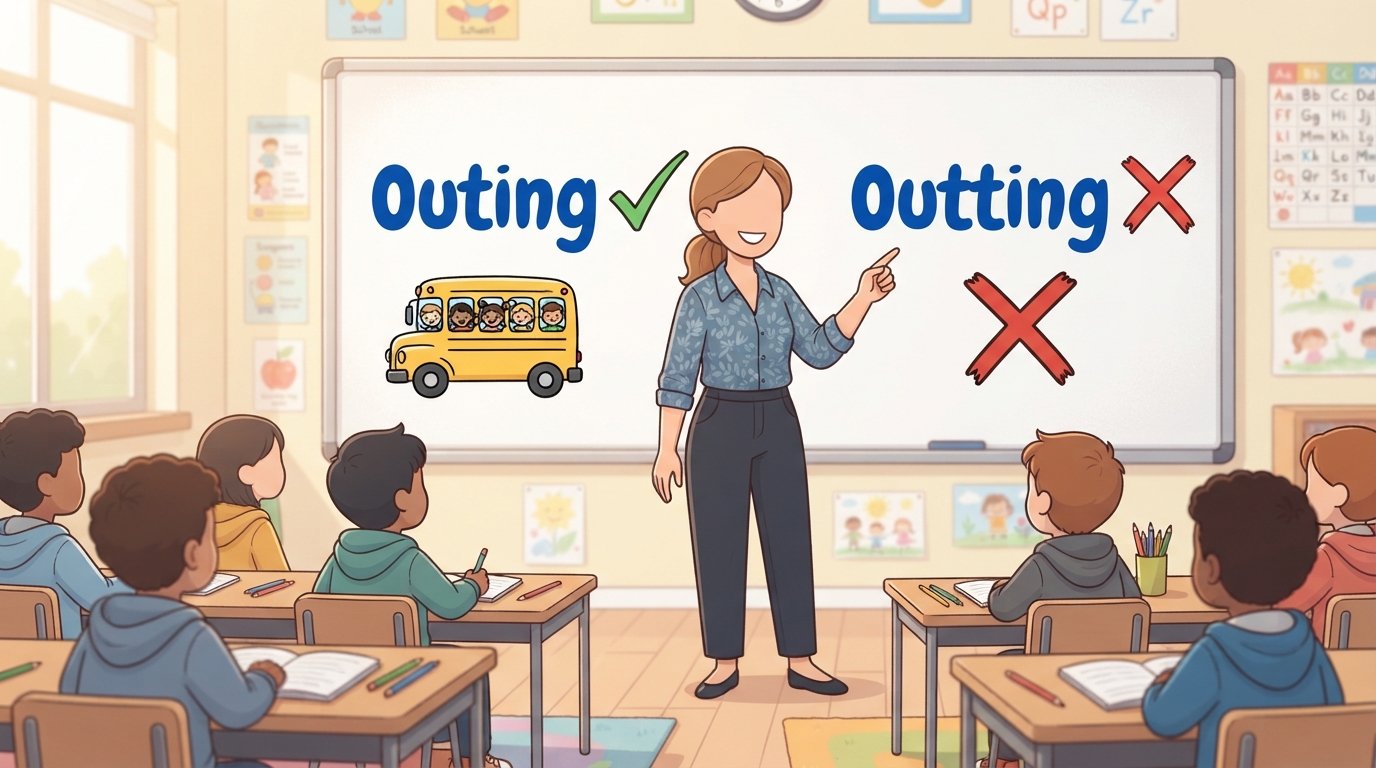
English spelling throws people off constantly, especially when two versions of a word both look like they could be right. If you’ve ever paused over outing or outting, you’re far from the only one. This word trips writers up because English sometimes doubles consonants before adding an ending, and that pattern makes it tempting to second-guess the spelling here too.
Here’s the quick answer: outing is the correct spelling, and outting is not accepted in standard English. Whether you mean a day trip, a group excursion, or the word used in another sense, the accepted form always keeps a single “t.” This guide explains why, walks through the grammar behind it, and shows how to use the word properly.
Settling the Outing or Outting Question
When people wonder which spelling is right, the correct one is:
- Outing
The spelling to avoid is:
- Outting
Every standard English dictionary and grammar reference agrees on this.
Right Way to Write It
- “We went on a family outing last weekend.”
Wrong Way to Write It
- “We went on a family outting last weekend.”
That second version contains a spelling error.
Why “Outing” Wins Over “Outting”
Much of the confusion traces back to the English rule about doubling consonants before -ing.
People often reason:
- Run → Running
- Sit → Sitting
And from there assume:
- Out → Outting
But that pattern simply doesn’t apply here.
The Actual Grammar Behind It
Outing isn’t built by taking the base word “out” and tacking on a doubled “t.” Instead, it’s a standalone noun (and, in certain contexts, a verb form) that has always been spelled with a single “t.”
That’s the whole reason:
- Correct: outing
- Incorrect: outting
English has plenty of odd exceptions, but once you know this one, it’s easy to apply.
What Does “Outing” Actually Mean?
Knowing the meaning makes the correct spelling much easier to hold onto.
1. A Trip or Social Excursion
This is by far the most familiar meaning.
Example: “The school organized an outing to the museum.” In short, it describes a short trip or group excursion taken for fun.
Common phrases include family outings, office outings, school outings, and weekend outings.
2. Publicly Revealing Private Information
In a different context, “outing” can mean disclosing private facts about someone, often related to personal identity.
Example: “The article caused controversy after outing the person without consent.”
This sense shows up less in casual writing, but it’s still perfectly grammatical.
Spell Outing or Outting: Why the Mix-Up Happens
A lot of people search for this spelling question simply because English spelling rules can be inconsistent.
Other Words Do Double the Consonant
Examples:
- Hit → Hitting
- Stop → Stopping
- Run → Running
Naturally, this leads people to assume “out” should follow the same pattern and become “outting.”
But “Outing” Doesn’t Follow That Rule
Outing is already a fixed, established word, and standard usage keeps it at one “t.” Treat it as a complete word on its own rather than a modified verb form, and the spelling becomes much simpler to remember.
Is It Outing or Outting Across English Dialects?
Another common question people raise involves regional spelling differences.
The answer stays consistent everywhere:
- British English: Outing
- American English: Outing
- Canadian English: Outing
- Australian English: Outing
No major English dialect accepts outting as correct. The spelling doesn’t shift across regions.
Using “Outing” Correctly in a Sentence
Here are a few natural examples of the word in action.
Trip or Excursion Sense
“We planned a weekend outing with friends.” “The company arranged a team outing.” “Their beach outing was a lot of fun.”
Disclosure Sense
“The unauthorized outing caused backlash.” “Privacy concerns were raised after the outing.”
The surrounding context tells you which meaning applies.
Frequent Mistakes With This Word
Here’s what people typically get wrong with spelling or usage.
Misspelling It
Wrong:
- Outting
Right:
- Outing
Missing the Second Meaning
Some writers only associate “outing” with a trip, forgetting it can also mean publicly revealing private information. Let context guide the meaning you choose.
A Simple Way to Remember the Spelling
One easy trick:
Think of it as:
- Trip = Outing
Not:
- Out + a doubled T
Another helpful comparison: words like
- Morning
- Evening
- Outing
all use plain, standard spellings with no extra consonants added.
Other Words People Misspell in Similar Ways
Several word pairs create the same kind of spelling confusion:
- Traveling or travelling
- Canceling or cancelling
- Benefited or benefitted
- Aging or ageing
- Outing or outting
Much of English spelling comes down to word history rather than one simple, universal rule.
FAQs About Outing or Outting
How do you spell outing or outting properly?
The correct spelling is outing, written with a single “t.”
Why is “outting” considered wrong?
“Outting” doesn’t appear in standard English dictionaries. The accepted spelling has always been “outing.”
What does outing mean exactly?
It typically means a short trip, excursion, or social event. In another sense, it can mean publicly revealing private information about someone.
Does British English spell it the same way?
British English follows the same rule — outing is correct there too.
Is outing used as a noun or a verb?
It works as a noun (referring to a trip or excursion) and, in certain contexts, as a verb form (referring to publicly revealing something).
Conclusion
If you’ve been going back and forth on outing or outting, the answer is straightforward: outing is the correct spelling, while outting has no place in standard English. That holds true whether you’re describing a fun day trip, a group excursion, or using the word in its other sense.
English spelling can be confusing at times, but this particular case has a clear answer. The next time you catch yourself hesitating over the spelling, you can confidently go with outing and use it correctly in your writing.





Leave a Reply