

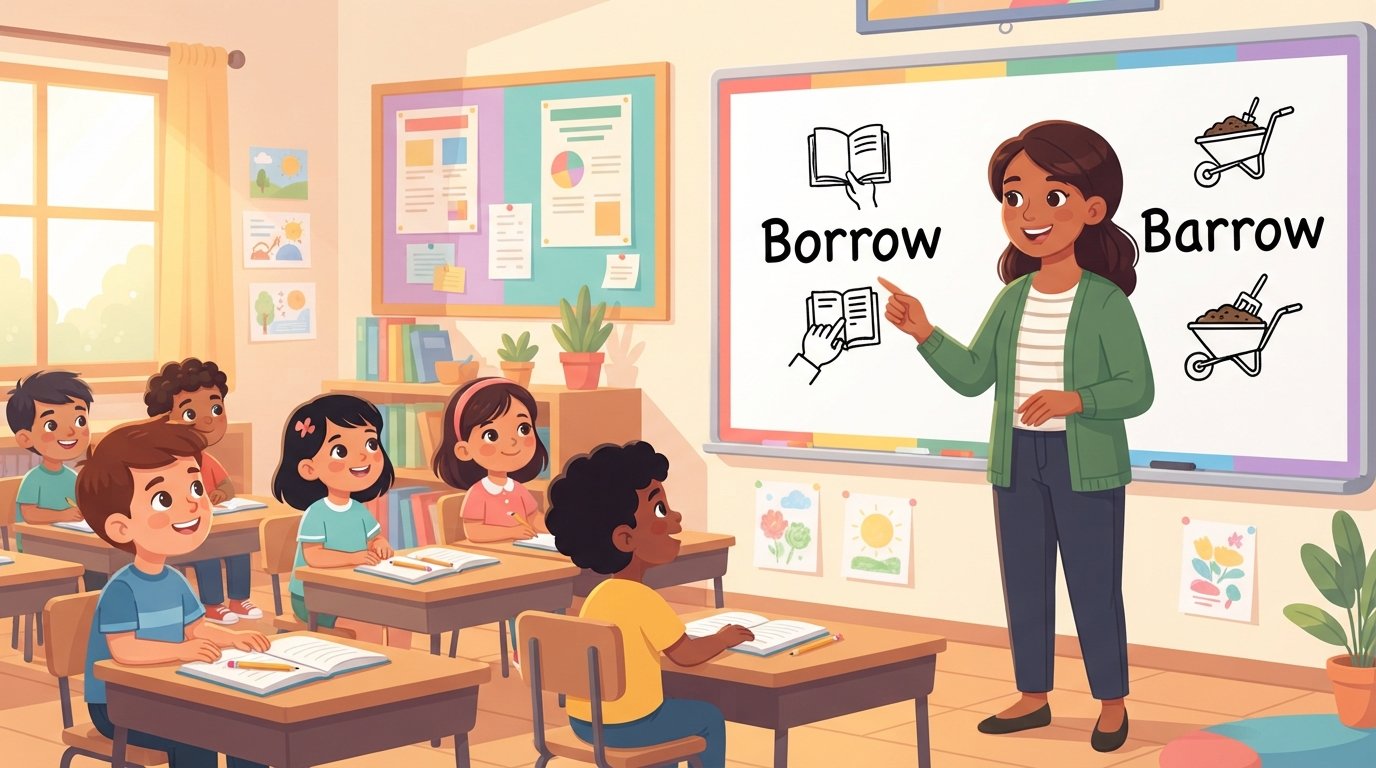
English has no shortage of words that sound alike but carry entirely different meanings, and borrow vs barrow is a classic example that trips up learners and native speakers alike. In certain accents the two words sound almost identical, so it’s easy to mix them up while speaking or writing.
Despite the similar sound, these two words don’t share any meaning at all. One describes taking something temporarily, while the other refers to a type of cart or even an ancient burial mound. Knowing the difference helps you avoid awkward errors and write with more precision.
This guide covers the full borrow vs barrow comparison — what each word means, how to use them correctly, real-world examples, memory tricks, and why this pair causes so much confusion.
Understanding the Word “Borrow”
“Borrow” is a widely used English verb that means taking something from someone else for a short time, with the intent of giving it back.
Everyday Situations Where “Borrow” Applies
People commonly use “borrow” when talking about money, books, tools, clothing, notes, or household items.
Sample Sentences With Borrow
- Can I borrow your pen?
- She borrowed a book from the library.
- He needed to borrow money for repairs.
At its core, the word always implies temporary use followed by an expected return.
Understanding the Word “Barrow”
“Barrow” doesn’t come up as often in daily speech, but it still carries a couple of important meanings.
1. A Small Cart or Wheelbarrow
In gardening and construction, a barrow usually means a handcart used to carry loads — he pushed the barrow across the garden; workers filled the wheelbarrow with soil.
2. An Ancient Burial Mound
In history and archaeology, a barrow can also mean a mound of earth raised over a burial site — the ancient barrow dates back thousands of years, and archaeologists explored the burial barrow.
Since this word shows up less often, many people wrongly assume it’s simply a variation of “borrow.”
Borrow vs Barrow Made Simple
Looking at purpose makes the difference much clearer.
- Borrow = to take something temporarily and return it later
- Barrow = a cart, or a burial mound
One word names an action; the other names an object or structure.
Why This Pair Gets Mixed Up So Often
The borrow vs barrow confusion has a few clear causes.
They Can Sound Alike
Depending on accent and speaking pace, the two words may come out sounding nearly the same.
Only One Letter Separates Them
With just a single letter difference between the spellings, typing mistakes happen easily.
“Barrow” Is Rarely Used
Most people use “borrow” all the time but rarely run into “barrow” outside of gardening or history topics.
Autocorrect Can Miss It
Because both spellings are valid English words, spellcheck tools don’t always flag the error.
Memory Tricks to Tell Them Apart
A couple of simple associations can make these words much easier to separate.
Borrow Rhymes With “Owe”
When you borrow something, you owe it back — that small connection helps the meaning stick.
Barrow Hides the Word “Arrow”
Picture a wheelbarrow rolling forward like an arrow moving across the ground. Visual associations like this tend to stick in memory.
Borrow in Everyday Sentences
At school: students often borrow textbooks from the library; I forgot my calculator, so I borrowed one.
In finance: businesses sometimes borrow money from banks; she didn’t want to borrow more than necessary.
Among friends and family: can I borrow your charger? He borrowed his brother’s jacket.
“Borrow” shows up constantly across everyday communication.
Barrow in Real Context
In the garden: the gardener pushed a heavy barrow filled with mulch.
On a construction site: workers loaded bricks into the wheelbarrow.
In history and archaeology: ancient burial barrows exist across Europe.
These examples show just how specialized the word “barrow” tends to be.
Mistakes Writers Commonly Make
Incorrect: Can I barrow your phone? Correct: Can I borrow your phone?
Incorrect: He pushed a borrow through the yard. Correct: He pushed a barrow through the yard.
Even a tiny spelling slip like this can confuse readers.
Does “Barrow” Connect to “Wheelbarrow”?
Yes, it does. The word “barrow” often appears as part of “wheelbarrow,” which is the version people recognize more easily today.
A wheelbarrow is a small hand-propelled cart, typically built with one wheel, used to carry heavy materials.
In casual conversation, most people simply say “wheelbarrow” rather than “barrow” on its own.
Grammar Behind Borrow and Barrow
“Borrow” functions primarily as a verb — I borrowed a laptop yesterday; she is borrowing notes from a friend. Related forms include borrowing, borrowed, and borrower.
“Barrow” functions as a noun — the barrow was full of dirt; tourists visited the ancient burial barrow. Unlike borrow, it isn’t typically used as a verb in modern English. This grammar split is one more way the borrow vs barrow pair stays easy to tell apart once you know it.
Words Related to Borrow and Barrow
Words similar to borrow: take temporarily, obtain, use, rent, receive.
Words similar to barrow: cart, wheelbarrow, handcart, burial mound, earth mound.
Why Choosing the Right Word Matters
The borrow vs barrow mix-up can shift the entire meaning of a sentence if you’re not careful.
For instance, “Can I barrow your book?” sounds off and confusing, while “Can I borrow your book?” reads naturally and correctly.
Careful spelling strengthens clarity, professionalism, readability, and overall communication accuracy.
FAQs About Borrow vs Barrow
What separates borrow from barrow?
Borrow means taking something temporarily with plans to give it back, while barrow refers to a cart or a burial mound.
Is “barrow” an actual word?
Yes. It commonly refers to a wheelbarrow or an ancient burial mound.
Which spelling is correct — borrow or barrow?
Both spellings are valid words, but they carry completely different meanings.
Why do these two words get confused so often?
They sound similar when spoken and differ by only one letter in spelling.
What exactly is a burial barrow?
A burial barrow is a mound of earth raised over ancient graves or tombs.
Can “barrow” ever function as a verb?
In modern English, “barrow” is used almost exclusively as a noun.
Conclusion
Sorting out borrow vs barrow becomes much simpler once you realize the two words belong to completely different categories. “Borrow” describes temporarily taking something and giving it back, while “barrow” describes a cart or an ancient burial mound.
Even though the spelling and pronunciation are close, context quickly makes clear which word a sentence needs. Paying attention to details like this can make your writing noticeably clearer and more professional.
If you enjoy untangling confusing English word pairs, exploring more vocabulary and grammar guides is a great way to keep sharpening your language skills.






Leave a Reply