

English spelling can trip you up more than expected, especially when two versions of the same word both seem plausible. One of the most common cases is cancelation vs cancellation. If you’ve ever paused mid-email, mid-article, or mid-business document wondering which spelling to go with, you’re definitely not alone.
The confusion exists because both spellings are technically real, but one is far more widely accepted than the other. Throw in the differences between American and British English, various style guides, and shifting grammar rules, and it’s easy to start second-guessing yourself.
This guide breaks down the difference between these two spellings, explains which one counts as standard, covers cancelation vs cancellation AP style guidelines, and shows you how to use the word correctly in everyday writing.
What Does “Cancellation” Actually Mean?
Before comparing spellings, it helps to nail down what the word itself means.
Cancellation refers to the act of canceling something. It can apply to:
- Flights
- Hotel bookings
- Appointments
- Contracts
- Subscriptions
- Events
- Orders
For example:
- The flight cancellation frustrated hundreds of passengers.
- We received a cancellation notice by email.
The word comes from the verb “cancel,” meaning to stop, revoke, or call something off.
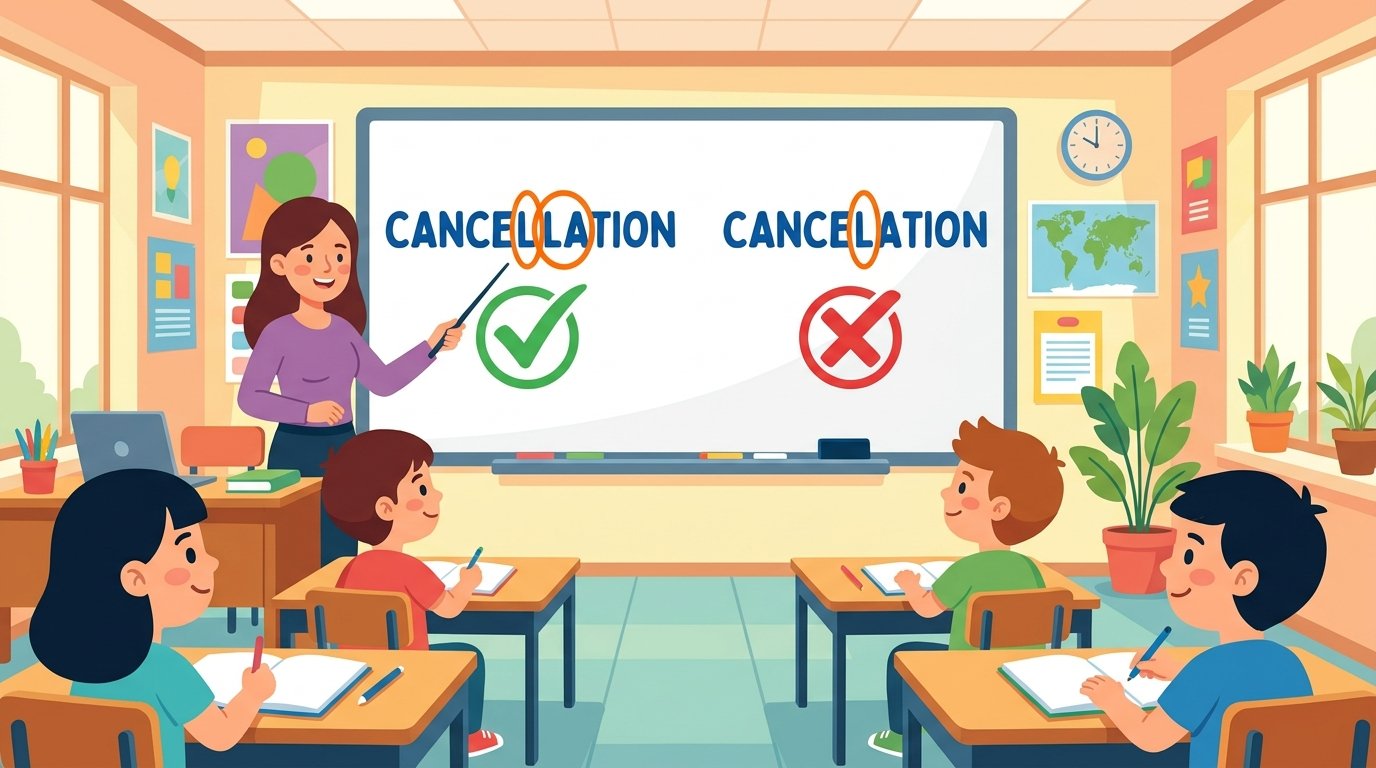
Cancelation vs Cancellation: The Core Difference
The distinction is simple:
- “Cancellation” with two Ls is the standard, widely accepted spelling.
- “Cancelation” with one L is far less common and generally treated as a variant.
In modern English, “cancellation” is the preferred version across most dictionaries, publications, and professional writing.
Why Do Two Spellings Even Exist?
The confusion comes from the fact that the base verb “cancel” already ends in one L in American English. Some assume the noun should simply take “-ation” and become “cancelation.”
But English spelling often doubles the final consonant when adding suffixes like “-ation” or “-ing,” especially after a stressed syllable.
That’s why “cancel” turns into:
- Cancelled
- Cancelling
- Cancellation
Even in American English, the double-L “cancellation” stays the dominant form.
So Which Spelling Is Actually Correct?
Technically, both spellings have shown up in dictionaries over the years. But in practice, “cancellation” is overwhelmingly treated as the correct, standard spelling today.
If you’re writing:
- Academic papers
- Professional emails
- Business documents
- Website content
- News articles
You should almost always reach for “cancellation.”
Sticking with the double-L version makes your writing look more polished and grammatically consistent.
The Spelling Rules Behind Cancelation vs Cancellation
To understand why double L became the standard, it helps to look at how English forms related words.
Words That Follow the Double-L Pattern
Several words tied to “cancel” use double Ls:
- Cancelled
- Cancelling
- Cancellation
This keeps related word forms consistent with one another.
American vs British English Differences
American English often simplifies spelling compared to British English. Examples include:
- Traveling vs travelling
- Labeled vs labelled
But “cancellation” is one of the rare exceptions where both American and British English generally favor the double-L spelling.
That’s part of why “cancellation” shows up so consistently in newspapers, universities, and professional publications around the world.
Cancelation vs Cancellation in AP Style
AP Style, short for Associated Press Style, is one of the most widely used writing guides in journalism and professional communication.
Under AP style rules:
- “Cancellation” is the preferred spelling.
- “Cancelation” is generally avoided.
This matters especially for:
- News writing
- Online publications
- Blogs
- Marketing content
- Public relations materials
Why Does “Cancelation” Still Show Up Sometimes?
Even though “cancellation” dominates modern usage, you’ll still spot “cancelation” from time to time.
This happens because:
- Some older dictionaries listed it as a variant spelling.
- People try to simplify the word based on logic rather than convention.
- Spell-check tools don’t always flag it.
- Some writers assume it follows simplified American spelling patterns.
That said, it’s much less common in edited or professional writing.
Examples of Correct Usage
Seeing the word in context makes the rule easier to remember.
Correct Examples
- Due to bad weather, the airline issued a cancellation notice.
- Ticket cancellation fees may apply.
- The cancellation policy is explained on the website.
- We received confirmation of the appointment cancellation.
The Less Preferred Variant
- The cancelation notice arrived yesterday.
This version isn’t always flagged as outright wrong, but it often reads as unusual or dated to most readers.
Common Mistakes Writers Make
Spelling confusion around this word usually comes down to mixing up the verb and noun forms.
Mistake 1: Using One L Everywhere
Some writers wrongly assume the pattern goes:
- Cancel → cancelation
- Cancel → canceling
But the noun form traditionally keeps the double L.
Mistake 2: Mixing Styles Within the Same Piece
Writers sometimes bounce between:
- Cancelled
- Canceling
- Cancellation
Consistency matters here. If you’re using American English spelling overall, make sure related words follow the same pattern throughout.
A Simple Trick to Lock In the Spelling
Here’s an easy way to remember the standard spelling:
“Cancellation” matches “cancelled” and “cancelling.”
All three commonly use double Ls. If the related forms carry two Ls, the noun usually should too.
How Dictionaries Handle This Word
Most major dictionaries list “cancellation” as the preferred spelling.
Some may include “cancelation” as a secondary or variant form, but it’s rarely the primary recommendation.
In real-world usage:
- “Cancellation” appears far more often across books and publications.
- Businesses almost always default to “cancellation.”
- Search engines strongly favor the double-L version.
That makes it the smarter choice for clarity and professionalism.
Why Correct Spelling Matters in Professional Writing
Small spelling choices shape how readers perceive your writing.
Using the accepted spelling helps you:
- Build credibility
- Improve readability
- Maintain consistency
- Avoid distracting your readers
- Strengthen professional communication
This becomes especially important in formal documents, resumes, customer policies, and online content.
FAQs About Cancelation vs Cancellation
Is it “cancellation” or “cancelation”?
Cancellation is the standard and preferred spelling in modern English. “Cancelation” exists as a variant, but it’s far less common.
Why does “cancellation” have two Ls?
The noun form follows traditional English spelling patterns, where related words like “cancelled” and “cancelling” also carry double Ls.
What does AP style recommend?
For cancelation vs cancellation AP style usage, AP style prefers “cancellation” with two Ls.
Is “cancelation” ever acceptable?
Some dictionaries recognize it as a variant spelling, but it’s rarely seen in professional or edited writing.
Which spelling should I use in business writing?
Always use “cancellation” in professional, academic, and formal communication for the sake of clarity and consistency.
Conclusion
The debate over cancelation vs cancellation confuses plenty of writers, since both versions technically exist — but only one is widely accepted in modern English. While “cancelation” occasionally shows up as a variant spelling, “cancellation” remains the standard across professional writing, journalism, education, and everyday communication.
Understanding these spelling patterns can help you write with more confidence and sidestep common grammar mistakes. Whether you’re drafting a business email, writing website content, or following AP style guidelines, sticking with “cancellation” is the safest and most polished choice.
English spelling doesn’t always feel logical, but once you recognize the consistency behind related words like “cancelled” and “cancelling,” remembering the correct form becomes a lot easier.





Leave a Reply