

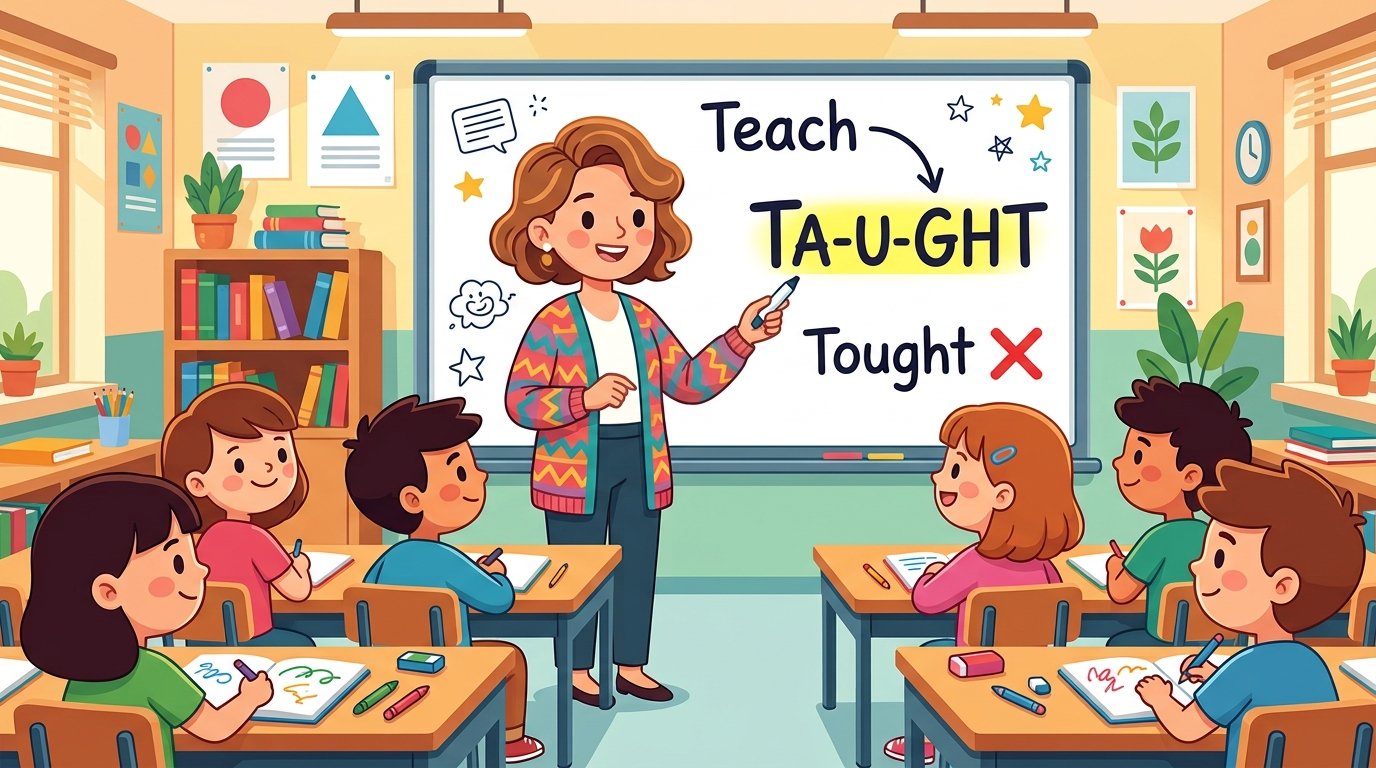
English has plenty of words that look alike but mean completely different things — and sometimes, one version isn’t even a real English word at all. Tought vs taught is a perfect example, and it’s a comparison that trips up students, writers, and English learners on a regular basis.
If you’ve ever wondered whether “tought” is actually correct, or searched for how to spell taught, you’ve landed in the right place. This guide walks through the spelling, meaning, pronunciation, and correct usage of each term so you can write with confidence.
Is “Tought” Actually a Word?
The short answer is usually not.
In modern English, “tought” is generally treated as a misspelling of either taught or thought, depending on what the writer meant to say.
Most dictionaries don’t recognize it as a standard English word. If you typed “tought” into a document, your spell-checker would almost certainly flag it and suggest another spelling.
Why People Write “Tought” by Mistake
A few common reasons drive this error:
- “Thought” and “taught” look visually similar.
- English vowel combinations can be genuinely confusing.
- Fast typing increases the odds of spelling slips.
- Pronunciation doesn’t always match spelling.
How Do You Spell “Taught” Correctly?
If you’re asking how to spell taught, the correct spelling is:
Taught
T-A-U-G-H-T
“Taught” is the past tense and past participle of the verb “teach.”
Examples of Taught in Use
- My teacher taught us algebra.
- She taught English for twenty years.
- My grandfather taught me how to fish.
In every one of these, the word refers to giving instruction or passing along knowledge.
Tought vs Taught: A Quick Comparison
| Word | Is It Correct? | Meaning |
|---|---|---|
| Taught | Yes | Past tense of “teach” |
| Tought | Usually no | Common misspelling of “taught” or “thought” |
Whenever you’re writing about education, lessons, or instruction, taught is almost certainly the word you’re looking for.
What Does “Taught” Actually Mean?
The word taught means to have given instruction, education, training, or guidance.
Someone who teaches a subject helps another person pick up new knowledge or skills.
More Examples of Taught in Sentences
- My parents taught me good manners.
- Our coach taught us teamwork.
- The course taught valuable programming skills.
- Experience taught her to stay patient.
Notice that “taught” consistently ties back to learning or instruction.
Does “Tought” Have Its Own Meaning?
Plenty of people search for the tought meaning or tought definition, expecting it to be a legitimate English word.
In standard English, though, “tought” has no accepted dictionary definition.
Most of the time, it’s simply:
- A typo for “taught”
- A typo for “thought”
Which one it was meant to be depends entirely on the sentence.
Example One
Incorrect:
- She tought me French.
Correct:
- She taught me French.
Example Two
Incorrect:
- I tought about the problem.
Correct:
- I thought about the problem.
Why Do These Words Get Mixed Up So Easily?
The confusion around tought vs taught comes down to the fact that English spelling isn’t always phonetic, meaning words aren’t always written the way they sound.
Several factors feed into the confusion:
- Similar letter patterns
- Silent letters
- Unusual vowel combinations
- Fast typing on keyboards or phones
- Autocorrect mistakes
Even fluent English speakers occasionally mix these two up.
Simple Tricks to Remember “Taught”
If the spelling still trips you up, these tips can help.
Connect It to “Teach”
Since “taught” comes from “teach,” link the two words together in your mind:
Teach → Taught
Lock In the “AU”
The word contains the letters:
A-U-G-H
If you can remember “AU,” you’re far less likely to accidentally write “tought.”
Give Your Writing a Quick Read-Through
Taking a few seconds to proofread emails, essays, or social media posts can catch simple spelling errors before they turn embarrassing.
Mistakes Worth Watching For
Sorting through real tought vs taught errors alongside their corrected versions makes the pattern easier to spot.
| Incorrect | Correct |
|---|---|
| He tought math. | He taught math. |
| She tought me driving. | She taught me driving. |
| I tought about it. | I thought about it. |
| They were tought well. | They were taught well. |
Learning to spot these patterns makes proofreading significantly easier.
When Should You Use “Thought” Instead?
Sometimes people accidentally write “tought” when they actually mean thought.
Reach for thought when referring to:
- Thinking
- Ideas
- Opinions
- Reflection
Example:
- I thought the movie was excellent.
- She thought carefully before answering.
Save taught exclusively for discussions of teaching or learning.
Practical Tips for Better English Spelling
Improving your spelling doesn’t happen overnight, but a few small habits make a real difference.
Try these strategies:
- Read regularly.
- Practice commonly confused words.
- Use spell-check tools.
- Learn word origins.
- Proofread important documents before hitting send.
Over time, you’ll start recognizing the correct spelling automatically.
FAQs About Tought vs Taught
Is “tought” a real English word?
In standard English, no. It’s generally treated as a misspelling of either “taught” or “thought.”
How do you spell “taught”?
The correct spelling is T-A-U-G-H-T.
What does “taught” mean?
“Taught” is the past tense of “teach” and means someone instructed, educated, or trained another person.
What’s the “tought” definition?
There isn’t one — it’s not recognized as a correct English word, so no standard dictionary definition exists.
Why do people confuse “tought” and “taught”?
The similarity in spelling and pronunciation, combined with English’s irregular spelling rules, leads many writers to mix them up.
Conclusion
Understanding tought vs taught gets much easier once you know that taught is the correct word, used as the past tense of “teach.” Meanwhile, “tought” is typically just a spelling mistake, usually meant to be either “taught” or “thought.”
Whenever you’re unsure, remember that taught relates to learning and instruction. Taking a moment to proofread your writing and practicing commonly confused words will help you avoid this mistake going forward and sharpen your overall English skills.


Leave a Reply