

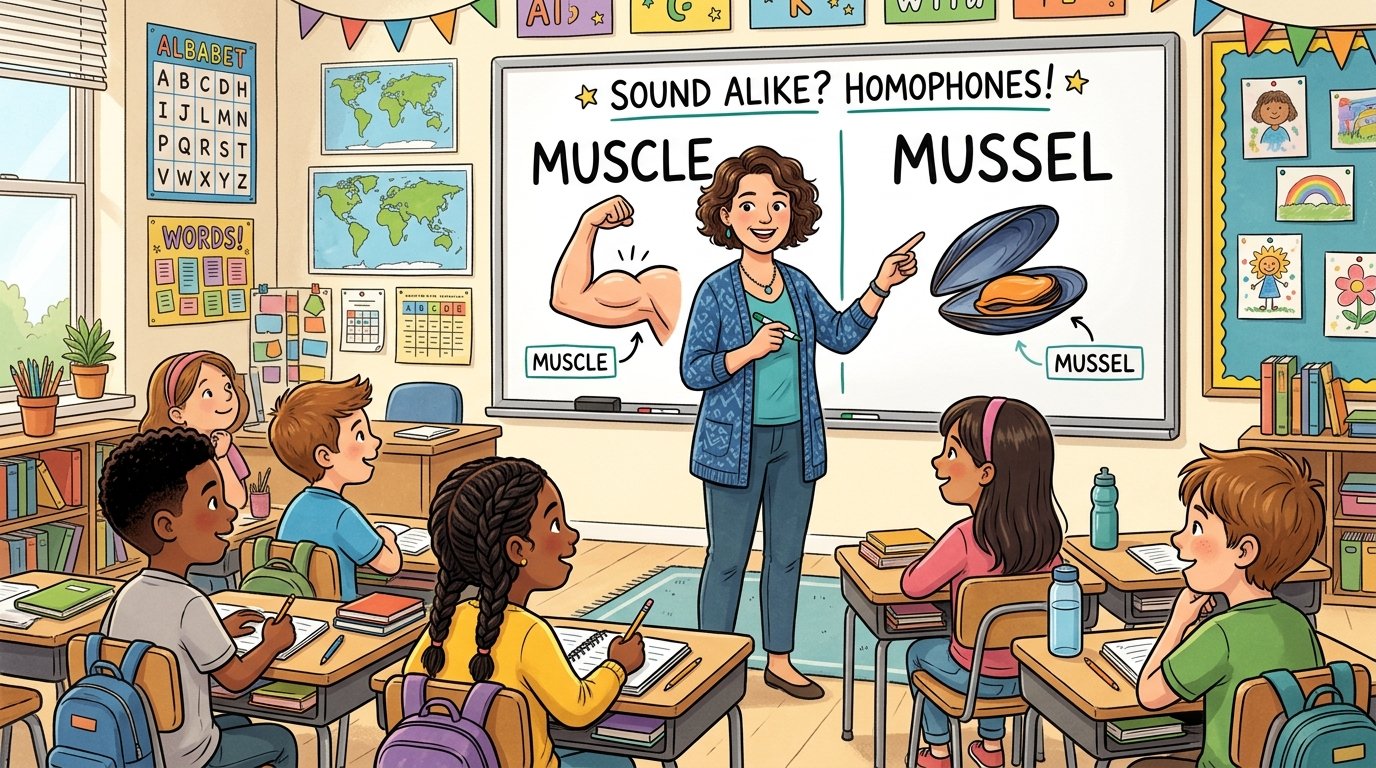
Ever typed muscle vs mussel into a search bar, puzzled over why two words that sound nearly identical mean something completely different? You’re definitely not alone. This pair of commonly mixed-up homophones trips people up all the time, whether they’re writing, talking, or just searching online.
Here’s the short version: a muscle is body tissue responsible for movement and physical strength, while a mussel is an edible shellfish found in both freshwater and saltwater. Even though they’re pronounced almost exactly the same, their meanings, origins, and everyday uses couldn’t be more different.
This guide walks through the differences between muscle and mussel, offers simple examples, and gives you an easy way to remember which spelling belongs where.
So What Exactly Is a Muscle?
A muscle is soft body tissue found in humans and animals that contracts and relaxes to produce movement. Muscles play a role in almost every physical action you take, from lifting something heavy to simply blinking.
The human body holds more than 600 muscles, all working alongside bones, nerves, and connective tissue to support movement, posture, and essential bodily functions.
The Three Main Types of Muscle
There are three primary categories of muscle tissue.
1. Skeletal Muscle
Skeletal muscles connect to bones and allow for voluntary, controlled movement. These are the muscles people usually focus on while working out.
A few examples:
- Biceps
- Triceps
- Quadriceps
- Abdominal muscles
2. Smooth Muscle
Smooth muscles line internal organs and operate automatically, without any conscious effort on your part.
They support functions such as:
- Digestion
- Contracting blood vessels
- Moving food through the digestive system
3. Cardiac Muscle
Cardiac muscle forms the heart and continuously pumps blood through the body.
Unlike other muscle types, it works involuntarily and never stops functioning throughout a person’s lifetime.
So What Exactly Is a Mussel?
A mussel is a bivalve mollusk that lives in oceans, rivers, and lakes. It has two hinged shells that shield its soft body on the inside.
Mussels are a well-known seafood favorite and also serve an important environmental role by filtering water in aquatic ecosystems.
Key Traits of Mussels
Common characteristics of mussels include:
- A hard, dark-toned outer shell
- A soft, edible interior
- The ability to filter tiny particles out of water
- Attaching to rocks or other surfaces using tough fibers called byssal threads
The Two Main Categories of Mussels
Mussels generally fall into two broad groups.
Marine Mussels
These live in saltwater environments and are commonly harvested for food.
Well-known examples include:
- Blue mussels
- Mediterranean mussels
Freshwater Mussels
These are found in rivers and lakes and play a key role in keeping water quality in check.
Certain freshwater species are now protected due to habitat loss and shifting environmental conditions.
Muscle vs Mussel: A Side-by-Side Look
| Feature | Muscle | Mussel |
|---|---|---|
| Definition | Tissue responsible for movement | A shellfish belonging to the mollusk family |
| Found in | Human and animal bodies | Oceans, rivers, and lakes |
| Function | Movement, support, and body processes | Filtering water and serving as food |
| Category | Biological tissue | Aquatic animal |
| Example | Arm muscle, heart muscle | Blue mussel, freshwater mussel |
Why Do People Keep Mixing Up Muscle and Mussel?
The confusion between muscle vs mussel happens because these two words are homophones — they sound alike but carry entirely different spellings and meanings.
For example:
- Correct: “I worked hard to build up my muscle strength.”
- Correct: “We had steamed mussels for dinner.”
- Incorrect: “I trained my mussels at the gym.”
Here’s a simple way to keep them straight:
- Muscle = Movement and strength
- Mussel = A shellfish from the sea
Where Did These Words Come From?
Digging into the history behind these words can make them stick in your memory more easily.
The Origin of “Muscle”
The word muscle traces back to the Latin term musculus, which translates to “little mouse.” Ancient observers thought muscles rippling beneath the skin looked like tiny mice scurrying around.
The Origin of “Mussel”
The word mussel comes from Old English muscle and the same Latin root musculus, which was also applied to shellfish because their shape resembled that of a small mouse.
Even though these two words share a historical connection, modern English keeps their meanings entirely separate.
Muscle vs Mussel in Everyday Conversation
In daily communication, using the right word truly matters since each term points to a completely different topic.
You’ll typically come across muscle in discussions about:
- Fitness and bodybuilding
- Health and anatomy
- Sports science
- Medical topics
You’ll typically come across mussel in discussions about:
- Seafood recipes
- Marine biology
- Aquaculture
- Environmental conservation
Understanding this difference sharpens both your writing accuracy and your overall vocabulary.
Common Errors to Watch Out For
Here are a few frequent mistakes worth avoiding.
- Using “mussel” when talking about exercise
- Incorrect: “She has strong arm mussels.”
- Correct: “She has strong arm muscles.”
- Using “muscle” when talking about seafood
- Incorrect: “The restaurant serves fresh muscles.”
- Correct: “The restaurant serves fresh mussels.”
- Assuming the two words can be swapped
- Even though they sound alike, their meanings are entirely unrelated.
Frequently Asked Questions
Is it muscle or mussel when talking about the human body?
The correct word is muscle. Muscles are the tissues that allow humans and animals to move, hold posture, and carry out essential bodily functions.
Are mussels a type of fish?
No. Mussels aren’t fish at all. They belong to the bivalve mollusk family, a group of aquatic animals protected by two shells.
Why do muscle and mussel sound so similar?
They’re homophones in English, meaning they share nearly identical pronunciation despite having different spellings and meanings.
Can you technically eat a muscle?
Not in the way people usually mean. When talking about seafood, the correct word is mussel, which is what’s actually edible. Animal muscle tissue is eaten too, but it’s referred to as meat rather than “muscle.”
What’s an easy way to remember the difference between muscle and mussel?
Try this simple trick:
- Muscle = Muscles help you move
- Mussel = Mussels live in the sea
Wrapping Up
Understanding muscle vs mussel becomes much easier once you know what each word actually means. A muscle is essential body tissue responsible for movement, strength, and various bodily functions, while a mussel is a shellfish found in both freshwater and marine environments.
Although these two words sound nearly identical, they belong to entirely different worlds — one tied to anatomy and fitness, the other to seafood and marine life. Keeping their definitions and everyday uses in mind will help you steer clear of common spelling slip-ups and communicate with more confidence.
For more helpful comparisons like this one, along with anatomy guides and educational content, exploring related topics can help you keep building your language skills.













Leave a Reply