

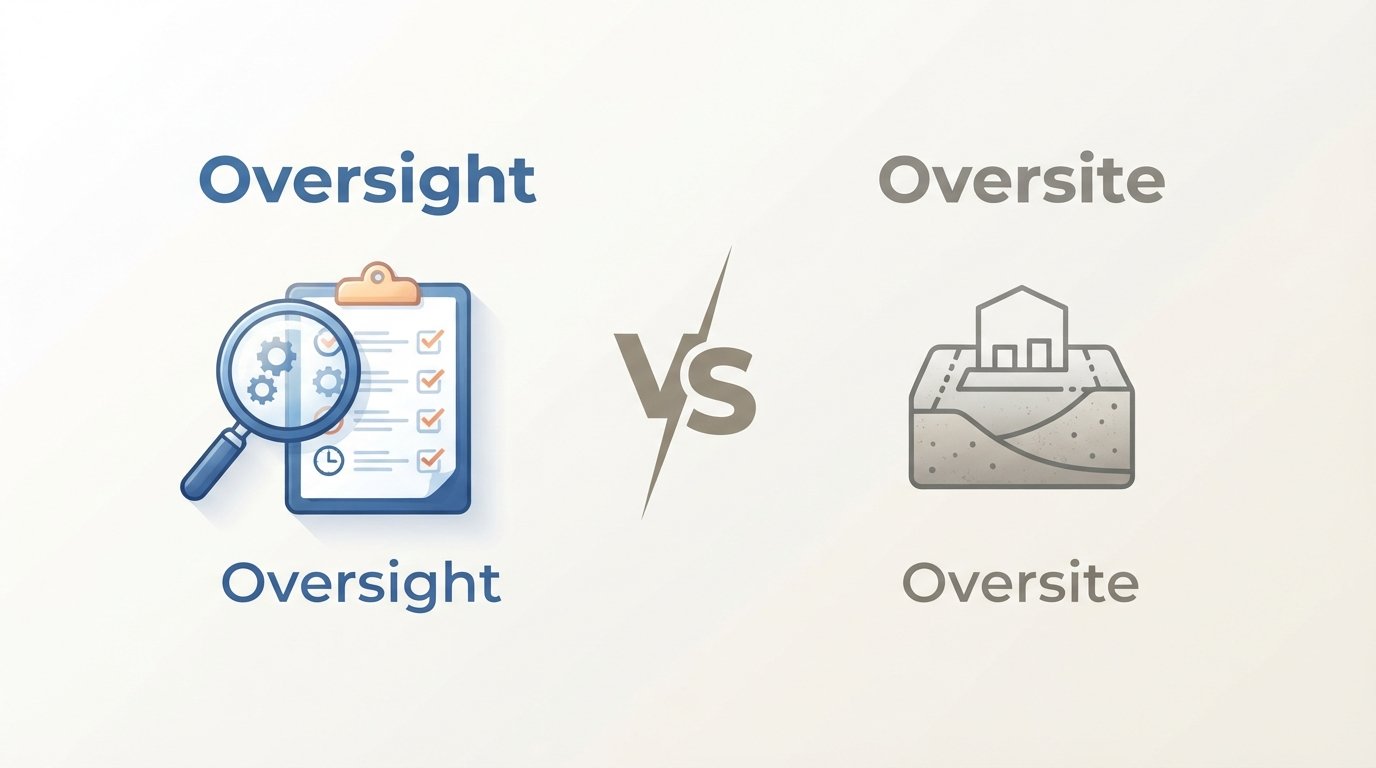
English is full of confusing word pairs, but few create as much doubt in professional writing as oversite vs oversight. At first glance, the two terms look almost the same, yet only one is accepted in standard modern English. This guide covers oversite vs oversight in full detail so you never second-guess the spelling again. This mix-up shows up often in workplace emails, legal papers, business reports, and management discussions, where precise wording really matters.
Knowing the correct oversight meaning and usage can sharpen your writing and help you avoid awkward mistakes. In this guide, you’ll find the definitions, key differences, sample sentences, grammar notes, and simple ways to remember which word to use.
Defining the Word Oversight
Oversight is a genuine English word, and it carries two separate meanings depending on the context.
It can refer to:
- Supervision or close monitoring
- An accidental mistake or something left out by mistake
This dual meaning makes oversight a little unusual compared to most English words.
When Oversight Means Supervision
In workplaces and organizations, oversight usually points to supervision, management, or careful monitoring of a process.
Examples include:
- Government oversight
- Financial oversight
- Project oversight
- Regulatory oversight
Used this way, the word carries a sense of authority and responsibility.
Example sentence:
- The committee provides oversight for company operations.
When Oversight Means a Mistake
The same word can also describe an unintentional error that happens because something wasn’t noticed in time.
Example sentence:
- Forgetting the deadline was an unfortunate oversight.
This second meaning is very common in day-to-day conversation.
Does “Oversite” Actually Exist as a Word?
The term “oversite” exists, but only within a narrow technical field, and it’s rarely seen in standard English writing.
In construction and engineering, “oversite” refers to a layer of concrete laid beneath flooring or a foundation. This is a specialized technical term and has nothing to do with supervision or mistakes.
Most of the time, when someone writes “oversite,” what they actually mean is “oversight.”
Breaking Down the Oversite vs Oversight Meaning
This confusion happens mainly because both words sound almost identical when spoken aloud.
Here’s the key distinction:
- Oversight = supervision or an accidental mistake
- Oversite = a specialized construction-related term
For general communication, workplace writing, management discussions, and formal documents, “oversight” is almost always the correct choice.
Reasons This Mix-Up Happens So Often
There are a few reasons this mix-up happens so often.
They Sound Almost the Same
The words sound nearly identical in speech, which makes spelling slips common.
Spellcheck Tools Can Miss It
Fast typing and spellcheck tools sometimes miss the error, since “oversite” technically exists in a niche sense.
The Word “Site” Feels Logical
People naturally assume “site” relates to watching over a physical place, which makes “oversite” seem logical even though standard English still calls for “oversight.”
How Oversight Is Used in Workplace Writing
The debate around oversite vs oversight comes up often here, since the word “oversight” appears constantly in workplace settings because organizations rely heavily on supervision and accountability.
Examples include:
- Executive oversight
- Legal oversight
- Administrative oversight
- Compliance oversight
Strong oversight helps organizations:
- Reduce errors
- Improve accountability
- Ensure regulations are followed
- Monitor project progress
- Maintain operational quality
Because the term is so common professionally, spelling it correctly really matters.
Using Oversight Correctly for Supervision
When talking about supervision, management, or monitoring, “oversight” is always the correct word to use.
Correct examples:
- The manager maintains oversight of the project.
- Regulatory oversight protects consumer interests.
- Financial oversight is essential in large organizations.
Incorrect examples:
- The manager maintains oversite of the project.
- Financial oversite improved accountability.
In standard English, all of these sentences should use “oversight.”
Side-by-Side Examples of Both Words
Comparing examples side by side makes the difference easier to grasp.
Correct use of oversight:
- The board has oversight responsibilities.
- Missing the email was an oversight.
- Government oversight ensures compliance.
Specialized use of oversite:
- Workers installed the oversite concrete layer.
Unless the topic is construction terminology, “oversight” is usually the word that’s intended.
Can Oversight Be Used as a Verb?
Another common question involves verb forms.
“Oversight” is mainly used as a noun, not a verb.
Examples:
- Correct: The department provides oversight.
- Incorrect: The department oversights the project.
Instead, English relies on verbs like:
- Supervise
- Monitor
- Manage
- Oversee
For example:
- The manager oversees the team.
The verb “oversee” is closely tied to the noun “oversight.”
How Oversee and Oversight Are Connected
Many people lock in the correct spelling by linking it to the verb “oversee.”
Examples:
- Managers oversee employees.
- Oversight ensures accountability.
Since oversee relates directly to supervision, remembering oversight becomes much easier.
Mistakes Worth Avoiding
Writers often make small but meaningful mistakes with these terms.
Avoid these issues:
- Using “oversite” in business writing
- Confusing oversight with oversee
- Treating oversight as a verb
- Assuming both spellings are interchangeable
Using accurate terminology improves professionalism and readability.
Why Getting the Word Right Matters
Precise language matters in both professional and academic communication.
Correct usage helps:
- Improve clarity
- Build credibility
- Avoid misunderstandings
- Strengthen business communication
- Demonstrate professionalism
Even a minor spelling error can affect how seriously your writing is taken.
Easy Ways to Remember the Difference
Here are a few simple memory tricks:
Link Oversight With “Sight”
Oversight involves watching, supervising, or noticing something.
Think:
- Sight = seeing
- Oversight = watching over something
Hold On to the Verb “Oversee”
If someone oversees a project, they’re providing oversight.
Keep Construction in Its Own Category
“Oversite” mainly belongs to specialized building terminology, not everyday writing.
FAQs
Which spelling is correct — oversite or oversight?
“Oversight” is the correct term in most professional, academic, and everyday situations.
What is the actual meaning of oversight?
It can mean supervision, monitoring, or an accidental mistake caused by not noticing something.
Is oversite genuinely a real word?
Yes, but it’s mostly used in specialized construction contexts and is uncommon in general English.
How does oversight differ from oversee?
“Oversee” is a verb, while “oversight” is a noun related to supervision or management.
Does oversight ever refer to a mistake?
Yes. The word can describe an unintentional error or omission.
Why does this pair confuse so many people?
The words sound very similar, and many assume “oversite” is the logical spelling for supervision-related meanings.
Conclusion
At the end of the day, the oversite vs oversight debate comes down to context and correctness. Understanding the difference between oversite vs oversight helps improve writing accuracy and professional communication. While “oversight” is the standard English term used for supervision, monitoring, and accidental mistakes, “oversite” belongs mainly to niche construction terminology.
Using the correct word strengthens clarity, credibility, and confidence in both business and everyday writing. Small language distinctions may seem minor, but they can significantly affect how your communication is understood and perceived.
If you want to sharpen your grammar and vocabulary further, exploring other commonly confused English words can help improve both your writing skills and your professional communication style.








Leave a Reply