

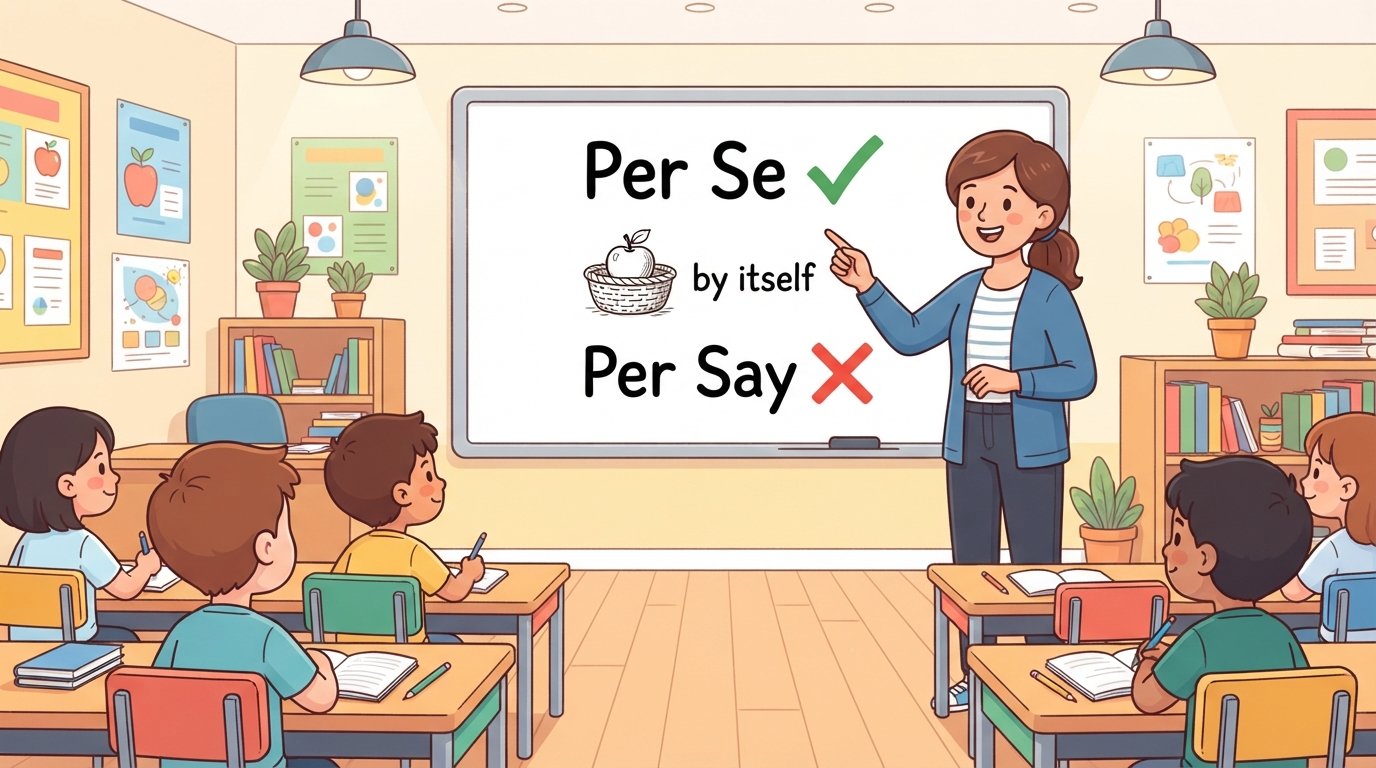
Ever typed “that’s not wrong, per say” and wondered if it looked right? You’re not alone. Per say or per se is one of the most commonly misspelled Latin phrases in English, and the confusion almost always comes down to how it sounds.
Per Say or Per Se: The Quick Answer
- Per se — Correct, standard Latin phrase used in English
- Per say — Incorrect, a common phonetic misspelling
The correct phrase is always “per se,” meaning “by itself” or “in itself.” No major English dictionary recognizes “per say” as a valid alternative.
Why Does “Per Say” Sound So Convincing?
The confusion comes down to pronunciation. In Latin, the word “se” is pronounced similarly to the English word “say.” Because people hear the phrase spoken aloud far more often than they see it written, they naturally assume the spelling matches the sound — leading straight to the mistake “per say.”
Understanding this pronunciation trap is the first step to avoiding it for good.
What Does “Per Se” Actually Mean?
At its core, per se means “by itself” or “in itself.” It describes the intrinsic nature of something, judged independently of outside factors.
Example
- “The movie isn’t bad per se, but the plot is predictable.”
Here, “per se” signals that the movie’s quality is being judged on its own terms — separate from acting, soundtrack, or other elements.
| Term | Meaning | Example |
|---|---|---|
| Per se | In itself, intrinsically | “The plan isn’t illegal per se, but it’s risky.” |
| Necessarily | Inevitably, certainly | “That decision isn’t necessarily the best choice.” |
Where Does “Per Se” Come From?
Per se comes directly from Latin:
- “Per” = by
- “Se” = itself
Put together, it literally means “by itself.” Latin phrases have shaped English for centuries, especially in legal, philosophical, and academic writing. Similar Latin-based expressions include per capita, per annum, and per diem.
Historically, English writers adopted “per se” to add precision or philosophical nuance to their arguments. You’ll still find it frequently in legal texts, scholarly writing, and careful journalism today.
Why People Write “Per Say” Instead
A few clear reasons explain why this mistake shows up so often:
- Mishearing the pronunciation — “se” sounds close to “say” in casual speech.
- Informal speech habits — people repeat what they hear without double-checking the spelling.
- Autocorrect and phonetic guessing — typing tools sometimes reinforce the error rather than catch it.
No matter how common it becomes online, “per say” remains a mistake — never an accepted variant.
Per Say or Per Se: Correct Usage in Sentences
Using “per se” correctly adds precision and a touch of sophistication to your writing.
In Everyday Conversation
- “The software isn’t bad per se, but it’s hard to use.”
In Professional and Legal Writing
- “This approach is not inefficient per se, but it may not scale well.”
- “The action does not constitute fraud per se, though intent must be considered.”
Quick Comparison
| Incorrect | Correct |
|---|---|
| “Per say, this is fine.” | “Per se, this is fine.” |
| “That’s not bad per say.” | “That’s not bad per se.” |
Notice that “per se” typically comes right before or after the idea it’s qualifying, keeping the sentence smooth and clear.
Per Say or Per Se: Common Mistakes to Watch For
Knowing the right spelling doesn’t automatically mean using the phrase correctly. A few frequent slip-ups include:
Using It as Filler
Wrong: “Well, per se, I don’t mind.” Better: reserve “per se” for moments when you’re clarifying the essence of something specific.
Confusing It With “Necessarily”
“Per se” isolates intrinsic quality, while “necessarily” points to certainty or inevitability — they aren’t interchangeable.
Overusing the Phrase
Sprinkling “per se” into every other sentence can make writing sound stiff or overly formal. Use it sparingly, for genuine emphasis.
Synonyms and Alternatives to “Per Se”
Sometimes a more natural, less formal phrase fits better.
| Synonym | Best Use | Example |
|---|---|---|
| In itself | Everyday English | “The idea isn’t bad in itself, but it needs work.” |
| Essentially | Emphasizing core meaning | “The plan is essentially sound, though adjustments are needed.” |
Choosing the right synonym can make your writing feel more natural without losing precision.
“Per Se” vs “Necessarily”: A Subtle but Important Difference
These two phrases often get confused, but they serve different purposes.
- Per se judges intrinsic quality: “The technique is not harmful per se, but improper use can be dangerous.”
- Necessarily signals certainty: “Improper use will necessarily cause problems.”
Understanding this nuance keeps your sentences precise and prevents misinterpretation.
“Per Se” vs “So to Speak”: Different Purposes Entirely
Another commonly confused phrase is “so to speak.” While “per se” conveys literal essence, “so to speak” signals something figurative or metaphorical.
- Per se: “The evidence is not conclusive per se, but it raises questions.”
- So to speak: “He’s a walking encyclopedia, so to speak.”
Mixing these two up can distort your meaning, so it’s worth keeping their purposes separate.
Real-World Examples of Per Say or Per Se in Use
Seeing the phrase in context helps cement correct usage: “The policy isn’t restrictive per se, but it limits flexibility.” “The film isn’t bad per se, though the storyline is weak.”
On social media, “per say” shows up constantly in comments — a clear sign of how strongly pronunciation shapes spelling online. Promoting the correct version helps maintain clarity in written communication.
Tips to Remember the Correct Form
A few simple tricks make “per se” easier to lock into memory:
- Pronounce it clearly as two syllables: “pur-say” — but always spell it “se.”
- Use the mnemonic: think “by itself,” mirroring the literal Latin meaning.
- Visualize it: picture a single apple sitting alone in a basket — per se, it’s just the apple, independent of everything around it.
These small tricks stick far better than plain memorization and help cut down on future mistakes.
Why Mastering “Per Se” Improves Your Writing
Small Latin-origin phrases like “per se” add precision and a layer of sophistication to your vocabulary. Using it correctly lets you express subtle distinctions — evaluating something’s intrinsic quality independently of outside context — without sounding overly formal or forced.
Summary: Per Say or Per Se?
- Per se is correct; per say is always wrong.
- It means “by itself” or “in itself,” focusing on the essence of something.
- Common mistakes include using it as filler, confusing it with “necessarily,” or overusing it.
- Proper placement and sparing use improve both writing and speech.
FAQs About Per Say or Per Se
Is “per say” correct?
No. The correct phrase is “per se.” Using “per say” is grammatically incorrect in English.
What does “per se” mean?
“Per se” is a Latin term meaning “by itself” or “in itself,” often used to isolate the true nature of something.
Can “per se” be used in casual writing?
Yes. “Per se” fits both casual speech and formal writing, as long as it’s used to genuinely clarify meaning.
Are there any synonyms for “per se”?
Yes — phrases like “essentially” or “intrinsically” can work as substitutes, though they carry slightly different shades of meaning.
Why do people mistakenly use “per say”?
Most people simply aren’t familiar with the Latin origin of the phrase, so they default to spelling it the way it sounds.
Conclusion
In short, the real phrase is per se, not per say. This Latin term means “by itself” or “in itself” and is used to isolate the true nature of something specific. Using it properly keeps your English grammatically correct and your writing precise — remembering that it differs from expressions like “necessarily” or “so to speak,” even though a few synonyms may apply depending on context.









Leave a Reply