

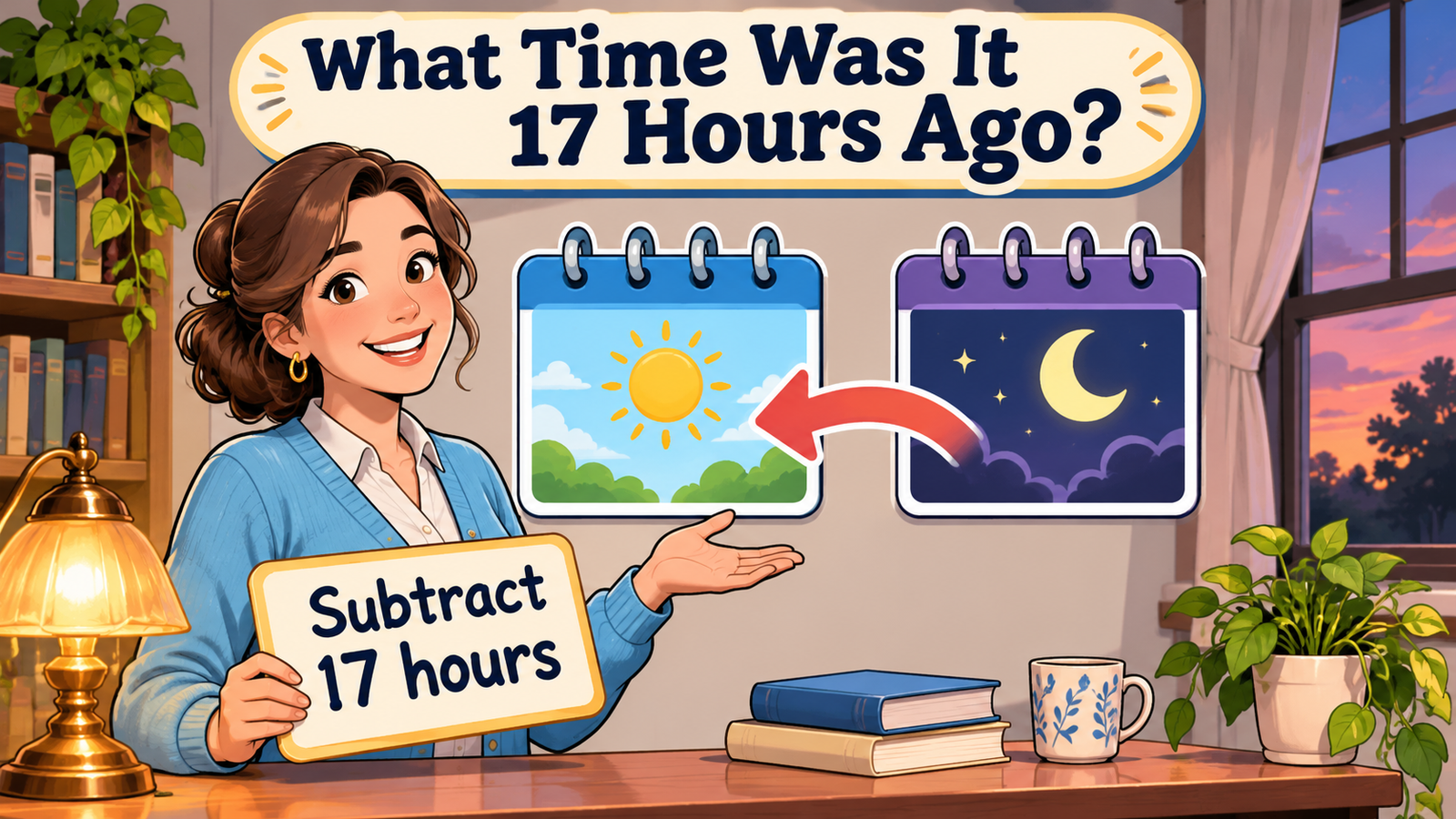
To calculate what time it was 17 hours ago, subtract seventeen hours from your reference moment. At 11:40 AM, the result is 6:40 PM yesterday. At 9:25 PM, it is 4:25 AM today. These examples assume the local clock offset stayed unchanged.
The phrase does not point to one fixed time of day. It moves with the reference moment, whether that is now, a screenshot’s capture time, or a recorded event. Start with the full date and time, then use the methods below to keep the answer accurate.
Why Seventeen Hours Can Be Confusing
Seventeen hours is longer than a twelve-hour clock cycle but shorter than a standard twenty-four-hour day. Moving back that far can change AM to PM, cross midnight, or remain on the same date. You cannot determine the date simply by seeing the number seventeen.
The safest approach is to track the movement in smaller pieces or use a 24-hour clock. Do not subtract seventeen from an isolated twelve-hour numeral and guess what the result means. The AM/PM label and the calendar date are part of the starting information.
Subtract Twelve Hours and Then Five
Split seventeen into twelve plus five. Starting at 11:40 AM, subtract twelve hours to reach 11:40 PM yesterday. Subtract another five hours to reach 6:40 PM yesterday. The minutes remain unchanged because the interval contains whole hours.
Starting at 9:25 PM, subtract twelve hours to reach 9:25 AM today. Five more hours takes you to 4:25 AM today. Writing the intermediate point makes the method easier to review and helps prevent accidentally moving back an extra day.
Use 24-Hour Time for a Direct Calculation
Convert the starting hour into 24-hour notation. For 9:25 PM, write 21:25. Subtracting seventeen from twenty-one gives four, so the answer is 04:25 on the same date. There is no need to change the minutes.
For 11:40 AM, eleven minus seventeen gives negative six. Add twenty-four to obtain eighteen and move back one calendar date. The result is 18:40 yesterday, or 6:40 PM. The added twenty-four corrects the clock position; it does not cancel the need to adjust the date.
The Same-Day Boundary Is 5 PM
With a constant local offset, starting before 5 PM gives a previous-day result. Starting at or after 5 PM gives a same-day result. At exactly 5 PM, seventeen hours earlier was midnight at the beginning of the current date.
Compare 4:59 PM and 5 PM. Subtracting seventeen hours from the first gives 11:59 PM yesterday. Subtracting from the second gives 12 AM today. This boundary example is a useful check because it shows how a one-minute change can alter the date label without changing the duration being subtracted.
Worked Examples Throughout the Day
At 2:15 AM, seventeen hours earlier was 9:15 AM yesterday. At 8:50 AM, it was 3:50 PM yesterday. At 1:30 PM, it was 8:30 PM yesterday. At 6:10 PM, it was 1:10 AM today. At 11:45 PM, it was 6:45 AM today.
These are fixed examples, not live answers. Choose the pattern that matches your starting period, then use your actual minutes. Do not copy the date label from a morning example into an evening calculation without checking whether you crossed the same midnight boundary.
Another Method: Yesterday Plus Seven Hours
Since seventeen equals twenty-four minus seven, another mental method is to start at the same clock time yesterday and then move forward seven hours. From 10 AM today, yesterday at 10 AM plus seven hours is yesterday at 5 PM. That is seventeen hours before the original reference.
From 8 PM today, yesterday at 8 PM plus seven hours reaches today at 3 AM. This method is useful if subtracting seventeen feels awkward. It still assumes an unchanged clock offset, and you must follow the date when the seven-hour forward step crosses midnight.
Converting Seventeen Hours Into Units
Seventeen hours equals 1,020 minutes, calculated as 17 × 60. In seconds, the duration is 61,200 seconds. These fixed conversions are useful when a record or system expresses elapsed time in smaller units.
Be careful with decimal notation. Seventeen hours and thirty minutes is 17.5 hours, not 17.30 hours. The question “seventeen hours ago” subtracts exactly seventeen hours; adding an extra half-hour changes the answer and should be stated separately rather than assumed from a display.
Keep the Reference Date With the Result
A clock time alone can be ambiguous once a conversation is saved or forwarded. Write the complete resulting date when it matters. For example, January 1 at 10 AM minus seventeen hours gives December 31 at 5 PM in the previous year.
This also matters at month boundaries. A result on the previous date may belong to a month with twenty-eight, twenty-nine, thirty, or thirty-one days. Use the actual calendar rather than subtracting one from the day number and leaving a nonexistent day zero.
Social Media Labels Are Not Always Exact
A label such as “17 hours ago” may be rounded or refreshed only periodically. Without the platform’s exact display rules, it should not be treated as proof of a timestamp precise to the second. It is often an approximate description of age.
If you are reconstructing an event, look for the original timestamp and its zone. For a screenshot, note when it was captured. Calculating seventeen hours before the time you view an old screenshot will not necessarily reveal when the pictured message was originally sent.
Time Zones and Elapsed Time
The same moment can have different local clock readings in different zones. Choose the zone in which you want to express the answer and keep it consistent. Seventeen elapsed hours is the same duration, but “yesterday” and “today” are local calendar labels.
If a daylight-saving change occurs during the interval, subtracting seventeen from the wall-clock hour can be wrong for elapsed time. Use a complete timestamp, subtract the duration, and then convert the result to the desired local zone. The simple 5-PM boundary rule applies only when the offset is unchanged.
Check the Answer in Reverse
Add seventeen hours to your result. If you calculated 6:40 PM yesterday, add twelve hours to reach 6:40 AM today and another five to reach 11:40 AM. Matching the original moment confirms both the time and the date.
If your reverse check misses by twelve hours, inspect AM and PM. If it misses by a whole day, inspect the date change. If the minutes differ, check whether you accidentally subtracted a number of minutes as well. This makes checking a useful diagnostic step rather than simply repeating the same calculation.
Frequently Asked Questions
What time was it seventeen hours ago?
Subtract seventeen hours from your reference date and time. The answer depends on that starting moment.
Is seventeen hours ago always yesterday?
No. Under a constant offset, starting at or after 5 PM produces a same-day result.
What is seventeen hours before noon?
It is 7 PM on the previous date, assuming no clock change.
What is seventeen hours before 10 PM?
It is 5 AM on the same date under ordinary unchanged-offset conditions.
How many minutes are seventeen hours?
There are 1,020 minutes, equivalent to 61,200 seconds.
Does this page show a live answer?
No. The examples teach the calculation. Use the current time or the recorded timestamp relevant to your question.
Conclusion
To find seventeen hours ago, subtract twelve hours and then five, or use 24-hour arithmetic. Keep the date attached and remember that a same-day result is possible later in the afternoon and evening.
Verify by adding seventeen hours back. When a rounded label or clock change is involved, a complete timestamp provides a more reliable answer than the visible hour alone.




Leave a Reply