

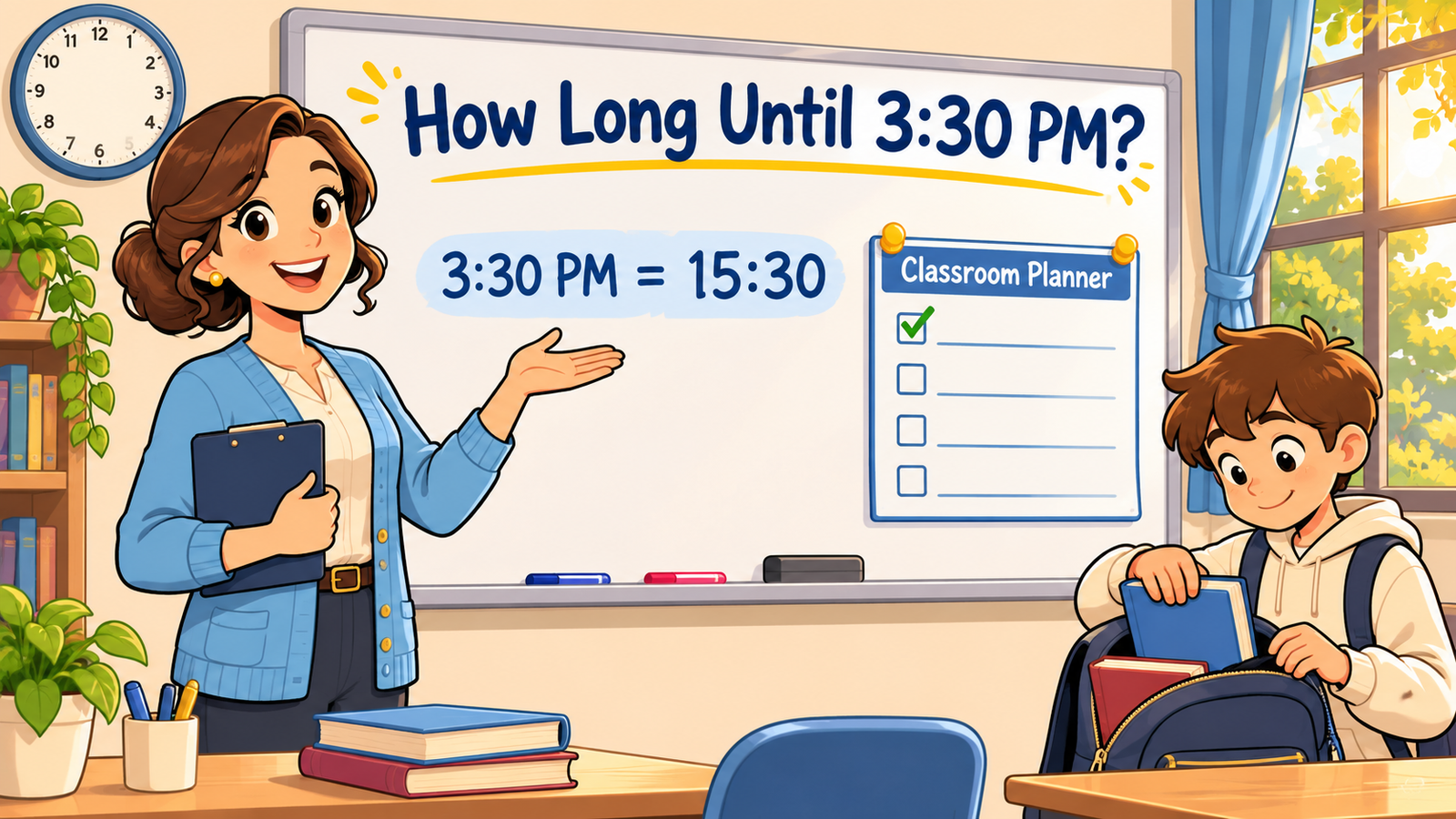
The time until 3:30 PM depends on your current time and the date you mean. From 2:10 PM today, the wait is 1 hour and 20 minutes. From 3:05 PM, it is twenty-five minutes. In 24-hour notation, your target is 15:30.
This page gives worked examples and calculation methods rather than a live countdown. Start with your own clock, confirm whether you mean today or tomorrow, and use the approach that feels easiest.
Understand the 3:30 PM Target
3:30 PM means half past three in the afternoon. The thirty indicates minutes after the hour. It is thirty minutes later than 3:00 PM and thirty minutes earlier than 4:00 PM, so it sits exactly halfway between those two clock times.
Do not confuse a clock time with a duration. “Three hours and thirty minutes” describes a length of time, while “3:30 PM” identifies a moment in a daily schedule. A three-and-a-half-hour timer ends at 3:30 PM only when it starts at noon under ordinary conditions.
Convert the Starting Time to the Same Format
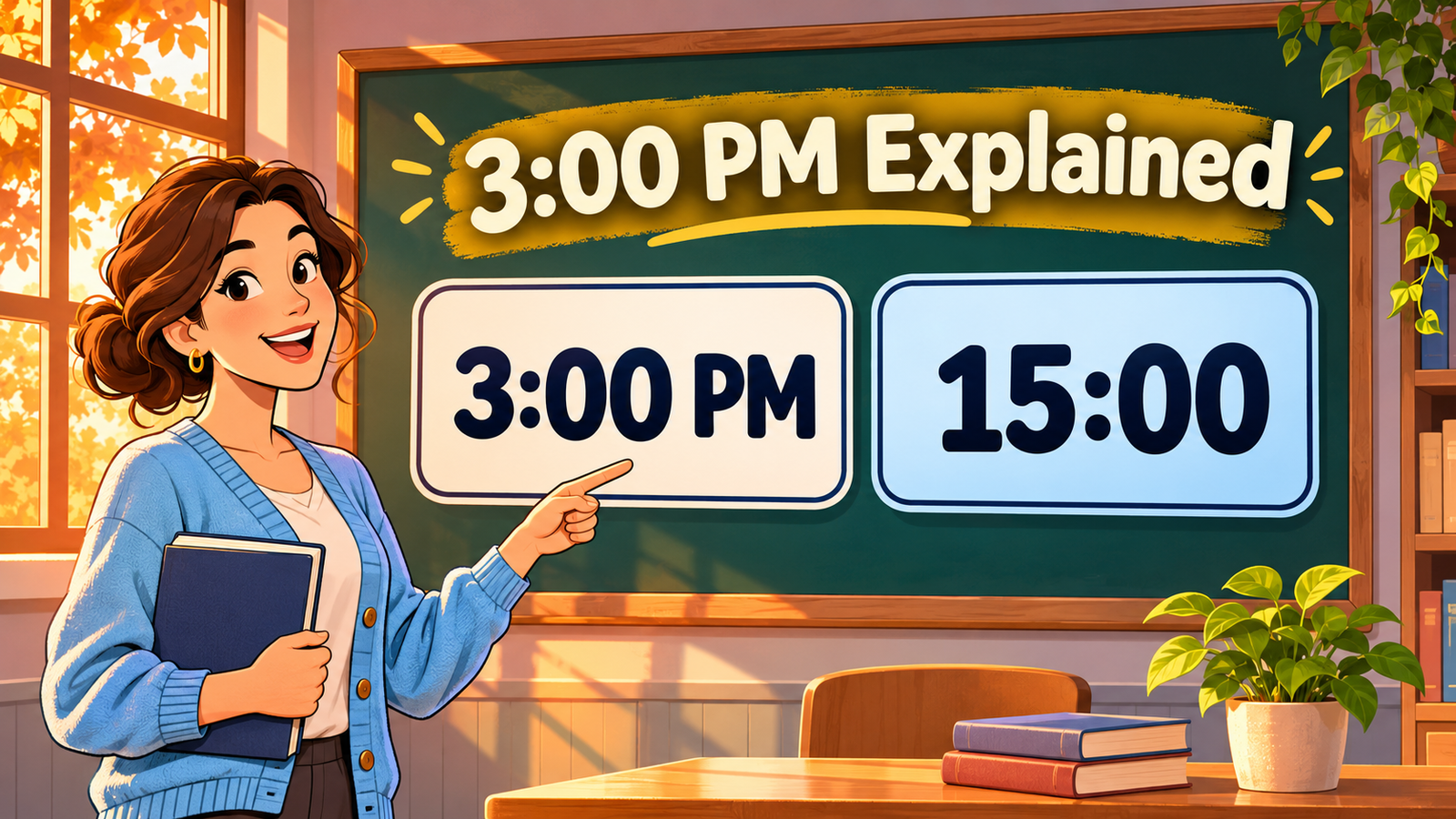
You can calculate using either a twelve-hour or a 24-hour clock, but keep the notation consistent. In the 24-hour system, 3:30 PM becomes 15:30, while 2:10 PM becomes 14:10. Subtracting those readings gives 1 hour and 20 minutes.
For morning starting times, the 24-hour hour normally stays the same. Thus 10:45 AM is 10:45. Midnight-hour times are the special case: 12:20 AM becomes 00:20. Clear conversion prevents a twelve-hour mistake before you even begin calculating the interval.
Count Forward to Half Past Three
Counting forward is useful when the starting minutes are awkward. From 1:48 PM, count twelve minutes to 2:00 PM, one hour to 3:00 PM, and thirty minutes to 3:30 PM. The total is 1 hour and 42 minutes.
From 11:55 AM, count five minutes to noon and then 3 hours and 30 minutes to the target. The total is 3 hours and 35 minutes. Breaking the wait at noon keeps the AM-to-PM transition visible and makes the addition easy to check.
Subtract Clock Positions in Minutes
The target 15:30 corresponds to 930 minutes on a standard midnight-based clock scale: fifteen times sixty plus thirty. Convert the starting time the same way. For 13:48, calculate thirteen times sixty plus forty-eight, giving 828 minutes.
Subtract 828 from 930 to get 102 minutes. Since sixty minutes make one hour, the result is 1 hour and 42 minutes. This agrees with counting forward. The formula is useful for ordinary same-day calculations when there is no change in the local clock offset.
Borrow an Hour When Needed
If you subtract clock fields directly, the starting minutes may be larger than thirty. To calculate from 1:48 PM to 3:30 PM, write the target as two hours and ninety minutes within the subtraction. Borrowing one hour contributes sixty extra minutes.
Now subtract one hour and forty-eight minutes to obtain one hour and forty-two minutes. The temporary “2:90” representation is arithmetic working, not a valid time to put on an invitation. Convert the result back to ordinary hours and minutes before presenting it.
Examples From Different Parts of the Day
At 8:20 AM, there are 7 hours and 10 minutes until 3:30 PM. At 12:40 PM, there are 2 hours and 50 minutes. At 2:45 PM, there are forty-five minutes. Each example assumes the target is later on the same date.
The closer you get to the target, the more useful seconds may become. From 3:29:35 PM, the wait is twenty-five seconds. If you only know the time rounded to the nearest minute, do not claim a precise second-by-second result that the starting information cannot support.
What If 3:30 PM Has Passed?
At 4:05 PM, today’s target was thirty-five minutes ago. If you are asking about the next daily occurrence, tomorrow at 3:30 PM is normally 23 hours and 25 minutes away. Label tomorrow explicitly so the answer cannot be mistaken for a remaining wait today.
A fixed appointment retains its original date after the start time passes. Do not let an automatically repeating countdown change the meaning of the appointment. First decide whether your question concerns a missed event or the next occurrence, then perform the relevant calculation.
Exactly at 3:30 PM
At exactly 3:30:00 PM, the remaining time to today’s target is zero. The target has arrived. A tool designed to show the next strictly future occurrence might instead move to tomorrow, so check what its displayed date says.
This distinction matters when comparing different timers or websites. One may hold at zero while another resets automatically. Neither display should replace the event details you were given. For a one-time schedule, the written date and time remain the reference.
Turn the Countdown Into a Departure Plan
Imagine an activity begins at 3:30 PM and you want to arrive ten minutes early. Your arrival target is 3:20 PM. If the journey takes twenty-five minutes, leave at 2:55 PM. Those are separate milestones derived from the same event time.
At 2:10 PM, you therefore have forty-five minutes before departure, even though the event is eighty minutes away. Using the full eighty-minute countdown for preparation would leave no travel allowance. Calculate backward through each required step to see how much usable time actually remains.
Choose an Alarm or a Timer
An alarm for 3:30 PM is tied to the clock. A timer for eighty minutes begins counting when you start it. If you calculate the eighty-minute wait at 2:10 PM but start the timer at 2:15 PM, it will finish five minutes after your intended target.
For a clock-based appointment, setting the actual time is usually simpler. If you prefer a timer, recalculate immediately before starting it. Check the AM/PM field and any date or repeat setting, especially when a device defaults to the next day after the selected time has passed.
Dates, Time Zones, and Clock Changes
For a remote event, identify which location’s 3:30 PM the invitation uses. Convert that dated target into your local time before subtracting. Merely comparing your current clock with a foreign clock’s 3:30 PM can give the wrong interval.
The everyday examples assume the clock offset stays constant. Across a daylight-saving transition or another offset change, elapsed time may differ from the apparent gap between local clock readings. A complete start and target timestamp lets a time-zone-aware calculator handle that distinction correctly.
Frequently Asked Questions
How long until 3:30 PM from 2:10 PM?
There are 1 hour and 20 minutes remaining on the same date. That is eighty minutes in total, assuming no clock-offset change during the interval.
What is 3:30 PM in 24-hour time?
It is 15:30. Add twelve to the afternoon hour three and preserve the thirty-minute field. Do not add a PM label after the 24-hour notation.
How long until 3:30 PM from noon?
The wait is 3 hours and 30 minutes, or 210 minutes. Noon is 12:00 PM, so this calculation stays within the afternoon portion of the same day.
What if the current time is 3:45 PM?
Today’s 3:30 PM was fifteen minutes ago. The next occurrence is normally 23 hours and 45 minutes away, on tomorrow’s date.
Does half past three always mean 3:30 PM?
It means thirty minutes after three, but the phrase alone does not specify AM or PM. Add “in the afternoon” or the PM label when the context is unclear.
Can a countdown tell me when to leave?
It gives the gap to the target you enter. To find a departure time, first subtract travel time and any arrival buffer from the event time, then count down to that earlier departure target.
Conclusion
To find the wait until 3:30 PM, use the correct date and compare your current time with 15:30. Count forward through convenient hours or convert both readings into minutes and subtract.
If today’s target has passed, distinguish it from tomorrow’s occurrence. Add the appropriate time zone for shared events, and calculate preparation and travel separately so the countdown supports your actual plan.



Leave a Reply