

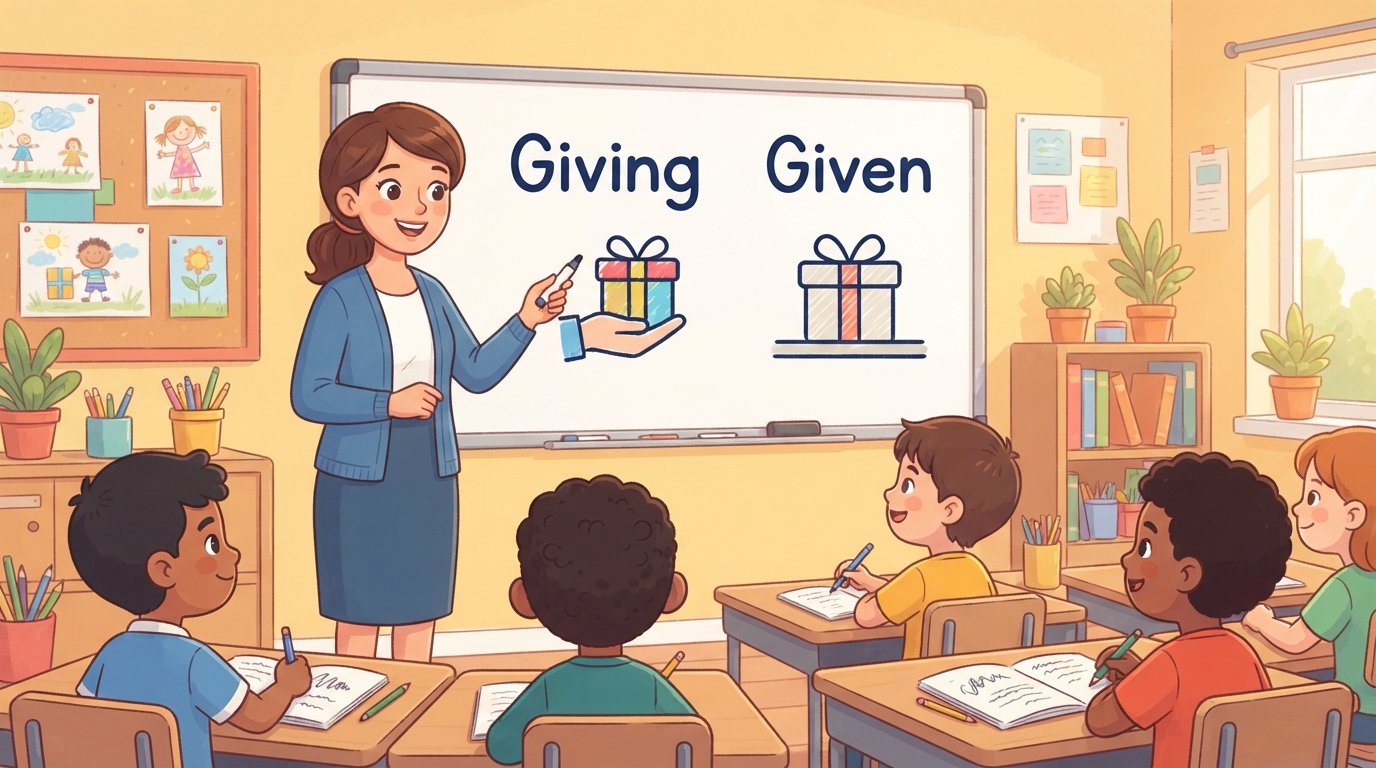
Two forms of the same verb, “give,” yet giving vs given trips up learners and native speakers alike. One shows action happening right now; the other shows something already finished. Once you spot the pattern, the confusion disappears fast.
Giving vs Given: The Quick Answer
- Giving — the present participle/gerund of “give,” used for ongoing actions.
- Given — the past participle of “give,” used for completed actions, passive voice, or as an adjective/preposition.
Quick Comparison
| Form | Verb Type | Used In | Example | Meaning |
|---|---|---|---|---|
| Giving | Present participle / Gerund | Continuous tenses, noun forms | “She is giving her speech.” | Action happening right now |
| Given | Past participle | Perfect tenses, passive voice, adjective, preposition | “She was given an award.” | Action already completed or a fixed condition |
Memory trick: If it’s happening, it’s “giving.” If it’s finished, it’s “given.”
Understanding “Giving” in Grammar
“Giving” as a Present Participle
“Giving” shows an action currently in progress, or one that was happening at a specific point in the past.
Examples:
- “I am giving my best effort.”
- “They are giving free samples at the store.”
- “She’s giving a lecture at the university.”
The structure “am/is/are + giving” forms the present continuous tense, used for actions in motion — not completed ones.
“Giving” in Past and Perfect Continuous Tenses
“Giving” also appears in past continuous and perfect continuous forms.
Past continuous (“was/were + giving”) describes something happening at a specific past moment:
- “He was giving his presentation when the power went out.”
Perfect continuous (“have/has/had been + giving”) emphasizes duration:
- “She has been giving piano lessons for five years.”
In short, “giving” focuses on duration and continuity, while “given” focuses on completion.
“Giving” as a Gerund (Noun Form)
Sometimes “giving” behaves like a noun rather than a verb — this is called a gerund.
Examples:
- “Giving is caring.”
- “I love giving gifts during the holidays.”
- “Her giving nature inspires others.”
| Sentence | Function of “Giving” |
|---|---|
| “Giving helps people feel connected.” | Subject |
Tip: if you can swap the word for a noun like “kindness” or “helping,” it’s functioning as a gerund.
Understanding “Given” in Grammar
“Given” as a Past Participle
Used with “have/has/had,” “given” forms perfect tenses, showing an action completed before another point in time.
Examples:
- “I have given my word.”
- “She had given the keys to her friend.”
- “They will have given their decision by tomorrow.”
| Tense | Structure | Example |
|---|---|---|
| Present perfect | have/has + given | “She has given her consent.” |
| Past perfect | had + given | “He had given his best before retiring.” |
Rule of thumb: “given” shows something already done — it’s about completion, not continuation.
“Given” in the Passive Voice
“Given” is widely used in passive sentences, where the subject receives the action rather than performing it.
Examples:
- “The award was given to the winner.”
- “He was given a second chance.”
| Active Voice | Passive Voice |
|---|---|
| “The teacher gave homework.” | “Homework was given by the teacher.” |
If the focus is on what was received rather than who gave it, use “given.”
“Given” as an Adjective
“Given” can also describe something specific, fixed, or established.
Examples:
- “At any given moment, something amazing could happen.”
- “We must follow the rules in any given situation.”
| Phrase | Meaning |
|---|---|
| Given time | A specific amount of time |
Tip: if you can replace “given” with “particular,” it’s functioning as an adjective.
“Given” as a Preposition
“Given” can also work as a preposition meaning “considering” or “because of,” often at the start of a formal sentence.
Examples:
- “Given his experience, he’s the best person for the job.”
- “Given the weather, we should stay indoors.”
| Sentence | Meaning |
|---|---|
| “Given the facts, your argument makes sense.” | Considering the facts |
Giving vs Given: Comparing Real Sentences
| Example With “Giving” | Example With “Given” | Explanation |
|---|---|---|
| “She is giving a lecture.” | “She was given a chance to lecture.” | Ongoing action vs. received action |
| “Giving up isn’t an option.” | “He has given up already.” | Gerund vs. past participle |
Giving vs Given: Common Mistakes Learners Make
Incorrect: “I’m given him my time.” Correct: “I’m giving him my time.”
Incorrect: “She has been give money before.” Correct: “She has been given money before.”
Incorrect: “He given the book to her.” Correct: “He gave the book to her.” / “The book was given to her.”
Tips to Remember the Difference
Think time: “giving” = happening now or continuously; “given” = already done. Say it out loud: if “is/was” fits, use “giving”; if “has/had” fits, use “given.” Memory trick: “giving” has “-ing” — still ongoing; “given” ends in “-en” — already ended.
Real-Life Usage Examples
Business: “The company is giving bonuses this month.” / “Employees were given recognition for their hard work.”
Daily life: “I love giving gifts.” / “I was given a gift on my birthday.”
“Giving” and “Given” in Idioms
| Expression | Meaning | Example |
|---|---|---|
| Giving up | Quitting or surrendering | “Don’t think of giving up yet.” |
| Given the chance | If the opportunity arises | “Given the chance, she would travel the world.” |
Quick Practice
Fill in the blanks: “She has _______ me great advice” (given). “I am _______ my best effort” (giving). “The books were _______ away for free” (given).
Summary Table
| Feature | Giving | Given |
|---|---|---|
| Verb form | Present participle / Gerund | Past participle |
| Focus | Ongoing / continuous | Completed / result |
| Used in | Continuous tenses, gerunds | Perfect tenses, passive voice |
| Common meaning | Performing the action | Receiving or describing the action |
In one line: if it’s in motion, it’s “giving.” If it’s done, it’s “given.”
FAQs About Giving vs Given
What’s the main difference between “giving” and “given”?
The main difference is tense and meaning. “Giving” shows something happening now or ongoing, while “given” refers to something already completed or provided.
Can both “giving” and “given” be used as adjectives?
Yes. “Giving” can describe a generous person (“She’s a giving person”), while “given” can describe something assumed or provided (“It’s a given fact”).
Why do English learners often confuse these two words?
Because both come from the same verb, “give,” and their forms look similar. Without knowing their grammatical roles, learners often mix them up.
How can I remember when to use “giving” or “given”?
Think of “giving” as active and happening, and “given” as passive and completed. Practice by creating your own example sentences.
What’s the best way to practice using “giving” and “given”?
Use both words in real-life contexts — write short sentences, listen to native speakers, and repeat them. Over time, your fluency will grow naturally.
Conclusion
Mastering giving vs given may seem tricky at first, but it becomes simple once the pattern clicks. Both words share the same root verb, “give,” yet play very different grammatical roles. “Giving” reflects an action in progress, while “given” shows a completed one. With a bit of practice and real-life examples, choosing the right word becomes almost automatic.



Leave a Reply