

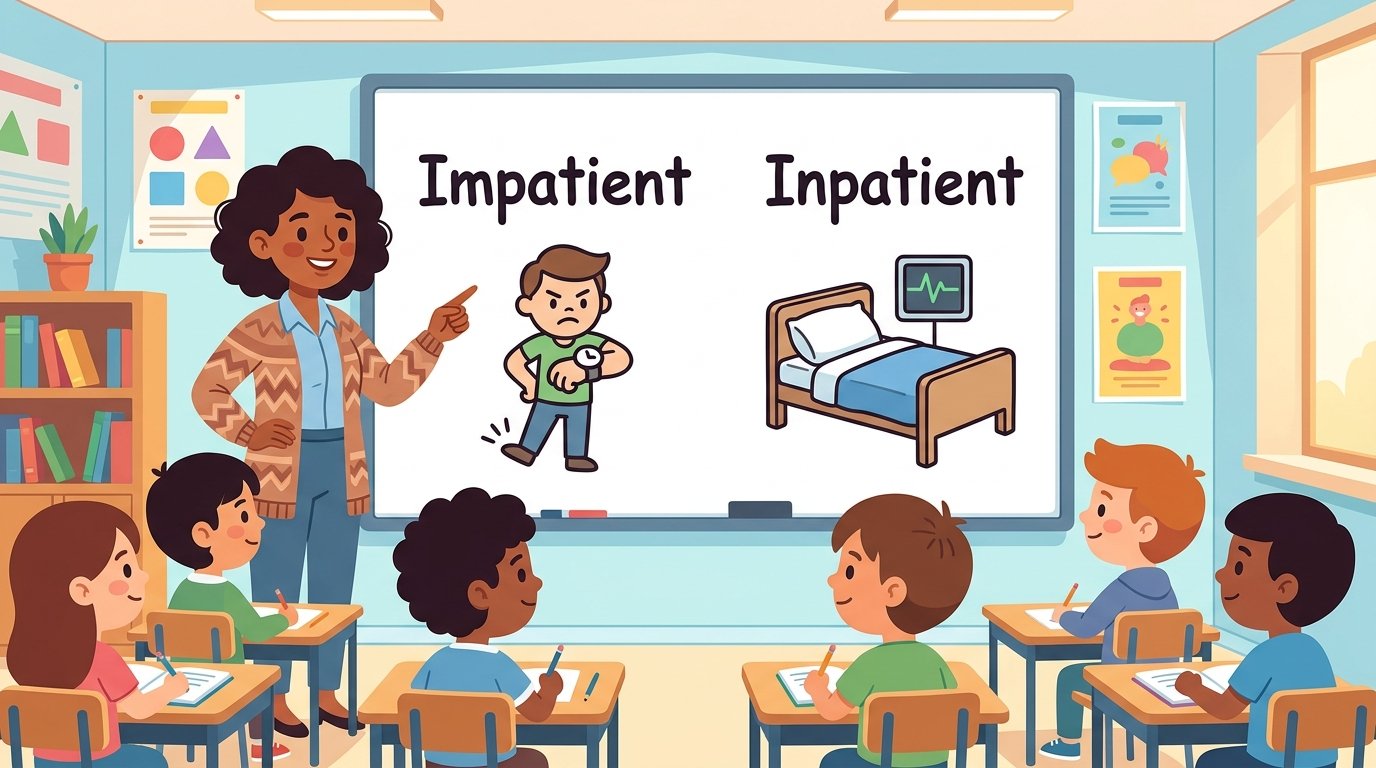
Two words that look and sound almost identical, yet mean something entirely different — impatient vs inpatient trips up plenty of writers, especially in emails, texts, and casual online posts. One describes a feeling; the other describes a medical situation. Mixing them up can completely change what your sentence is actually saying.
Impatient vs Inpatient: The Quick Answer
- Impatient — an adjective describing restlessness, annoyance, or a lack of patience.
- Inpatient — a noun/adjective referring to someone admitted to a hospital for treatment.
Example Comparison
- “She became impatient while waiting for her coffee.” (an emotion)
- “The hospital admitted five new inpatients today.” (a medical status)
Same-sounding words, completely different meanings.
What Does “Impatient” Mean?
Impatient describes someone who finds it hard to wait. It reflects restlessness, frustration, or eagerness when things aren’t moving as quickly as expected.
Example
- “He grew impatient waiting for the results.”
This word is about a feeling — not a physical condition.
Synonyms and Antonyms
| Synonyms | Antonyms |
|---|---|
| Restless | Patient |
| Irritable | Calm |
| Eager | Content |
| Anxious | Relaxed |
What Does “Inpatient” Mean?
Inpatient belongs entirely to healthcare terminology.
- As a noun, it means a person who stays in a hospital overnight or longer for treatment.
- As an adjective, it describes anything related to that kind of care — like “inpatient treatment” or “inpatient facility.”
Examples
- “She’s receiving inpatient care after her surgery.”
- “The inpatient recovered well after the operation.”
Impatient vs Inpatient: Quick Comparison Table
| Term | Part of Speech | Meaning | Context |
|---|---|---|---|
| Impatient | Adjective | Feeling restless or annoyed due to delay | Emotion |
| Inpatient | Noun/Adjective | A person admitted to a hospital for care | Healthcare |
Impatient vs Inpatient: Understanding the Prefixes
The confusion often comes down to two prefixes that look alike but mean opposite things.
- Im- means “not” — so “impatient” means “not patient.”
- In- means “inside” — so “inpatient” means someone inside a hospital.
This is the same prefix pattern found in other word pairs:
- Im- → impossible, immoral, imperfect
- In- → inland, indoors, inbound
Inpatient vs Outpatient: The Medical Context
Understanding “inpatient” gets easier when you compare it to its medical opposite: outpatient.
| Category | Inpatient | Outpatient |
|---|---|---|
| Duration of stay | 24 hours or longer | A few minutes to several hours |
| Example treatment | Surgery, recovery, serious illness | Routine checkups, minor procedures |
| Level of care | Continuous monitoring | Periodic visits |
For example, someone undergoing heart surgery would be treated as an inpatient, while someone getting a routine blood test would be an outpatient.
Common Usage Patterns for “Impatient”
- Impatient with — “She’s impatient with slow learners.”
- Impatient for — “He’s impatient for the weekend to start.”
- Impatient to + verb — “I’m impatient to hear the news.”
Common Mistakes People Make
Since these words look and sound so similar, mix-ups happen often — especially in casual or fast-typed writing.
Incorrect
- “She’s an impatient at the hospital.”
- “He was inpatient for his package.”
Correct
- “She’s an inpatient at the hospital.”
- “He was impatient for his package.”
Why This Happens
- The words sound nearly identical when spoken.
- Autocorrect sometimes swaps one for the other.
- Writers don’t pause to consider which meaning actually fits.
A Simple Trick to Remember the Difference
Here’s an easy way to keep them straight:
“If you’re in the hospital, you’re an inpatient. If you’re not patient, you’re impatient.”
Visual Cue
Picture two scenes:
- A person tapping their foot in line = impatient
- A person lying in a hospital bed = inpatient
If you’re talking about feelings, it’s “impatient.” If you’re talking about medical treatment, it’s “inpatient.”
Where These Words Come From
Both words trace back to Latin roots, which helps explain the pattern:
- Impatient comes from the Latin impatientem, meaning “not able to bear.”
- Inpatient combines “in” (inside) with “patient” (a person receiving care).
Other Confusing Word Pairs Worth Knowing
| Pair | Difference |
|---|---|
| Immoral vs. Amoral | Immoral means against morals; amoral means lacking morals entirely. |
| Infectious vs. Contagious | Infectious relates to disease spread by pathogens; contagious relates to spread through contact. |
A Quick Example of How Context Changes Meaning
Consider this scenario involving the same person:
- Scenario 1: “After waiting for two hours, Sarah became impatient and left the clinic.” — expressing her frustration.
- Scenario 2: “Sarah was admitted as an inpatient for observation after her surgery.” — describing her medical status.
Same person, same setting, completely different meanings depending on which word is used.
FAQs About Impatient vs Inpatient
What’s the main difference between “impatient” and “inpatient”?
“Impatient” describes an emotion — being unable to wait calmly. “Inpatient” refers to a hospitalized person receiving treatment.
Can “inpatient” describe feelings?
No. It always relates to medical care, never emotions.
Is “outpatient” the opposite of “inpatient”?
Yes. An inpatient stays in the hospital, while an outpatient visits and leaves the same day.
How do you pronounce “impatient” vs “inpatient”?
They sound almost identical: /ɪmˈpeɪʃənt/ and /ɪnˈpeɪʃənt/. Context, not pronunciation, is what tells them apart.
Can “impatient” ever be used in a medical context?
Not really. “Impatient” always describes behavior or emotion, never someone receiving medical care.
Conclusion
Understanding the difference between impatient vs inpatient helps you communicate with more clarity and professionalism. Even a small spelling difference can completely shift the meaning of a sentence. Remembering that “inpatient” connects to hospitals and “impatient” reflects emotion means you’ll never mix the two up again.










Leave a Reply