

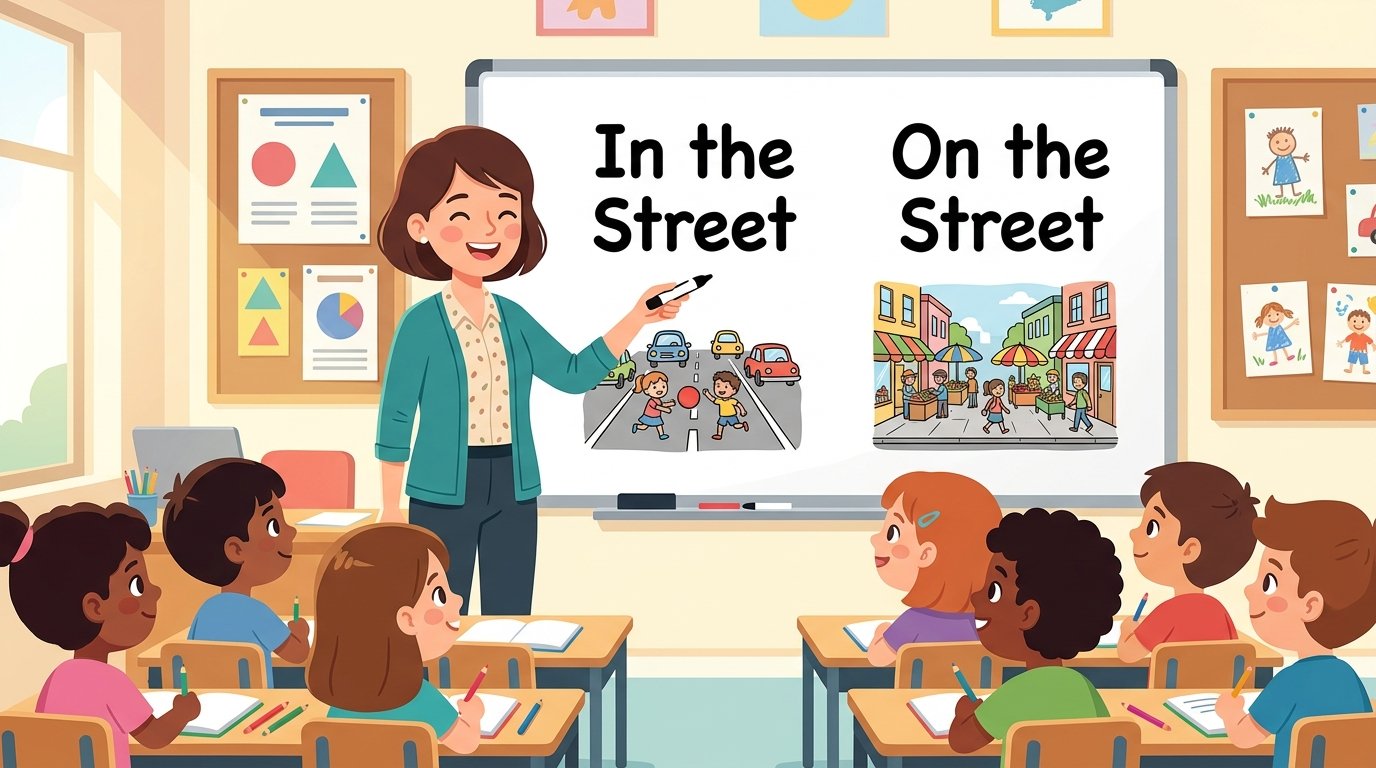
English prepositions can trip up even confident speakers, and “in the street” or “on the street” is a classic example. Both phrases sound perfectly natural, yet they carry subtly different meanings depending on context. This guide breaks down when to use each one, with clear examples to help it stick.
In the Street or On the Street: The Quick Answer
- “In the street” suggests being within the road itself — among traffic, activity, or danger.
- “On the street” refers to location or surface — along the road, or connected to general street life.
Quick Comparison
| Phrase | Core Meaning | Example |
|---|---|---|
| In the street | Inside the boundaries of the road; among traffic | Children were playing in the street. |
| On the street | Along or upon the street; general location or street life | Vendors sell food on the street. |
What Does “In the Street” Mean?
“In the street” paints a picture of someone or something positioned within the road’s space — where cars move, noise happens, and activity unfolds.
Examples
A car broke down in the street. Children ran and shouted in the street after the parade. Police officers stood in the street directing traffic.
This phrase often carries a sense of presence, energy, or even danger, since it places the action directly inside the roadway.
What Does “On the Street” Mean?
“On the street” shifts the focus toward location, surface, or social context. It’s the more common choice in everyday American English.
Literal Examples
There’s a new café on the street near my apartment. The bus stopped on the street outside the library.
Figurative and Idiomatic Uses
“On the street” isn’t always literal. It can also describe public rumor (“Word on the street is that the mayor’s resigning”), homelessness or hardship (“He’s been living on the street since he lost his job”), or practical intelligence — “street smart” describes knowledge gained from real-world experience.
In the Street or On the Street: Grammar Guidelines
| Use “In the Street” When… | Use “On the Street” When… |
|---|---|
| Describing presence within the road or traffic | Referring to position along the road’s surface |
| Talking about activity inside the street’s boundaries | Talking about general location, business, or lifestyle |
| Emphasizing action or danger | Emphasizing everyday description or scene |
Example Comparisons
“Kids were playing in the street” means they’re inside the road, among cars. “Shops stand on the street” means they’re located along the street. “The car stopped in the street” means it’s blocking traffic. “He found a wallet on the street” means he picked it up off the ground.
How Verbs Influence the Right Preposition
Certain verbs naturally pair with one preposition over the other.
| Verb | Correct Phrase | Example |
|---|---|---|
| Stand | in the street | People stood in the street cheering. |
| Park | on the street | You can park on the street after 6 PM. |
| Play | in the street | Children played in the street. |
| Sell | on the street | Vendors sell snacks on the street. |
The trick is to picture where the action actually happens. If it takes place within the street’s space, use “in.” If it happens along or on top of the street, use “on.”
What About “At the Street”?
“At the street” is used far less often, and only for a specific point or intersection — not a general area.
Correct: “Meet me at the street corner.” “She waited at the street light.”
Incorrect: “She lives at the street.” ❌
Use “at” only when referring to a specific location connected to the street, like a corner or a light — never for general position or movement.
British vs American English: Which Preposition Is Preferred?
Regional habits shape which phrase feels more natural.
| Variety | Common Choice | Example |
|---|---|---|
| American English | On the street | There’s a café on the street near me. |
| British English | In the street | Children were playing in the street. |
British speakers often lean toward “in,” while American speakers tend to favor “on.” Both are understood worldwide, but knowing your audience helps your English sound more natural.
Can These Phrases Be Used Interchangeably?
Sometimes — but context still matters. “I saw him in the street” means he was physically standing in the road, while “I saw him on the street” simply means you noticed him in the same general area.
Both are grammatically correct, but “in the street” reads as more specific and literal. If you’re describing danger or movement, “in” fits better. If you’re describing lifestyle or general scene, “on” is the natural choice.
Popular Expressions Using These Phrases
“Dancing in the Street” evokes joy and celebration happening right in public space. “Word on the street” is a common idiom for rumors or informal news. And “street smart” describes practical intelligence gained from real-world experience, not textbooks.
Summary: In, On, or At?
| Preposition | Use It For | Example |
|---|---|---|
| In | Something inside the road or traffic area | Kids ran in the street. |
| On | Location or activity along the street | Shops are on the street. |
| At | A specific point or intersection | Meet me at the street corner. |
FAQs About In the Street or On the Street
What’s the main difference between “in the street” and “on the street”?
“In the street” suggests being within or surrounded by the street, like children playing there. “On the street” focuses on the surface or location, like cars parked or shops lining the road.
Are “in the street” and “on the street” interchangeable?
Not always. Native speakers sometimes use them loosely, but the choice of preposition can shift the meaning, so picking the right one matters for clarity.
Which version is more common — British or American?
British English commonly uses “in the street,” while American English typically prefers “on the street.” Both are grammatically correct.
When should I use “at the street” instead?
Use “at the street” only for a specific point, like a corner or intersection — not for general position or area.
Why do English prepositions feel so tricky?
Prepositions don’t always follow clear-cut rules. Their correct use often depends on context and nuance rather than a fixed formula.
Conclusion
Mastering “in the street” or “on the street” comes down to understanding how context shapes meaning. “In the street” places the action inside the road itself, while “on the street” describes location, surface, or general street life. Once you notice this pattern, choosing the right preposition becomes second nature.






Leave a Reply