

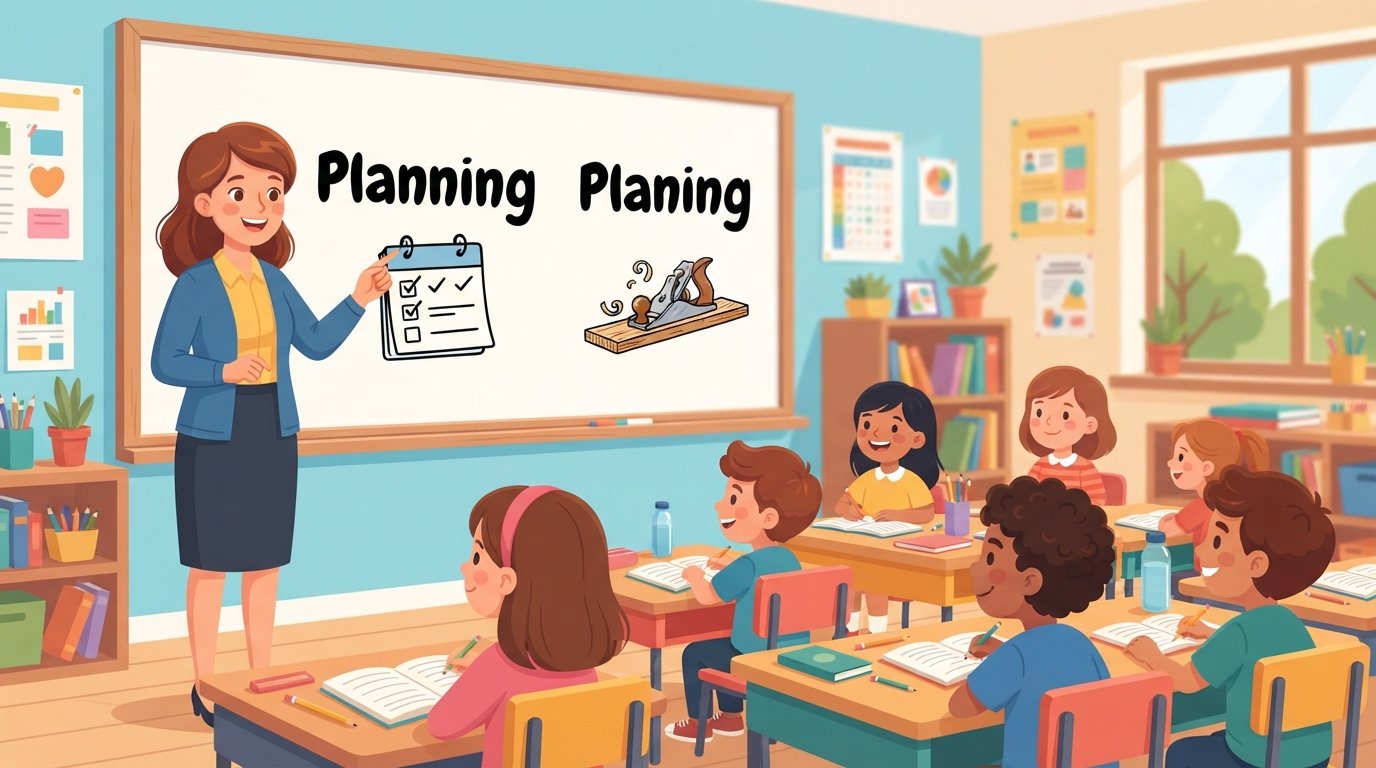
English spelling can throw people off more than expected, especially when two words look nearly identical but carry completely different meanings. If you’ve ever paused to wonder planing or planning, you’re not the only one. The confusion happens because both words are genuinely correct English — they just belong to very different situations.
Here’s the short version: planning is the word you want when talking about preparing, organizing, or making plans, while planing is a separate, technical word tied to woodworking and engineering. Knowing the difference keeps you from an awkward spelling mistake and makes your writing noticeably clearer.
Working Out Which Spelling Fits
If you’re trying to work out which one is correct, the answer really depends on what you’re trying to say.
Reach for “Planning” When You Mean:
- Organizing something
- Preparing for what’s ahead
- Making arrangements
- Thinking ahead
Example:
- “I am planning a vacation.”
This is the version you’ll see constantly in everyday English.
Reach for “Planing” When You Mean:
- Smoothing wood with a tool
- Gliding across a surface
- A technical engineering or aviation process
Example:
- “He is planing the wooden board.”
Both words are legitimate — they simply mean entirely different things.
Which One Should You Use in Everyday Writing?
For most people asking this question, the answer nearly always comes back to:
- Planning
That’s because “planning” shows up in daily conversation far more often.
Examples:
- Planning a trip
- Planning a meeting
- Planning your future
- Planning an event
Here’s an incorrect version:
- “I am planing my wedding.”
And the correct one:
- “I am planning my wedding.”
Unless you’re actually working with wood or describing a technical process, chances are you need planning.
What Exactly Does “Planning” Mean?
Getting a handle on the meaning behind each word starts with defining both clearly.
The Meaning Behind Planning
“Planning” is the act of:
- Preparing something in advance
- Organizing the steps involved
- Making decisions ahead of time
- Building out a strategy
Examples:
- Financial planning
- Event planning
- Business planning
- Travel planning
Sentence example:
- “She is planning her next business move.”
The Grammar Rule Behind It
“Planning” comes from:
Plan + ing = Planning
Since “plan” ends with a consonant right after a short vowel sound, the final “n” gets doubled.
That’s why it becomes:
- Plan → Planning
And never:
- Plan → Planing
What Exactly Does “Planing” Mean?
Plenty of people are surprised to discover that “planing” is a genuine English word.
The Meaning Behind Planing
“Planing” typically points to one of two things.
Smoothing wood is the most common meaning. In woodworking, a plane is a tool used to smooth or shape wood.
Example:
- “He is planing the surface of the table.”
Gliding across water or air is the second meaning. In technical usage, a boat or aircraft “planes” when it moves smoothly across a surface.
Example:
- “The speedboat was planing across the water.”
This meaning is fairly specialized and doesn’t come up much in everyday writing.
Planning and Planing Meaning in Hindi
People searching for the Hindi meanings of these words are usually looking for a quick, clear distinction.
Planning in Hindi
Planning = योजना बनाना / योजना तैयार करना
Examples:
- Trip planning = यात्रा की योजना बनाना
- Business planning = व्यापार की योजना बनाना
Planing in Hindi
Planing = लकड़ी को रंदे से चिकना करना / सतह को समतल करना
In technical use, this covers surface smoothing and gliding motion.
So the Hindi meanings are completely different depending on which word you’re using.
Why Planing and Planning Keep Getting Mixed Up
This spelling confusion comes from a few overlapping factors:
- Both words look almost the same on paper
- Both are legitimate English words
- Adding “-ing” often shifts spelling patterns in tricky ways
The Grammar Rule That Explains It
For “plan”:
- The vowel sound is short
- The final consonant doubles
That’s why:
- Plan → Planning
Similar examples include:
- Run → Running
- Sit → Sitting
- Stop → Stopping
This grammar rule is exactly why “planning” ends up with two Ns.
Examples That Make the Difference Clear
Correct Use of Planning
- “We are planning a road trip.”
- “She is planning her studies.”
- “They are planning a surprise party.”
Correct Use of Planing
- “The carpenter is planing the wood.”
- “The boat began planing over the water.”
An Incorrect Example
Wrong:
- “I am planing my future.”
Right:
- “I am planning my future.”
Which Spelling Fits School and Exam Writing?
If this question comes up in grammar tests, essays, or school assignments, the correct choice depends entirely on context.
If the sentence is about:
- Organizing
- Preparing
- Thinking ahead
Go with:
- Planning
If the sentence is about:
- Woodworking
- Surface smoothing
- Technical motion
Go with:
- Planing
In everyday academic writing, “planning” comes up far more often than “planing.”
A Simple Trick to Keep Them Straight
Here’s an easy memory shortcut:
Planning Means Plans for the Future
Think:
- “Making a plan”
That points you to:
- Planning
Planing Means a Plane Tool or Surface Motion
Think:
- A woodworking plane
- A boat planing across water
This small mental picture makes the word much easier to recall.
FAQs About Planing or Planning
Planing or planning — which one is correct?
Both are correct, but they carry different meanings. “Planning” means organizing or preparing, while “planing” is a technical term tied to smoothing or gliding.
Is it planing or planning in everyday writing?
In most everyday writing, planning is the word you want.
What does planning actually mean?
Planning means preparing, organizing, or making arrangements for something ahead of time.
What does planing actually mean?
Planing usually refers to smoothing wood with a plane tool, or gliding over a surface in technical contexts.
Why does “planning” get a double N?
Because “plan” follows a grammar rule where the final consonant doubles before “-ing” is added — turning Plan into Planning.
What’s the meaning of planing or planning in Hindi?
Planning means योजना बनाना, while planing means सतह को चिकना या समतल करना.
Conclusion
If you’ve been stuck on planing or planning, the key is understanding what each word is actually built for. Planning is the right choice when you’re talking about organizing, preparing, or making plans, while planing is a technical word tied to woodworking or gliding motion.
In everyday writing, most people need planning, not planing. The next time you catch yourself wondering is it planing or planning, just remember: if it involves making plans, the correct spelling is planning with a double “n.”





Leave a Reply