

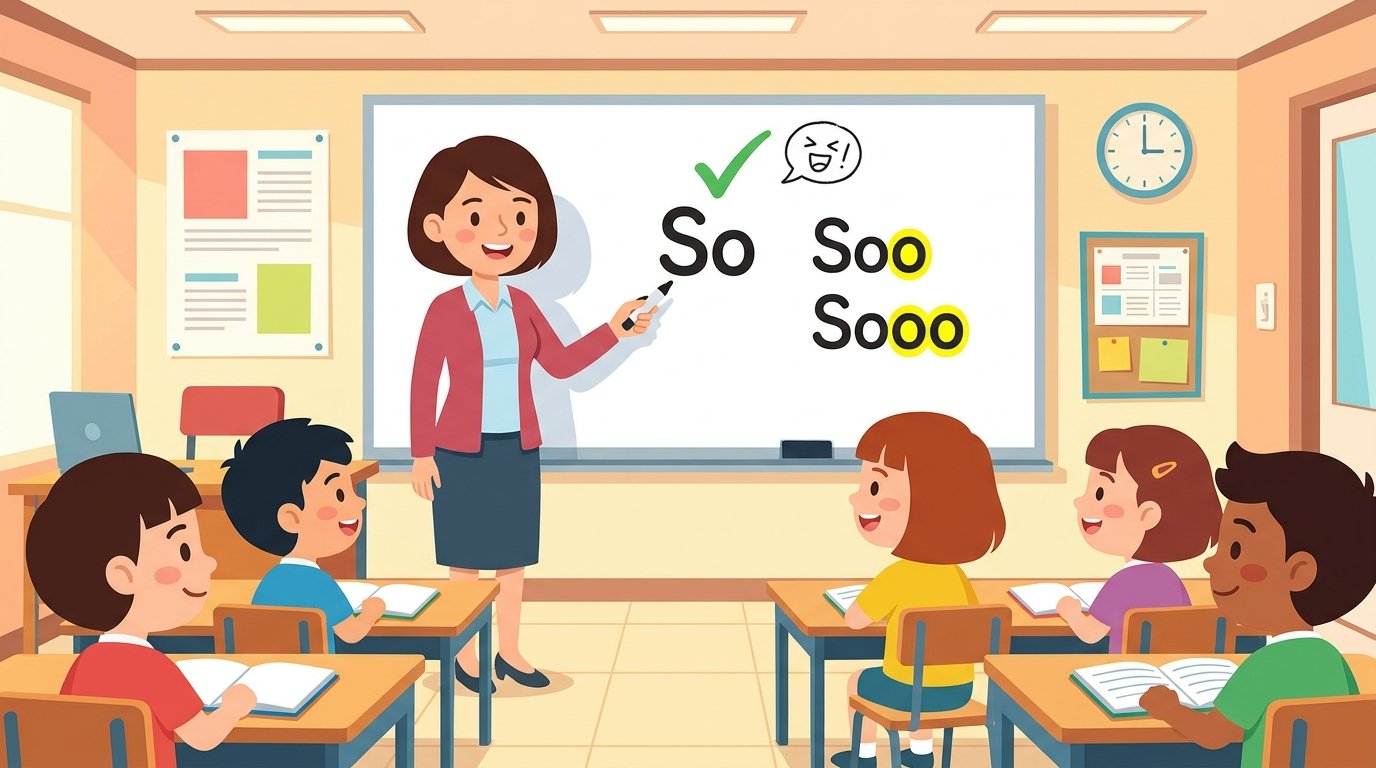
Texted “I’m sooo tired” lately? You’ve already used soo vs so without even thinking about it. One is standard English, the other is a stylized, emotional stretch of the original word. This guide breaks down what each one actually means, and when each belongs in your writing.
Soo vs So: The Quick Answer
- “So” — Standard English word, correct in all formal and informal writing.
- “Soo” — Not a recognized English word; a casual, emotional exaggeration used mostly in texting and social media.
Example Comparison
- “I’m so tired.” (correct, standard)
- “I’m sooo tired.” (casual, emotional emphasis)
What Does “So” Actually Mean?
“So” is one of the most versatile words in English. It can function as an adverb, a conjunction, or a discourse marker.
As an Adverb
“So” shows degree or intensity.
Examples:
- “She was so happy she couldn’t stop smiling.”
- “I’m so tired right now.”
As a Conjunction
“So” connects cause and effect.
Examples:
- “He forgot his umbrella, so he got wet.”
- “You should study, so you can pass the exam.”
As a Discourse Marker
In conversation, “so” helps guide the flow of dialogue, signaling continuation or transition.
Examples:
- “So, what happened next?”
- “So that’s why she left.”
Is “Soo” Actually a Real Word?
The short answer: no, not as a standard English word.
You won’t find “soo” listed in Oxford English Dictionary, Merriam-Webster, or Cambridge Dictionary as an accepted spelling of “so.”
That said, “Soo” does appear in English for a few unrelated reasons:
- As a proper noun (Sault Ste. Marie is nicknamed “the Soo”)
- As part of a name or title (like the “Soo Locks” or “Soo Line Railroad”)
- As a surname common in some Asian cultures
But as a substitute for “so,” it isn’t grammatically correct — it’s more of a stylistic, emotional expression than a legitimate word.
Why Do People Write “Soo” Instead of “So”?
“Soo” became common thanks to informal online communication. On social media, in texts, and in chats, people naturally stretch words to add tone or personality that plain text can’t express on its own.
When someone types “I’m sooo bored,” they’re not just saying they’re bored — they’re saying it in a drawn-out, more dramatic way.
Common Reasons People Use “Soo”
- To exaggerate feelings — “That’s sooo funny!”
- To mimic natural speech patterns
- To sound playful or casual rather than formal
- To show enthusiasm, especially in fan or pop-culture conversations
This kind of letter-stretching has a name in linguistics — orthographic elongation — and it’s essentially a way of adding tone of voice to typed words.
Soo vs So: Emotional Intensity Scale
The more o’s added, the stronger the emotional emphasis tends to feel.
| Spelling | Emotional Tone | Example |
|---|---|---|
| So | Neutral | “I’m so tired.” |
| Soo | Playful emphasis | “I’m soo tired.” |
| Sooo | Strong emotion | “I’m sooo tired, I can’t move.” |
| Sooooo | Dramatic exaggeration | “That’s sooooo funny!” |
This pattern reflects how spoken language uses rhythm and stress — stretching a word visually mimics how it sounds when spoken out loud with emphasis.
When Should You Use “So” Instead of “Soo”?
| Context | Correct Form | Example |
|---|---|---|
| Formal writing | So | “The results were so significant they changed our conclusion.” |
| Academic essays | So | “This study was so thorough that it influenced future research.” |
| Emails and work communication | So | “I’m so glad we finished the project on time.” |
| Text messages | Soo / Sooo | “I’m sooo excited for tonight!” |
| Social media captions | Soo / Sooo | “That sunset was sooo pretty!” |
Simple Rule of Thumb
Use “so” in any professional, formal, or academic setting. Use “soo” only for casual, expressive, low-stakes situations. In short: “so” communicates clarity, while “soo” communicates feeling.
Common Mistakes Related to Soo vs So
1. Confusing “So” With “Too”
- “So” means to a great extent — “I’m so happy.”
- “Too” means also, or excessively — “I’m too happy” (unnaturally so).
2. Overusing “Soo” in Professional Writing
Writing “soo” in emails, essays, or reports weakens credibility.
Weak: “I’m soo grateful for the opportunity.” Better: “I’m so grateful for the opportunity.”
3. Mixing Up “Soo” With “Sew”
They sound similar but mean completely different things — “sew” means to stitch fabric together, while “so” expresses degree or connects ideas.
What Language Experts Say About “Soo”
Linguists generally agree that “soo” isn’t officially recognized, but they understand exactly why it exists.
According to Oxford University Press, repeating letters is a common way digital communication expresses tone, emotion, or enthusiasm that plain text can’t capture on its own.
Editors typically treat “soo” as informal emphasis rather than a legitimate spelling variation — in print or professional writing, they’ll almost always correct it back to “so.”
Why “Soo” Has Become So Popular Online
The rise of “soo” and “sooo” tracks closely with the growth of social media communication. Platforms that reward casual, emotionally authentic tone naturally make room for stretched spellings like this one.
Influencers often use it to sound relatable (“I’m sooo ready for this collab!”), while memes exaggerate it further for humor or sarcasm. It’s become part of how younger generations express digital tone and personality online.
FAQs About Soo vs So
Is “soo” a real word?
Not officially. “Soo” isn’t recognized as a standard English word. It’s an informal, playful, exaggerated version of “so,” mostly used in texting and social media.
When can I use “soo”?
You can use “soo” in casual communication, tweets, DMs, or lighthearted comments to show extra emotion or excitement. Avoid it in formal writing, emails, or academic contexts.
Is using “soo” a grammatical mistake?
Technically, yes — it isn’t grammatically proper, but it’s widely accepted in informal settings because it adds tone and personality.
Why do people add an extra “o”?
Adding extra letters is a way to emphasize how excited, amused, or emotionally expressive someone feels — similar to stretching a word out loud in speech.
What’s the main difference between “so” and “soo”?
“So” is the correct, formal, grammatically proper word. “Soo” is its informal, modern, emotional twist — a product of digital language that makes writing feel more personal and expressive.
Conclusion
Language keeps evolving with every text, tweet, and message we send, and soo vs so is a great example of that shift. While “soo” adds emotion, emphasis, and a bit of playfulness, “so” keeps your grammar polished and professional. Knowing when to use each one comes down to context — casual chats invite creativity, while formal writing still calls for the traditional form.



Leave a Reply