

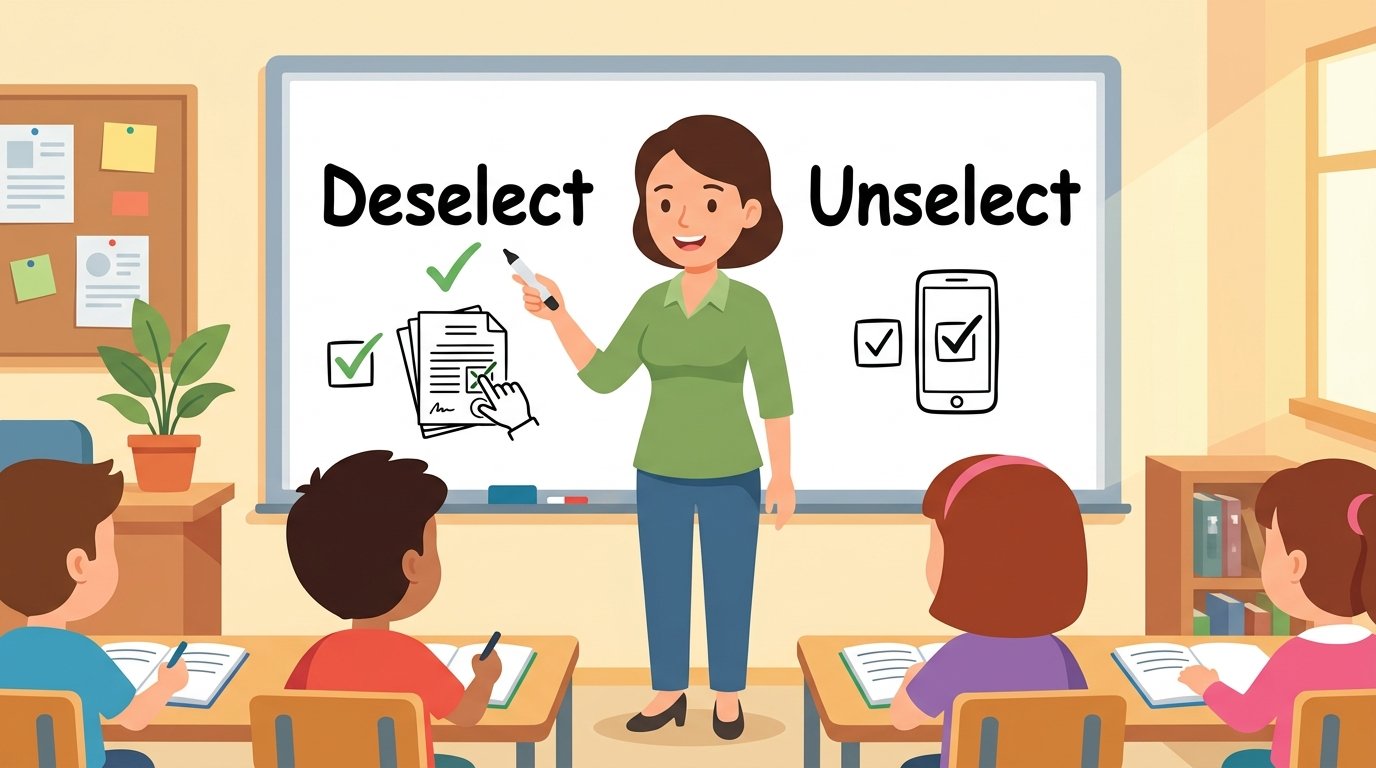
Software menus and app buttons often force a small decision most people never think twice about: unselect or deselect. Both words describe removing a choice, and both show up constantly in tech interfaces. But only one is considered standard English. Here’s the breakdown.
Unselect or Deselect: The Quick Answer
- Deselect — Standard, dictionary-recognized English
- Unselect — Informal, widely used but not officially standard
Both mean to reverse a selection, but “deselect” is the term you’ll find in professional writing, UX design, and software documentation, while “unselect” tends to show up more casually.
Example Comparison
- Formal: “Click ‘Deselect All’ to remove all chosen files.”
- Casual: “You can unselect the pictures you don’t want.”
What Does “Deselect” Mean?
Deselect (verb): To undo a selection or remove something that has already been selected.
This word appears in major dictionaries, including Merriam-Webster, Cambridge, and Oxford, and is fully recognized as standard English.
Examples
- “To deselect all items, press Ctrl + Shift + A.”
- “You can deselect unwanted photos before uploading.”
- “After selecting multiple options, deselect the ones you no longer need.”
Where “Deselect” Shows Up
- Software and application manuals
- UX/UI design copy
- Instructional documents
- Technical and academic writing
What Does “Unselect” Mean?
Unselect (verb): To remove or cancel a selection.
Unlike “deselect,” this word isn’t formally recognized by all major dictionaries. Still, it’s widely understood and used frequently in casual and tech contexts.
Examples
- “If you change your mind, just unselect the checkbox.”
- “You can unselect tags that don’t apply.”
- “Unselect all before saving changes.”
Where “Unselect” Shows Up
- Software interfaces, especially modern web apps
- Casual tech conversations or blog posts
- Informal documentation or chat support copy
Unselect or Deselect: Understanding the Prefixes
Both words share the same root — “select” — but attach different prefixes.
- “De-“ means “reverse” or “remove” (as in deactivate).
- “Un-“ means “not” or “the opposite of” (as in unlock).
So logically, both words make sense. Historically, though, “deselect” entered formal English earlier and became standardized in technical writing.
How Technology Shapes New Words
Technology constantly reshapes language, and plenty of “nonstandard” words eventually become mainstream simply because people use them so often.
Consider these examples:
- “Unfollow” and “unsend” became everyday tech verbs.
- “Unfriend” entered the dictionary after social media popularized it.
The “un-“ prefix fits naturally into digital culture — it’s quick, action-oriented, and intuitive. “Unselect” follows the same pattern, even without full dictionary approval yet.
Dictionary Presence: Deselect vs Unselect
| Word | Dictionary Status |
|---|---|
| Deselect | Recognized in all major dictionaries |
| Unselect | Rare or missing from most dictionaries |
Only “deselect” appears consistently across formal dictionaries with a clear definition. “Unselect” may show up in online glossaries or crowd-sourced references, but lacks that same formal recognition.
When Should You Use “Deselect”?
Use “deselect” when:
- Writing technical documentation
- Creating UX copy for enterprise software
- Drafting official reports or guides
- Communicating with professionals or developers
Examples
- “To deselect all files, click the checkbox next to the folder name.”
- “Users can deselect features they don’t want to install.”
When Should You Use “Unselect”?
Use “unselect” when:
- Writing for a casual or friendly audience
- Designing UI for consumer-facing apps
- Creating conversational content or FAQs
Examples
- “Don’t worry, you can unselect that option anytime.”
- “If you tapped by mistake, just unselect the image.”
Unselect or Deselect: Tone Comparison Table
| Context | Preferred Term | Tone |
|---|---|---|
| Corporate or technical manual | Deselect | Formal |
| Consumer app interface | Unselect | Friendly |
| Blog or how-to article | Either | Neutral |
Why “Unselect” Still Persists Despite Not Being Standard
A few reasons explain why “unselect” continues to thrive:
- Simplicity — it sounds direct and natural to many users.
- Parallel structure — it fits alongside “unfollow,” “unlike,” and “unsend.”
- User familiarity — everyday users care more about clarity than technical correctness.
- Digital evolution speed — language rules often lag behind fast-moving UX trends.
How Big Tech Companies Handle This Choice
Interestingly, major tech companies don’t always agree.
- Microsoft and Apple both consistently use “Deselect All” across their software menus, following formal English standards.
- Google shows mixed usage — “Deselect” in some products, “Unselect” in others — reflecting a more casual, user-friendly tone in certain interfaces.
This shows that even large brands adjust their word choice based on audience and platform.
How to Decide Which Term Fits Your Writing
Ask yourself these quick questions:
- Who’s my audience? Developers and professionals lean toward “deselect.” Everyday app users respond well to “unselect.”
- What’s my tone? Formal or instructional content favors “deselect.” Friendly or conversational content works fine with “unselect.”
- What’s my platform? Desktop or enterprise software typically uses “deselect.” Mobile or social apps often lean toward “unselect.”
A Simple Rule to Remember
If you’re writing for clarity and professionalism, always choose “deselect.” If your goal is a casual, approachable tone that matches consumer app language, “unselect” works fine — as long as you stay consistent throughout your content.
FAQs About Unselect or Deselect
What does “deselect” mean in software?
“Deselect” means to remove a choice that was previously selected, such as unchecking a checkbox or turning off a selected item in a menu.
Is “unselect” a real word?
Yes, it’s used casually in English, but it’s less formal and not always recognized in professional or technical writing.
When should I use “unselect” instead of “deselect”?
Use “unselect” in informal settings or UI design where the tone is light. Use “deselect” in software documentation or official instructions.
Why are both terms often confused?
Because they sound similar and mean almost the same thing, people often use them interchangeably. Context — formal versus casual — usually determines which fits best.
Conclusion
Language and technology evolve together, shaping how we communicate every day. Whether you’re writing, designing, or documenting a process, knowing when to use unselect or deselect keeps your message clear and professional. While both have their place in modern English, “deselect” remains the preferred term in most software and computing contexts — and staying consistent with your choice is what really matters.








Leave a Reply